Online Reporter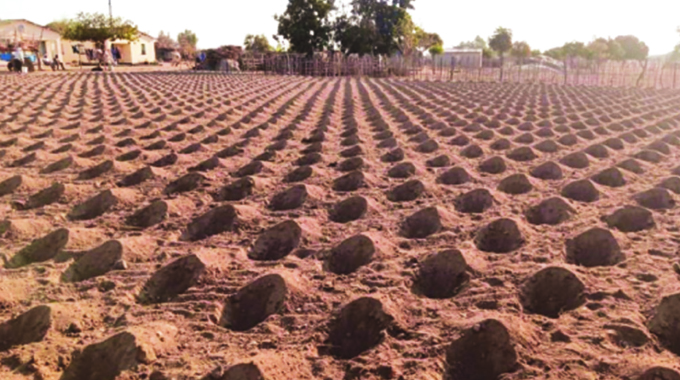
ZIMBABWE’s farmers are not just producing more crops and food through the range of Government and private sector support now available.
They are producing a wider range of the best crops for their areas so that they can make money even with the growing climate difficulties.
Irrigation is being continually built up and extended, both in water storage, such as dams, and in the infrastructure needed to get the water from dams, boreholes and rivers to fields.
The core of the summer cropping remains food, but an ever greater range of crops and varieties. The programme includes maize, sorghum, pearl millet, soya beans, sunflower, African peas, ground nuts and sugar beans and these are just the field crops.
There is the more specialised horticulture now possible through village business units, centred on the continuous drilling of more boreholes until every village and school has its guaranteed water supply.
Experience gained during the Second Republic’s major effort to support farmers practically will see, this year, even more tighter tailoring of making sure that every farmer being backed through one of the State schemes, and they are the majority, will be using the best methods to produce the best variety of grain for their area, plus a reasonable addition of cash crops, including oil seeds, usually soya or sunflower.
Over the last few years, we have had some respectable rainy seasons, a rainy season that had a very severe dry spell half way through and a rainy season that was the worst drought for more than 40 years. What is important is that we are no longer just shrugging our shoulders and saying we must make do with what comes.
We have been developing new farming systems, with the Pfumvudza/Intwasa conservation farming having made probably the largest single difference to smallholder farming in generations. Using the correct varieties of the correct crops for each zone and area, this is now allowing farmers to plan for at least something worth harvesting regardless of the weather.
But we have also been pushing irrigation very hard, converting potential into actual irrigated land.
Another 15 000ha comes on tap for the coming season, taking the total to 232 000ha and summer cereals are now getting the sort of support that was once reserved for winter wheat, with 500 000 tonnes now expected from 100 000ha of the irrigated land, in the same order of magnitude as the 300 000 tonnes of wheat we now regularly reap from 60 000ha.
The growth of irrigation means that there are more impounded lakes that can be used for fishing as well as water storage, and the village borehole programme means that ever more fishponds are now being built. This coming season the Presidential Community Fisheries Scheme plans on stocking 3 million fingerlings in the 200 fishponds ready for aquaculture, with new breeding centres set up across the country to make sure that communities can get the right fingerlings promptly.
Fish farming does extend the range of food available for the communities, but also offers opportunities for sales, first to those in the area, but some thought needs to be given as to how fish can be processed on site or kept fresh while in transit to other markets. Zimbabwe still imports fish, yet far more of requirements could be farmed locally, and if fish were more readily available new markets would develop.
The financing of farmers is being continually extended and enriched. While the Agricultural and Rural Development Authority and other Government agencies through the National Enhanced Agriculture Productivity Scheme and the swathe of Presidential programmes still take a leading role, the private sector is stepping up its own efforts to ensure that the raw materials needed by the agro industries are produced, with contract farming starting to make an ever larger contribution.
More co-ordination is now being done through a Food Crop Contractors Association, and we would expect that this will make contract farming easier to regulate, ensuring that the contracts are fair and that farmers deliver without side marketing and contractors pay promptly. This is Government policy as well as the desirable commercial relationship that should exist.
Mechanisation levels continue to rise, thanks to the programmes and investment opportunities set up.
Most A2 and equivalent farmers now have at least their own basic mechanisation, although they need to contract for things like combine harvesters where they need the equipment for just a couple of weeks a year.
But there is a growing number of A1, communal land and other smallholder farmers who need ever more access to mechanisation even if this is not yet fulltime and so resources can be shared. For that to be effective, there will be a need for ever more effective cooperative and community schemes that can be used to hold and maintain the equipment.
One interesting point over the expansion of crops and crop varieties being grown is that seed houses and other suppliers need to be able to do a lot more than just pack three kinds of maize seed and wait for sales. By the look of it, even a modest seed house will now need a fair amount of shelf space for its offerings, and we hope that we can start seeing some specialist seed and research businesses finding ever more desirable varieties or preserving the very best of the traditional varieties.
For farmers, an increase in the variety of crops and the types of crops means extra streams of income. The days when someone could make money by growing just one crop are long past and most farmers need a spread of production to have the multiple streams of income, preferably spread a bit through the year, that converts them from subsistence or very poor farmer into the sort of business producer who fits comfortably inside an upper middle-income society.
Markets are growing and with the private sector now taking more interest in what farmers can produce, as well as what they have been growing, we should see greater opportunities for farmers seeking to make a decent living.