admin
admin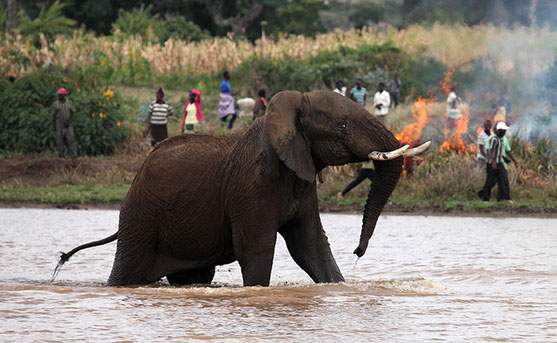
COMMUNITIES in some districts of Manicaland Province have over the years grappled with situations that involve encounters between humans and wildlife, resulting in negative outcomes.
In some cases, such scenarios have resulted in loss of lives.
While it is an integral part of the ecosystem, wildlife can pose serious threat to the safety, livelihoods and well-being of people if not well managed.
For instance, when elephants destroy crops, buffaloes damage property, crocodiles attack people, or hyenas kill livestock, human livelihoods are lost in the process.
This sometimes force people to retaliate or defend themselves against the animals.
When this occurs, it inevitably gives rise to what is commonly referred to as human-wildlife conflict.
This is a result of competition for limited resources such as food, water and space to live.
Sadly, undesirable consequences for both people and their resources on one hand and wildlife and their habitats on the other become the endgame.
Elsewhere in this paper we carry a story on how the human-wildlife problem is rearing its ugly head in some communities across Manicaland.
Recently, some buffaloes were sighted in Mutare District, while two people were killed by crocodiles along Save River in Chipinge last week.
One of the reptiles was trekked by Zimbabwe Parks and Wildlife Management Authority (ZimParks) rangers and killed.
In Buhera, hyenas are also wreaking havoc.
This challenge is becoming more common, serious and widespread owing to human population growth, agricultural expansion, infrastructure development, climate change and factors that drive habitat loss.
Put simply, any factor that forces people and wildlife into closer contact makes conflict between the two parties highly likely.
According to ZimParks spokesperson, Mr Tinashe Farawo, at least 68 people lost their lives countrywide due to wildlife attacks in 2021, while at least 66 died in human-wildlife conflicts last year.
To mitigate the impact of this problem on communities, Government last year established the human-wildlife conflict relief fund to cushion affected victims by way of funeral assistance, hospitalisation and treatment.
A specialised human-wildlife conflict unit was also established under ZimParks.
Government, through ZimParks, is implementing interventions to reduce human-wildlife conflict.
The measures include conversation education in the use of barriers, translational, sterilisation and selective culling of wildlife, as well as approved hunting quotas and fencing to restrict or control the movement of wildlife.
Other stakeholders like animal rights advocates have also come up with initiatives and implemented interventions to reduce the adverse effects on people and retaliation against wildlife.
These include creating barriers, deploying deterrents or moving wildlife.
The success of efforts is guaranteed by consultative and collaborative processes with other players like game authorities and the local communities.
Effectively managing human-wildlife conflicts is, therefore, crucial in achieving the United Nations’ Vision for Biodiversity 2050 goal, which espouses humanity to live in harmony with nature and ensure that wildlife and other living species are protected.
Human-wildlife conflict is also recognised as a global concern in the UN Convention on Biological Diversity’s post-2020 global biodiversity framework.
In Zimbabwe, the Parks and Wildlife Act provides the legal framework for human-wildlife conflict.
It recognises several wildlife issues which include the killing animals that are considered a danger to humans.
However, ZimParks advises people to desist from provoking wild animals, give them due space and avoid travelling at night.
When one comes across wild animals, it is prudent to call authorities who are trained to and have the capacity to handle wildlife, like ZimParks, and not attempt to confront them.
This is one of the several effective ways of taming the human-wildlife conflict.


 Online Reporter