
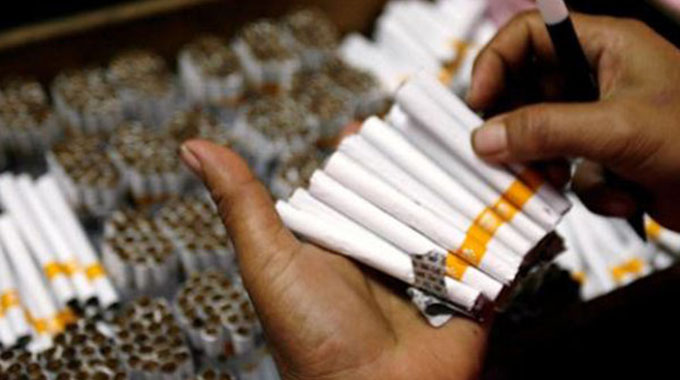
ZIMBABWE has reclaimed its place as the largest exporter of tobacco from Africa and is back as the fourth or fifth largest exporter of tobacco in the world, but it exports 98 percent of the crop as raw tobacco, that is as leaf rather than cigarettes, cigars, pipe tobacco and rolling tobacco.
It is not quite as bad as that unadorned figure of 98 percent implies. A lot of value is added between the farmer curing and delivering the leaf to the tobacco merchant and the containers being shipped out.
The merchants do some processing, getting the moisture value spot on, cleaning the leaf, quite often removing some of the stalk, ensuring very precise grading, and making up the precise parcels of grades required. This, along with insurance charges, can add at least 25 percent to the value.
But as Minister of Lands, Agriculture, Fisheries, Water and Rural Development Anxious Masuka noted this week, a lot of businesses in other countries make a lot more money than our farmers and merchants by turning this leaf into things smokers smoke. His rough guess of a 12-fold increase in value probably includes some of the taxes that get added in almost every country before the smoker is allowed to buy, but there is still a lot of value that could be added by Zimbabwean workers in Zimbabwean factories, creating jobs and increasing the value of exports.
But there are a range of barriers that we need to overcome.
At a purely technical level, we need to face the fact that major global brands and major global manufacturers rarely use single source tobacco in any product.
They create blends from different types of tobacco coming from a range of producing countries. So a standard cigarette in a major market could include tobacco from Brazil, India, Zimbabwe, Malawi, and the United States, plus probably Turkey and some other specialist flavour producers.
Zimbabwe does not just concentrate on flue-cured Virginia tobacco, which is good quality, it produces almost nothing else.
Yet a modern standard global brand probably includes varying amounts of oriental tobaccos, a small high-flavour sun dried or air dried leaf.
Pipe tobaccos include other varieties of air dried leaf, plus specialist fire-curing and other curing techniques. These sort of tobaccos were once grown in Zimbabwe in small quantities for a small group of specialist tobacconists catering for local demand, but those have all gone, along with producers of local rolling tobacco and even the UDI cigar makers.
So one aspect of exporting made-up products would be to include farmers, seed suppliers, merchants and manufacturers to look at what could be produced and what additional leaf varieties would be required.
We could grow them, as we have the climate, but farmers need markets from season one. The second problem is that the global retail tobacco manufacturing and trade is controlled by a very small number of companies, along with national monopolies in some countries.
The global players, with their national subsidiaries, do their level best to keep out others and have bought out most competitors, unless there is a national monopoly.
The possibility that one of these major manufacturers would move part of their global production to Zimbabwe, even if we had the range of tobacco flavours required for the blend, is remote. It has been tried. Our local manufacturers can get licences for the local market, and in fact one manufacturer connected to a global company is doing this for a pair of brands.
That might open a partial door to cigarette exports, but probably not a large door. So Zimbabwe would need, if it was generating its own brands, to work outside the established industry, and that is rather hard as attempts in colonial times found. At times local farmers and merchants did not see why they could not establish a Southern Rhodesian brand, and they all failed.
The first major attempt was during the First World War, with a brand called Sunspot. The manufacturer managed to get donations to make a lot of small boxes of these cigarettes to give to British troops on the Western Front. They smoked them, as they were free, but wanted their home brands when spending money.
Even British companies in the 1950s, and Imperial Tobacco tried harder than most as Southern Rhodesia was easily the largest raw tobacco producer in the sterling area, but found the regional export market difficult, let alone expansion back to Britain. UDI killed off those meagre efforts.
So we are in the position that export-orientated tobacco manufacturing would require a major effort to have the right additions to our already high-quality filler and Virginia leaf, be able to create blends and brands that could be marketed, and then be able to break through non-tariff and tariff barriers to sell.
Probably the best route, at the moment, would be to ensure that the rules for Comesa and the growing Africa Free Trade Area do not have tariff or non-tariff barriers for tobacco products.
This would at least give Zimbabwean manufacturers access to markets, although they would face the local taxes in each market.
These can be high, often several times the value of the tobacco product as many countries use taxes to make new smokers think very seriously before they light their first cigarette and encourage others to give up for financial reasons.
The local taxes on tobacco, and even in the European Union each country has its own tobacco-product taxes, as does every state in the US and even some cities, make using price competition difficult.
If the bulk of the cost of a cigarette or a packet of pipe or rolling tobacco is tax, then variations in the cost of the underlying product do not matter much. If it were not for that then a Zimbabwean manufacturer with negligible transport costs and zero foreign merchant mark-ups could probably manufacture a quality cigarette and sell it at a noticeably lower price in many markets, even with brand resistance.
Those who look at Zimbabwean cigarette sales in South Africa need to remember that these are smuggled cigarettes and South Africa has very high tobacco taxes. So even buying taxed Zimbabwean cigarettes wholesale or retail and carrying them across the Limpopo does allow serious price competition.
All the obstacles mean that moving into the next stage, or becoming a major manufacturer and exporter of tobacco products, is not going to be easy. It is possible, with probably AfCFTA being our best opportunity since there we can be involved in rules negotiations and seeking abolition of non-tariff barriers is one objective of any free-trade area.
So long as the local tobacco taxes in each country, whether paid at the point of entry or at a local factory gate, are identical for all manufacturers then we can compete, and must be allowed to. The value addition is a worthwhile goal, but it will involve a lot collaboration across the industry, from variety researchers through farmers and merchants to manufacturers, to have the right products, and then use the opportunities that arise through Government negotiations to get market access.