

 admin
admin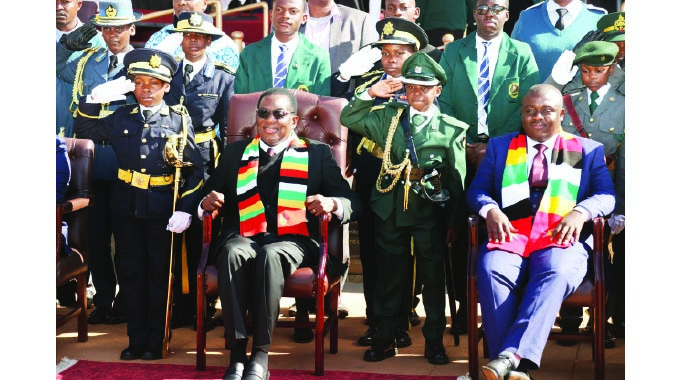
THE major push by the Government to expand the work being done by vocational training centres so that two million youths can benefit is critical not just for the growth of the Zimbabwean economy and the industrialisation this requires, but also for fairness in opening up opportunities.
Opening the Junior Parliament this week, President Mnangagwa went directly into the areas of greatest concern for most young people, better schools and skills training.
Better schools are being built and extended and equipped, through direct action and via devolution, with most rural district councils and the odd urban council spending a fair percentage of their devolution funds on filling gaps in education and health services. But the second area where the President was pushing hard was in the practical training of young people when they came out of school, so that they could earn a good living as adults.
The Second Republic has been stressing that education must have practical applications, and the Education 5.0 policy in universities and polytechnics is now creating business units and ensuring that graduates can use the theory they have been learning.
But not everyone goes to university or a polytechnic college or can find a place in areas of formal tertiary education. Even many jobs in the public or private sectors have advertisements requiring a minimum of five O-Levels at Grade C or better, and the majority of those coming out of school do not have them.
This is not to say that they are useless, but it does mean that they were largely excluded from a lot of economic areas, of continuing education and of employment in most formal sectors.
Even a fair number with O-Level or A’ Level or degrees are now required to become self-employed and need to add practical skills to their academic accomplishments if they want to make a decent life for themselves.
It is here that the vocational training centres under the Ministry of Youth Empowerment, Development and Vocational Training come to the fore. President Mnangagwa highlighted the stress and the aims after last year’s election when he set out the first Cabinet of his second term.
Youth was no longer one of the items in the ministry dealing largely with sport, arts and recreation, as a sort of hanger on, and the empowerment and training of youth was handed over to a dedicated ministry.
For far too long society has seen those who had trouble with academic examinations as somehow scheduled for subsistence farming or being urban vendors, with very few opportunities.
Yet the workforce in most countries does not have the equivalent of O-Level, an examination meant for the top quarter or third of the population.
Educationalists have been arguing for years that there is a need for some other recognition of four years of secondary schooling, which most Zimbabwean children pass through these days as a matter of right, than just the O-Level academic examination.
After all, the colonial settler regimes made sure that white children came out of their compulsory high school with a useful qualification. To a very large extent, the vocational training colleges are filling this gap. While O-Level certificate holders are welcome, the rest of the high school graduating contingent are not excluded.
The idea is to teach young people in a very wide range of practical courses skills that they can put to use to earn themselves a decent living, individually and in groups.
A good start has been made, with initial targets being one such centre in each district, but to build up the numbers fast so that most youth can access the centres and acquire the skills they find they need when they need them.
A go-ahead young person with their own business might well require more than one course to widen their range of skills. The centres are still to some extent evolving, but we see no problem with short, medium and longer courses, depending on the complexity of the required skill and the starting point of those on the courses.
The point is that at the end of a course, the students will have the desired skill at the desired minimum level of competence. In some areas, the training centres could even lay on courses that young people in that area feel they need.
Zimbabwe inherited, like other settler-colonial societies, a very rigid hierarchy of “white jobs” and “black jobs”, with a lot of effort in the past making sure that the indigenous majority would not be able to compete with the settler minority, and that meant limiting skills training to avoid such competition, especially with the lower-skilled settlers.
So the unskilled were dumped back in the communal lands or allowed to be domestic workers, casual labourers or farm workers.
But shortly after independence, the schools system was opened right out, with a right given to all children for secondary education.
This has produced the highest literacy rates in Africa and a large majority of people who are functionally literate in at least two languages, along with basic levels of numeracy. But we have not been building fully on this base until President Mnangagwa took action back after his first election.
Since then we have seen the formal systems insisting on the addition of a practical pillar, to back the retained theoretical pillars, and then the determination to build up the network of vocational training centres.
At the same time, some Government departments have been pushing their own additional training. The Agriculture Ministry, for example, wants farmers to attend training schemes for Pfumvudza before they are eligible for the inputs and that has meant the inputs are used properly. More advanced agriculture training can come through the vocational training centres, as farming becomes ever more a proper business for farmers.
But the central thrust we now have is where we are now creating this seamless range of training that includes everyone who needs to learn skills, not just a favoured few.


 Peter Tanyanyiwa
 Online Reporter