

 Online Reporter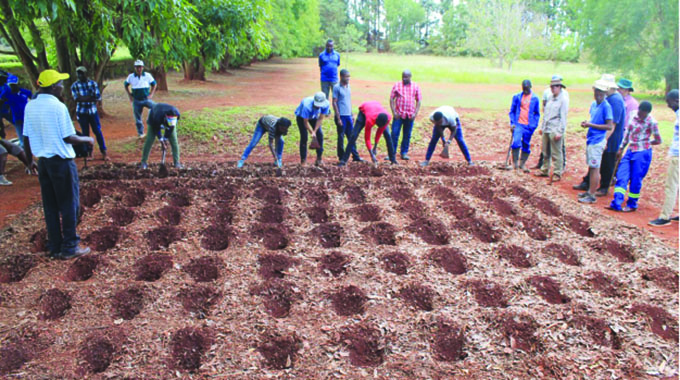
Despite what amounted to a short growing season in almost all parts of Zimbabwe, the national maize crop harvest will be close to two million tonnes, more than enough to meet the 1,8 million tonnes needed to be milled into mealie meal.
After some reasonable falls in November last year that at least dampened the ground, there was then that long dry spell between mid-November and late December, followed by good rains in most areas between shortly before Christmas and the beginning of this month, with the odd showers since.
Unlike the very damaging dry spell of similar length in the 2021-2022 season in the middle of the season, that caused harvests to be seriously reduced, this season’s dry spell at the beginning of the season at least allowed farmers to cope, even if many had to plant later than they hoped. So we have a reasonable harvest.
Interestingly, the farming experts have noted that along with the irrigated, or partially irrigated, crop the conservation farming techniques demanded by the Pfumvudza/Intwasa programme also coped well with the rainfall patterns we saw.
Having good water retention from the early rains, and then keeping moisture in the soil through mulching, while making sure that later rains soaked in instead of running off worked.
This was important since the southern parts of Zimbabwe had rains that were above average by the standards of those more arid areas, the northern parts were a little below normal, especially in the breadbasket province of Mashonaland West.
While this was nothing like the drought of last year, it still affected yields. Estimates of the expected harvest from traditional grains have yet to be made, but considering the total rainfall they are likely to be good.
The huge advantage of our indigenous sorghum and finger millets is that they cannot only cope with lower rainfall, but also with more intermittent rainfall, their growth being halted in dry spells and then resuming when more rain falls.
Last year’s drought meant those extra rains never fell.
Added to the maize and traditional indigenous grains, there will be a good harvest of irrigated winter wheat, the dam levels in almost all of Zimbabwe rising during this season to above what was there to irrigate last year’s record wheat crop.
The upshot is that in terms of total grain harvests, those of maize, traditional grains and wheat combined, means that Zimbabwe will produce a reasonable surplus this year, but that there will be need to juggle between what is needed by people for their food, what is wanted by people, what is needed to stock feeds and what can be placed in reserve.
Climate change has produced many new variables, as can be seen with the season now ending that was generally regarded as a good season, despite the truncated growing period for the dry-land crops.
It is becoming increasingly necessary for irrigation to be built up to provide supplementary irrigation in the summer season and full irrigation for the winter crops and the horticulture for much of the year.
Farmers with supplementary irrigation were able to get their maize crop in earlier, cope with the dry spell, and then use rainfall, with just the odd sprinkle from the irrigation during the dry weeks to get a very good crop indeed that will show a profit despite the irrigation water and power costs.
Even in a drought year, farmers using supplementary irrigation will still get more than half their water from the free rainfall.
This means that as we expand irrigation into the small-scale farming sectors we need to build in flexibility, rather than just commit all irrigation to fixed plots in irrigation schemes.
It should be possible to have both the partial supplementary irrigation over a far larger area in the summer season, before moving to the full irrigation over a small area for wheat and horticulture.
It is also becoming obvious that we need to encourage Zimbabweans to adopt far more varied diets when it comes to eating grains, rather than just have almost all meals built on a core of ground white maize.
Until a little over a century ago traditional grains were the staple diet and maize was largely eaten as a green roasted vegetable at the end of the rainy season.
The major shift was partly because of the then need for double processing of traditional grains, partly because of initial research to increase maize yields and partly with the fast growing market for maize.
A lot of the best tasting varieties of traditional grains were lost during a drive to improve yields, and it seems worthwhile to recover some of these.
Wheat was almost always an urban food, eaten as baked bread with some cake, and totally imported until the late 1960s with growing harvests to our present surpluses over the last three seasons.
With the sort of harvests we can now expect in what we can think of as ordinary years, measured against what we call the “good year” we have just seen, it is clear that a far more diversified farming environment and far more varied diet will be required. The expansion in village horticulture as a benefit of the borehole programme means new varieties of vegetables can be introduced.
That includes a lot more imagination in how we prepare stock feeds where more hay and lucerne seem to be required along with a better mixture of grains.
It is likely that we will need better fed animals rather than trying to dramatically expand the number of livestock.
It is the same in oil seeds and cash crops, where we need to make sure we have a good mixture of crops instead of relying on far too small a group that can be hit by drought or flood.




 Bongani Ndlovu