Zvamaida Murwira
Senior Reporter
EDUCATIONAL institutions must be inspired by the country’s rich liberation history to produce young people who will propel a knowledge-driven economy anchored on new technologies, industrialisation and modernisation of the nation beyond Vision 2030, President Mnangagwa has said.
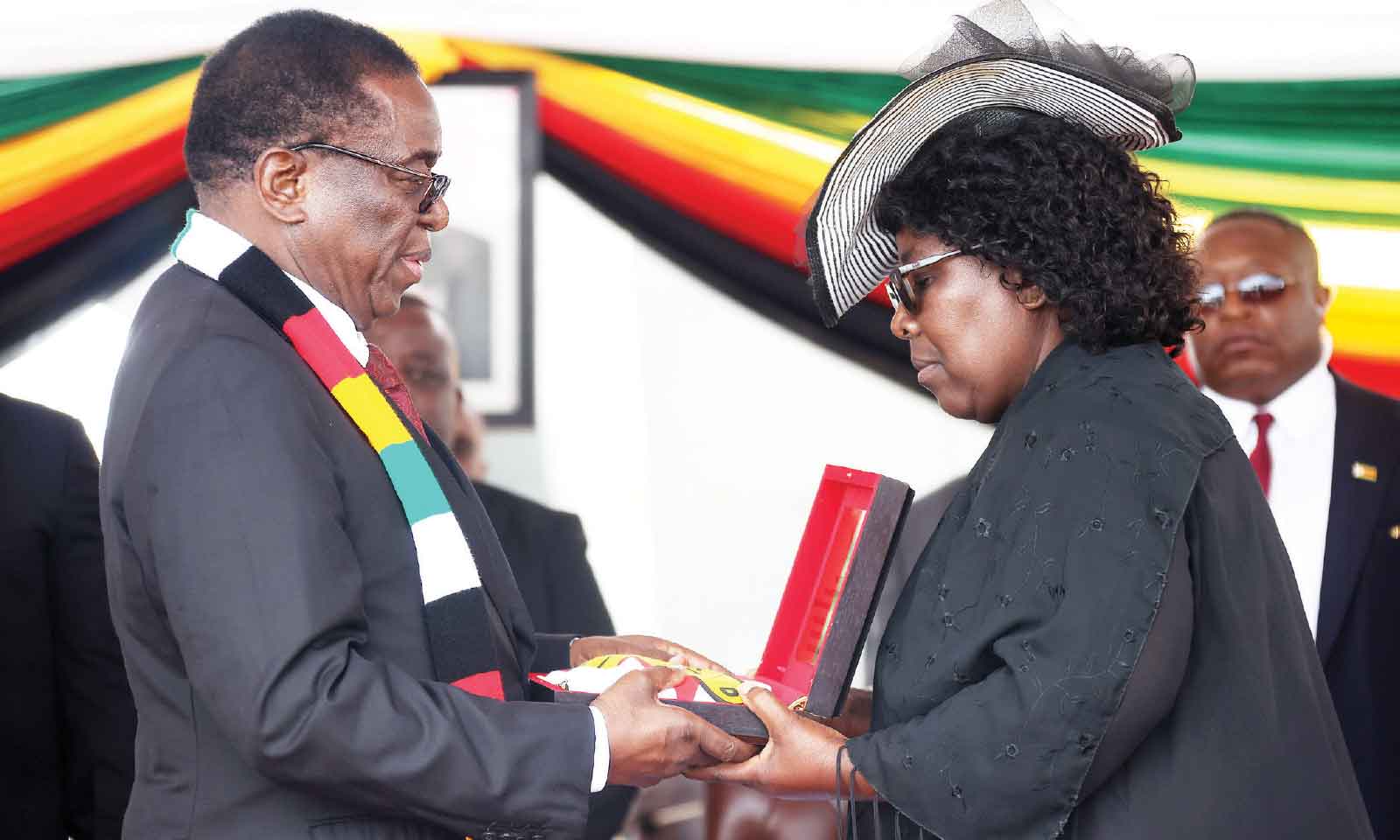
Addressing mourners at the burial of Brigadier-General (Retired) Samuel Mpabanga at the National Heroes Acre in Harare yesterday, the President noted that yesteryear schools were political hotbeds and sources of consciousness to inspire young people to take up arms, but given the country’s evolution, educational institutions must be engines for economic development.
Brig-Gen Mpabanga, also known as eMpini or Cde Moffat Nkomo, died on February 9 at Gwanda Provincial Hospital. He was 69.
“Many schools of yester-year, like those attended by our heroes, throughout the country, were the hot-beds of political education and awakening, which saw many young people make the crucial decision to fight for the liberation, freedom and independence of our country,” President Mnangagwa said.
“Such was the centrality of schools as mobilisation grounds towards our liberation war efforts. At the present time, there is a new kind of revolution, one that is driven by science, technology, digitisation and innovation.
“Education institutions must rise to the occasion and produce young people who can effectively drive the development, prosperity and growth of our nation.”
He challenged the education sector, along with the youth and learners at every level, to be inspired by the country’s rich liberation war history and leverage on the Heritage-Based Education 5.0 to be the new heroes who propel a knowledge-driven economy, anchored on new technologies, for the industrialisation and modernisation of the nation.
President Mnangagwa described Brig-Gen Mpabanga’s legacy as a shining example for future generations.
“I call upon all Zimbabweans, from across the political divide and the younger generation in particular, to draw life-lessons from these departed heroes of our nation.
“Let us always remain true to ourselves, as Zimbabweans, our identity and the right to chart our own destiny and future, as the times demand. We are a sovereign people and should never revoke this absolute right to please illusionary entities or cyber-societies. We say no to such trends,” he said.
President Mnangagwa said Zimbabwe is an independent country, which shall do that “which is right and necessary for us, so that our people can enjoy a higher quality of life and well-being”.
He said the story of the country’s forefathers under colonialism, culminating in the armed liberation struggle, must be told in its entirety, from the narratives of all participating voices.
“The unitary and indivisibility of our state must be jealously defended. Likewise, our development, industrialisation, modernisation and prosperity should continue to be all-encompassing, no person, place or region must be left behind,” President Mnangagwa said.
“It is in this spirit that the Second Republic is accelerating the devolution and decentralisation agenda.
“Our departed national hero has passed on at a time when preparations for the hosting of this year’s Independence Day celebrations, in his home province of Matabeleland South, are at an advanced stage.”
He said a lot of progress is ongoing in various districts of Matabeleland South province to improve road infrastructure, water availability, agriculture productivity and energy access.
To improve access to training and skills development for the youth and women, the construction of a Vocational Training Centre in Matobo District has started.
President Mnangagwa said the Second Republic is scaling up policies and programmes that will see the full realisation of the aspirations that inspired many of the sons and daughters of Zimbabwe to wage the protracted war of liberation.
Born on August 31, 1956, at Manama Mission Hospital, Matabeleland South Province to Jonas Mpabanga and Rosina Mpabanga (née Maphala), Brig-Gen Mpabanga was the fourth born in a family of six children.
In 1963, a young Samuel enrolled for primary education at Mapate Primary School and later transferred to Beitbridge Primary School to complete his primary education.
In 1971, he enrolled at Manama Mission for secondary education, transferring to Matobo Secondary School where he completed his Ordinary Level studies in 1974.
He grew up against a background of increasing colonial supremacy on one hand and the rapid decolonisation of Africa, on the other.
Chronicling his life history, President Mnangagwa noted that during his time, there were discriminatory legislation such as the Land Apportionment Act of early 1930s and the Native Land Husbandry Act enacted in 1950/1951, which had seen mass evictions of Africans from their birth-lands and the creation of the so-called “native reserves”, along with other measures advancing political and socio-economic discrimination.
The President said Brig-Gen Mpabanga was only nine-years-old doing primary education at Mapate Primary when the racist Ian Smith-led government, without shame, unilaterally declared independence in 1965.
In 1977, he crossed the border via Botswana to join the liberation struggle under ZIPRA.
He went through a perilous journey, which included imprisonment at Selibe Pikwe, before being airlifted to Nampundwe Camp in Zambia, about 45km north-west of Lusaka.
After undergoing training at Mulungushi Camp, which is about 48km east of Kabwe town, the late “Cde Moffat Nkomo”, along with other trainees, left Zambia for further military training at Odessa, in the then USSR, until 1979.
Upon his return from Russia, he was appointed instructor at Solwezi and later deployed, with other ZIPRA cadres, to Siabonga along the Zambezi River.
He held the appointment of Military Commissariat, until he was attested into the Zimbabwe National Army in 1980.
Brig-General Mpabanga had an illustrious career in the ZDF, which saw him holding several key positions.
Some of them include Officer Commanding 31 Infantry Battalion, Officer Commanding at 28 Infantry Battalion, Officer Commanding Support Weapons at All Arms Battle School, Officer Commanding at the Zimbabwe School of Infantry, Officer Commanding at All Arms Battle School, General Staff Officer Grade 2 at All Arms Battle School.
He was also Director Staff Junior Division at the Zimbabwe Staff College, Head of Wing Junior Division at the Zimbabwe Staff College, General Staff Officer Grade 1 Staff Duties at Army Headquarters, Commanding Officer at 41 Infantry Battalion 2005-2007, Staff Officer Grade 1 Policy at Zimbabwe Defence Forces Headquarters 2008-2010, among others.
He was promoted to Brig-Gen upon retirement in 2022.
As an outstanding General Officer, he was awarded medals which included the Liberation Medal, Independence of Zimbabwe Medal, Ten Years’ Service Medal, Long and Exemplary Service Medal, Mozambique Campaign Medal, DRC Campaign Medal, Grand Officer of the Zimbabwe Order of Merit Award.
He is survived by wife Sethekele Mpabanga and three children namely; Nisbett, Michael, Thulisile Naomi and four grandchildren.
Yesterday’s burial was attended by the two Vice Presidents, Dr Constantino Chiwenga and Dr Kembo Mohadi, Cabinet ministers, Zanu PF Politburo members, service chiefs and diplomats accredited to Zimbabwe, among others.