Online Reporter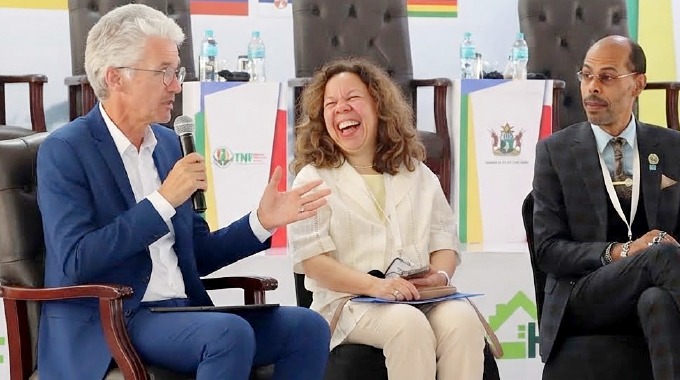
Theseus Mauruki Shambare in Victoria Falls
THERE was something almost poetic about the way secretary-general of Luxembourg’s Economic and Social Council, Daniel Becker, arrived at the Zimbabwe Tripartite Negotiating Forum (TNF) Global Summit in Victoria Falls.
As the morning road stretched from his place of stay towards the summit venue, Becker was not expecting the journey to become part of the summit experience itself.
Then, there it was.
An elephant appeared along the tarred road, its massive frame emerging among the trees as Becker travelled towards the summit. He watched, taking in a sight that, for someone from
Luxembourg, belonged more naturally to the pages of a schoolbook than to a morning commute.
“In Luxembourg, even in the textbook of a Grade One child, you cannot find a picture of a baboon or an elephant,” said Becker, Secretary-General of Luxembourg’s Economic and Social Council.
For him, coming to Zimbabwe was already a rare experience. And the country had not finished introducing him to its wild side.
During a Friday excursion to Victoria Falls, Becker was caught in the spray of Mosi-oa-Tunya — “the smoke that thunders.”
Soaked by the Falls, he did not complain.
“It was a blessing,” he said.
By the final morning of the five-day summit, baboons and impalas had joined the elephant on his growing list of encounters with animals in the wild.
But inside the resort where even the golf course has, over the years, had to accept that elephants sometimes have the right of way, the conversation was about something seemingly far removed from elephants.
It was about algorithms.
It was about artificial intelligence (AI), climate finance, the future of work, investment, industrialisation, social protection and whether economies can become more technologically advanced without leaving workers, communities or the natural environment behind.
The inaugural Tripartite Negotiating Forum Global Summit, which began on September 21 and ended on Friday, brought together Government, business, labour, investors, development partners, academics and other stakeholders from across the world under the theme “Inclusive Growth, Decent Work, Beneficiation and Investment Promotion.”
It ended with the adoption of the Victoria Falls Declaration.
The setting itself made the contrast difficult to ignore.
Outside the conference rooms, Victoria Falls continued doing what it has done for generations — elephants moving through the landscape, trees responding to pressure, the Zambezi feeding one of the continent’s most remarkable natural spectacles.
Inside, delegates were trying to work out how human systems should respond to equally profound disruptions.
AI was one of them.
Becker argued that the technology debate should ultimately return to a much simpler question: what is all this intelligence being used for?
“Seeing these animals this morning was a good reminder that ultimately the question is not only how intelligently we use AI, but what we choose to use the intelligence for,” he said.
Suddenly, the elephant outside and the algorithm inside did not seem so far apart.
Both were about adaptation. Both were about living within changing environments.
And both raised the question of how human beings should shape the environment in which they, and other forms of life, must survive.
Artificial intelligence can process information faster, identify risks and assist investment decisions. But the technology itself is not the destination.
“The technology itself is not the objective. The objective is the outcome,” Becker said.
For Luxembourg, he explained, the emphasis is increasingly on moving from simply collecting environmental, social and governance data to using it intelligently.
AI can help assess climate risks such as flooding, drought and extreme weather, screen investments and identify potential green-washing. But Becker cautioned against allowing the machine to become the decision-maker.
“AI should not decide where climate money goes. It should rather be that AI helps us to get the evidence behind decisions… faster, broader and more transparent,” he said.
That distinction mattered in Victoria Falls because the summit was not simply a technology conference.
The delegates were grappling with the human consequences of technological change.
If machines become more capable, what happens to workers? If businesses become more productive, how should the gains be shared? If investment changes the structure of an economy, who gets the new opportunities?
And if a country pursues green growth, how does it protect workers and communities whose livelihoods may depend on industries undergoing transition?
Raúl Henríquez, director and secretary-general of Curaçao’s Social and Economic Council, brought the discussion closer to the workplace.
“AI is an instrument; the impact on human beings matters,” Henríquez said.
For him, that meant resisting the temptation to assume that a technology developed elsewhere would automatically fit another economy.
“What works in Luxembourg may not work in Zimbabwe,” he said, stressing the importance of technologies suited to local circumstances and ecosystems.
Businesses, he said, needed practical advice on technologies that worked in their own context, while workers needed accessible opportunities to learn as their responsibilities changed.
“Workers need accessible opportunities to learn, including as responsibilities change,” Henríquez said.
Social dialogue, he argued, could help identify these needs before investment decisions were made and help determine how productivity gains could contribute to sustainable enterprises and improvements for workers.
Tourism offered a particularly appropriate laboratory.
Curaçao, like Victoria Falls, is seeking to build a smarter and more sustainable tourism destination. But becoming smarter, in Henríquez’s view, should not mean becoming less human.
“Becoming smarter should strengthen local businesses and improve the work of those who welcome visitors,” he said.
The message was simple: technology must learn to fit people, rather than people being forced to fit technology.
That principle extended beyond technology.
Elena Topoleva-Soldunova of the Civic Chamber of the Russian Federation challenged delegates to reconsider the role of civil society in development.
“NGOs should not be seen only as contractors delivering social services,” she said.
Their distinctive value, she argued, lies in their proximity to communities.
“NGOs have community knowledge, local trust and the ability to detect problems earlier,” Topoleva-Soldunova said.
In her model of development, the Government provides policy, rights and infrastructure; business brings investment and capacity; labour brings workers’ voices, skills and practical knowledge; while civil society brings local knowledge, trust and flexibility.
“People should be co-authors of development,” she said.
It was another version of the same conversation taking place around AI.
Different parts of society have different strengths.
The challenge is not to make one replace the other, but to find a way for them to work together.
Her argument fitted neatly into the summit’s broader emphasis on social dialogue.
The challenge is getting Government, business, labour, civil society and communities around the same table before decisions are made, instead of asking communities to react after the decisions have already been taken. And then, inside the conference room, the principle was tested in real time.
Perhaps nowhere was that more visible than in the debate over the Victoria Falls Declaration itself.
The document sought to capture the summit’s broad priorities around inclusive growth, decent work, beneficiation, investment promotion, green growth, digitalisation and stronger institutional cooperation. But agreeing on the words proved to be part of the social dialogue process.
At one stage, sections dealing with implementation, monitoring and accountability were suspended after delegates questioned whether participating economic and social councils had the mandates to make binding commitments on behalf of their institutions.
One delegate from Luxembourg made the concern explicit: he could not commit his council to provisions that had not been considered by its own governing structures.
The room paused. The document was reconsidered. Some provisions were removed. Others were amended.
A proposed new global cooperation platform was questioned because existing international structures already performed related functions.
The language was adjusted. The discussion was not a sign of failure. It was social dialogue in its most literal form — people disagreeing over the detail of a common document until they could live with the wording.
Eventually, the declaration was adopted as a common framework focused on inclusive growth, decent work, beneficiation and investment promotion.
The moment was revealing. The summit was talking about learning to live with disruption, but it was also demonstrating the harder task of learning to live with difference.
Different institutions had different mandates. Different countries had different systems. Different sectors had different interests.
Consensus, therefore, did not mean that everyone started from the same position.
It meant finding language and commitments that could accommodate those differences.
Minister of Public Service, Labour and Social Welfare Edgar Moyo captured that point in his closing remarks.
“The closure of this summit is not the end of our engagement, but the beginning of continued dialogue, cooperation and collective action,” Moyo said.
“The value of this summit will ultimately be reflected in the actions that follow.”
The words carried weight because the summit had deliberately moved beyond a narrow labour agenda.
The discussions ranged from industrialisation and beneficiation to green growth, energy security, agriculture, digitalisation, platform work, skills, investment and social protection.
The final question was, therefore, not whether technology should be embraced.
It was how it should be governed. Not whether investment should come. But what kind of investment creates productive capacity, decent work and lasting value.
Not whether economies should become greener. But how the transition can protect workers, enterprises and communities.
And perhaps most importantly, whether development can move forward without severing its relationship with the natural systems that sustain it.
For five days, the resort became a meeting point between those two worlds.
Outside, the trees around the resort bore the marks of elephants that had stripped them of their leaves. At first glance, they could look damaged beyond repair. Yet nature has its own rhythm of recovery.
Given space and time, trees can sprout again, regenerate and become part of a renewed forest, even when the rains have not yet arrived.
There was a lesson in that too. Nature does not always survive by resisting change. Sometimes it survives by adapting to it.
Inside the conference rooms, delegates were wrestling with a similar question in human terms: how do societies adapt when the environment, technology and economies around them are changing?
The elephant did not need an algorithm to survive. The algorithm did not need an elephant to function. But the people designing the future need to understand both.
They need technology that works with people, development that works with communities and economic growth that can coexist with the natural environment.
In the end, perhaps that was the thread running through five days of speeches, panels, negotiations and a declaration in Victoria Falls.
It was not simply a conversation about how to move forward. It was a conversation about how to move forward together.
And as Becker discovered on that morning journey to the summit, sometimes the most complicated conversation about the future begins with something very simple, an elephant standing by the road.