dyton mupawaenda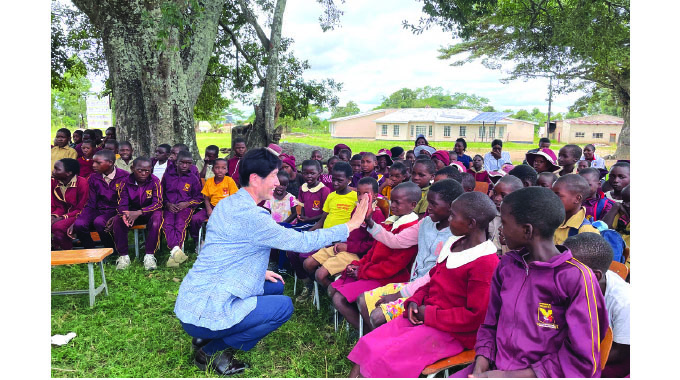
Park Jae-South Korea Ambassador
At the outset, I would like to begin with insisting that “A” is for “Agriculture” as far as Zimbabwe is concerned.
Over 60 percent of the population, directly or indirectly, are employed in the agricultural sector.
About 33 million hectares out of 39 million hectares of total land are used for agricultural purposes.
It is indeed a pivotal sector of the Zimbabwean economy. That is why the number one priority for the Korean Embassy in Zimbabwe is the agricultural sector.
The Embassy has been implementing various projects in the field of agriculture through development assistance programmes.
Among those implemented and under implementation, I attach special attention to one project for a small school, located near Rusape.
The school is Lawrencedale Primary School, having around 500 students.
With the assistance from the KOPIA Zimbabwe Centre, an innovative development co-operation platform to facilitate agricultural partnerships, a project is being implemented at Lawrencedale Primary School in Rusape.
The Lawrencedale Project is about effective utilisation of agricultural technologies to scale up and commercialise agricultural produce.
The KOPIA Zimbabwe Centre aims among other things to enhance the productivity and income level of local farmers and their families through supporting an indigenous chickens and vegetable project at Lawrencedale.
The students at Lawrencedale are engaged in the project with a 100 roadrunner chickens and vegetable gardens that are being thoughtfully maintained at proper or manageable levels, to avoid any possible extra burden to a regular curriculum for the students.
When I visited the school last month with colleagues from the KOPIA Office, I had the pleasure of being welcomed by the students, teachers, and parents with lovely poems, songs, and dances. Yet, it was all the more amazing to see the young students deliver presentations on rearing chickens, growing vegetables and generating income.
The project at the Lawrencedale is not a big one, but a small grant project. However, the reason why the project attracts my attention is not from its scale or size.
It is because, the project is in many ways, is a testament on what the Korean Embassy is trying to do in Zimbabwe overall, not just in agriculture.
First, the project is about education.
Education is the investment in people; which is the most profitable aspect for the growth of a country.
A Korean saying states that ‘education is planning for a 100 years for the development of a country’. Similarly, an African saying goes that ‘it takes a whole village to raise a child.’
Guided by dedicated teachers and parents, students at Lawrencedale are involved in all the processes of the project from cleaning the pen, feeding the chickens, helping the eggs hatch by using incubators, and taking care of the chicks.
At the same time, students are taught to plant vegetable seeds, water them, as well as pick them after they grow.
As one of the teachers told me, this is a practical hands-on learning experience which perfectly supplements classroom teaching and agriculture textbooks.
Second, the project is about food. Fresh eggs and vegetables, and sometimes chickens are provided for the students at meal time at the school.
They contribute to a healthy meal plan for the school as well.
Third, the project is about the economy, or making money. The school sometimes engages in chicken selling businesses. They know when the chickens or eggs may be sold to consumers outside the school.
The income is reserved for supporting tuition for students and management of the school. Though small in scale and size, this is typical case of self-help. What we call the Saemaul Undong spirit in Korea.
As I wrote above, the story of Lawrencedale requires diligence, a mindset of self-help, and co-operation among all the stakeholders.
These were the very slogans during the nationwide campaign of developing rural villages in Korea.
The Embassy will continue to be with Lawrencedale in furthering the success story, and work towards creating more similar stories for the future.
The inaugural Africa-Korea Summit meeting is to be held in Seoul in June this year.
At the upcoming summit, the priority area of discussion will be economic cooperation, including trade and investment, energy, infrastructure, and ICT.
Again, agriculture will be one of the core issues for discussion. Thus, agriculture ministers of Africa and Korea will meet separately, as well on the sidelines of the summit.
The specific agenda of the meetings may include achieving mechanisation of agriculture, and thereby boosting its productivity.
During the bilateral meeting between Zimbabwe and Korea, the agenda for agriculture may include developing rice and maize varieties suitable for the climate of Zimbabwe.
I hope that this high profile occasion this year may contribute to Zimbabwe in reclaiming its status as the breadbasket of Africa.
Furthermore, it is my personal hope that Lawrencedale Primary School will be able to play an encouraging role in the path towards this goal.



 Online Reporter