admin
admin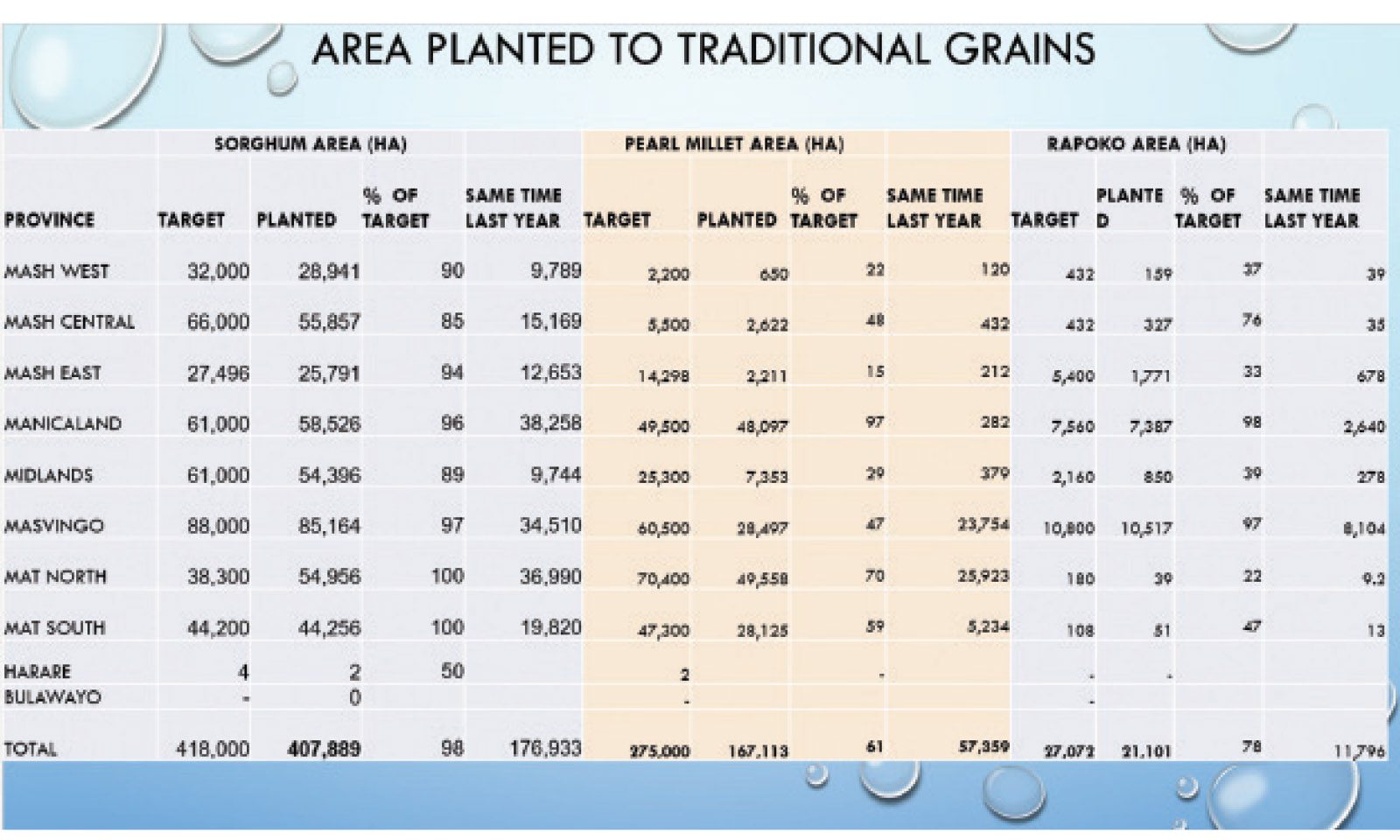
Nqobile Tshili Bulawayo Bureau
FARMERS from Matabeleland and Midlands provinces have been urged to embrace planting of traditional grains, adopt water harvesting techniques and consider early planting under irrigation to ensure good yields as the country braces for normal to below normal summer cropping season.
The southern parts of the country are set to receive the lowest rains this year while most parts of the country are expected to receive normal to below normal rains.
As a result, agronomists have advised farmers to adopt conservation farming models and to mainstream the planting of traditional grains that can withstand drought.
Zimbabwe like other southern African countries is projected to experience El Nino effects characterised by low rainfalls, according to preliminary regional weather forecasts.
Zimbabwe has already adopted Government climate-proofing methods to guarantee national food security including the construction of dams and rehabilitation of irrigation schemes to cushion the country from the impact of low rainfall.
At the household level, the Government introduced Pfumvudza/Intwasa, which supports nearly three million households countrywide. The household climate-proofing programme has seen smaller-holder farmers improving yields despite erratic rains.
The successful implementation of agricultural transformation programmes has enabled Zimbabwe to increase its food production and as such the country has stopped importing maize and wheat.
In a statement, the Ministry of Tourism, Climate, and Hospitality Industry said the Matabeleland region and the Midlands will be the worst affected in terms of projected low rainfalls.
“Much of the country is likely to receive normal to below-normal rainfall for the period October 2023 to March 2024,” it said.
“For the bulk of Matabeleland North, parts of Midlands covering Gokwe North and South districts, parts of Matabeleland South province covering Bulilima district will receive below normal to normal rainfall for the sub-season October-November-December.”
Acting director for Agricultural Rural Development and Advisory Services in Matabeleland North Mr Dumisani Nyoni said farmers should not be dampened but must plan ahead of the coming rainy season.
He said farmers in the region who depend on rain-fed agriculture should plant traditional grains as they are drought-tolerant.
“In Matabeleland region where we usually receive low rains we encourage farmers to plant millet and sorghum, which can withstand low rains,” said Mr Nyoni.
“They can also include sunflower and cotton as their cash crop as well as cowpeas, which they can use as relish. We also encourage farmers to plant round-nuts and groundnuts.
“The aim is to diversify to avoid putting all the eggs in one bucket.”
Mr Nyoni said due to the erratic rains expected, farmers should space their planting periods.
“In line with the projected season, the rains may come early or delay but in between there will be prolonged dry spells. Also, during this period, we should expect to receive heavy downpours within a short space of time. We should also expect very hot weather conditions,” said Mr Nyoni.
Farmers, he said, should harvest water so that during the prolonged dry spell they can irrigate their crops.
Mr Nyoni said farmers should start putting lime in their fields to improve the quality of soils.
He said the coming cropping season will also heavily impact livestock farming and as such farmers should plan for supplementary feeding.
Mr Nyoni discouraged farmers from moving livestock from one zone to another in search for pastures as this can expose their animals to diseases. He said unregulated movement of animals may result in farmers losing their livestock.
The ministry said Mashonaland West is also expected to receive below-normal-to-normal rainfall. It noted that preliminary projections indicate the rains will be erratic across the country hence the Government was considering putting in place measures for cloud seeding.
“The Meteorological Services Department will continue to monitor all the available seasonal climate indicators, which influence Zimbabwe’s rainfall as they evolve. Thus, the seasonal rainfall predictions will be updated on a monthly basis beginning end of October,” it said.
“In addition, there will be daily weather forecasts and 10-day weather bulletins that will take into account any changes.”
The Government has said farmers with irrigation facilities should not wait for the onset of the rains but should consider early planting taking into account the temperature thresholds needed for germination as may be guided by agronomists.
The ministry, however, said the forthcoming season would likely be characterised by violent storms, prolonged dry spells, flash floods and tropical cyclones.
“There is a need to intensify water harvesting and conservation programmes. Dam construction and borehole drilling/ deepening, conservation and protection of wetlands should continue.
“Agricultural activities such as planting and fertiliser application should be guided by the 10-day weather forecasts as well as advice from agricultural authorities.”



 Online Reporter