admin
admin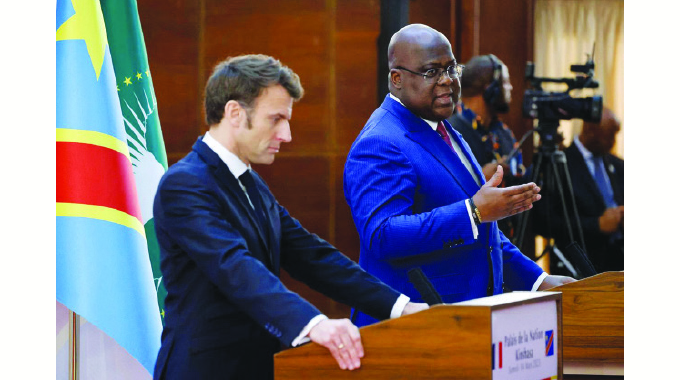
Gibson Nyikadzino-Correspondent
The world has become more African, Asian or Latin American as it is also Western such that no civilisation has greater dominance than the other.
New leaders are emerging and the ground is becoming more equal and no race should be taken for granted.
Videos, amplified on social media platforms, of Namibia’s President Hage Geingob reprimanding the Ambassador of Germany and DR Congo’s President Felix Tshisekedi publicly challenging a falsehood by French President Emmanuel Macron while the two addressed the media are more examples of an awakening Africa.
These two leaders, and many others, need to be protected from the West. In the past, leaders who spoke bluntly against the Western establishment and leadership like DR Congo’s (formerly Zaire) Patrice Lumumba, Burkina Faso’s Thomas Sankara and Congo-Brazzaville’s Pascal Lissouba experienced tragic ends in natural and political life.
If Africa is to be more organised, no contemporary leader should fall to the sword of the Western countries.
In this prism, the young leaders of Guinea, Mali and Burkina Faso have raised the conscious awakening of their people and young Africans by rejecting and expunging France’s neo-colonial dominance from that region in the name of fighting terrorism.
Africa’s re-awakening is a conversation that unsettles the Western establishment because that speaks contrary to Western political, economic and social paradigms, simultaneously creating new possibilities through their disruptions.
As can be witnessed, Western power is now on the decline and what is only left to hold on to is its nude arrogance!
Politics of infatuation
Imagine how rich and exciting Zimbabwe’s national political architecture was going to be if opposition political parties that challenge Zanu PF’s dominance had alternative policies and composed of people who think for themselves about governance from an idea’s point of view.
Recently, Zimbabwe’s engagement with its creditors about the debt clearance strategy exposed how much the opposition is obsessed with wanting to win political power than providing alternative ideas about how it will deal with the debt question.
Anticipation grew that the opposition would provide new perspectives at policy level on suggestions about debt clearance.
The usual sentiments have been: “we cannot help Zanu PF to be accommodated by our friends when we are not in Government”.
Zimbabwe’s debt is a key economic, developmental and diplomatic matter that cannot be resolved by winning elections alone, but needs a policy balancing that captures the commitment to mend relations and desire to continue a trajectory that rewards Zimbabwe’s efforts.
The weakness of the opposition is its infatuated politics to think that the IMF, World Bank and the US are their friends who will cancel the debt without any formal engagements.
Paid to create problems
As many would agree, Zimbabwe is not only moving towards an anti-colonial path, but it is showing signs that it has adopted the de-colonial trajectory in terms of its economic, social and political inclinations.
But the de-colonial process is not an easy one.
Decolonisation is as violent as colonialism for it seeks to separate the mind of the colonised from that of the coloniser whose relationship was forged through subjugation and force.
Where anti-colonialism was achieved through “progressive violence” as noted by Frantz Fanon, de-colonialism is more ideological and non-violent.
But the social effects of colonialism and its violence are what we also see in the opposition body politic in Zimbabwe today through the adoption of a militaristic nature of politics which works as compensation on the lingering desire to maintain the colonised-coloniser relationship.
Such behaviour goes deep and takes longer to eradicate.
Because of the penchant to create violence which the US has noticed in the opposition through some politicised civic society organisations, it should be made clear that such organisations are going to be paid to create problems for Zimbabwe’s reputation ahead of the 2023 elections.
There are states that will want to interfere directly in Zimbabwe’s elections and indirectly through civic society members.
Tired of protest democracy
When President Mnangagwa started his term, the opposition had more to say about protest than it had to contribute in terms of ideas.
Politicians in the mould of Elias Mudzuri got embarrassed for doing their national duty through meeting President Mnangagwa at State House.
Where President Mnangagwa made a State of the Nation Address (SONA), the opposition did what they termed “Hope for the Nation Address” (HONA).
Hashtags and social media movements became the rallying point for the opposition’s latitude in thought.
The biggest negation of this kind of politics is that the desire for protest democracy has now died and the reality is that the opposition cannot provide any alternative to Zanu PF.
The opposition, with its nature and kind of approach that is less of ideas and more of radicalised emptiness of thought, has to think thoroughly on whether it stands a chance to defeat Zanu PF.
What is to be done?
As long as the opposition does not think of formulating ideas that challenge Zanu PF in the framework of Zimbabwe’s circumstances, theirs will remain an illegitimate quest and wish to lead Zimbabwe.
The essence of an African renaissance and reawakening is to come up with new ideas that speak Africanness and challenge the “westoxification” of the national political space by ideas that do not relate to our history.
For those in the opposition ranks, now can be the time to cultivate and recalibrate their western inclined-thoughts with paths for decolonisation for them to challenge Western “universalism” like what Presidents Geingob and Tshisekedi did.
The emerging African movement of straight-talking leaders who are no longer ready to listen to the old lectures by Western leaders that take African leadership for granted should be emulated.
Africa has to take up this discussion on how it plans to evaluate these discussions and come up with common positions that are new paths from Western thinking.


 Online Reporter