Chronicle Editor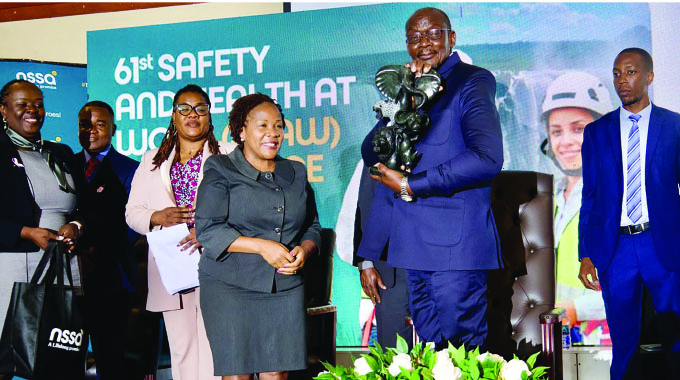
Fairness Moyana in Victoria Falls
EMPLOYERS have assured the Government of their commitment to addressing workplace hazards by putting in place safety protocols to minimise injuries or deaths.
In remarks during the official opening of the 61st National Conference on Safety and Health at Work (SHAW) 2024 here yesterday, Employers’ Confederation of Zimbabwe (EMCOZ) acting president, Mr Farai Dube, said business was committed to reducing occupational hazards in the workplace through various safety initiatives.
“This year’s theme ‘Promoting an Occupational Safety Health Culture Through Vision Zero’, resonates with our commitment as business, as far as reducing hazards and accidents in the workplace is concerned,” he said.
“Vision Zero is not just an ordinary concept, but it is a mind-set. It is a commitment and an intentional effort towards creating workplaces where no one gets hurt and the well-being of everyone is a priority.

“Vision Zero is a deliberate effort towards zero accidents, zero harm, and zero occupational disease. In this light, this conference reaffirms our pledge to eliminating hazards and minimising risks at the workplace,” said Mr Dube.
“As business, we need to foster a culture of open communication and reporting incidences. Not only reporting but also investing in training and empowering our employees to avoid accidents.
“As employers, we recognise the importance of creating and providing a safe and healthy environment for our employees and our stakeholders. Our commitment should not be based on the business case or legal basis but we strongly view this as a moral obligation,” he added.
Mr Dube said since occupational safety and health were every employee’s right and shared responsibility, the employer body was urging its members to provide protective equipment and conduct training on safety for its workers.
“In this regard, as organised business, we constantly urge our members to provide regular occupational safety and health training to employees. We urge them to acquire and provide the necessary personal protective equipment and to carry out regular and thorough risk assessments at the workplace,” he said.

“We urge them to implement the necessary preventive and mitigation measures. Employers should continuously monitor the work environment to promote continuous improvement in occupational safety and health. We encourage the organisations to have systems that are best practices in their sectors.”
Mr Dube, who is the first vice-president of Emcoz, said economic development should focus on accelerating industrialisation thereby creating safer jobs while calling for the formalisation of the informal sector.
“Inclusive and sustainable industrialisation, together with innovation and infrastructure, can unleash dynamic and competitive economic forces that generate employment and income,” he said.
“We need to give attention to promoting new technologies, facilitating international trade and enabling the efficient use of resources.
Formalising the informal sector can yield several trade benefits that include better working conditions and protection for informal workers. Formalising the informal will accelerate trade, spur economic growth, and reduce poverty.
International Labour Organisation (ILO) Occupational Safety and Health (OSH) specialist, Ms Peneyambeko Munkawa, also called for more action towards workplace safety beyond pushing profits.

“This is an era with a high degree of uncertainty and competition on development agendas and ideologies. With the social, environmental and economic priorities increasingly in conflict, only a collective action, as national and global, public and private actors, as well as the formal and informal actors, will propel us towards Vision Zero,” she said.
“The ILO has, through the adoption of the Tripartite Declaration of Principles concerning Multinational Enterprises and Social Policy (MNE Declaration), provided clear guidance on how enterprises can contribute through their operations worldwide to the realisation of decent work,” said Ms Munkawa.
“Prevention of injuries cannot be pursued through pushing duties, and responsibilities into hidden corners called sub-contracting, and outsourcing. Injuries experienced in the informal sector and lives lost at the lowest segments of our value chains are not trivial.
“If anything, they are devastating, as they lead workers, families and communities into poverty and suffering.”
She commended the Government, Nssa, partners and stakeholders for efforts to promote workplace safety arguing that the world labour body was ready to support Zimbabwe towards the harmonisation of OSH legislation as announced by President Mnangagwa during his State of the Nation address.

The annual gathering, which brings together business, social partners and the Government, comes against the backdrop of a notable increase in workplace incidents recorded. About 4 622 disabling injuries were reported with 65 deaths recorded annually between 2019 and 2023.
This year’s edition sought to facilitate the sharing of experiences, best practices and expert insights on establishing safe and healthy work environments.
The conference, which ends today, also served as a platform for networking and collaboration among OSH professionals, researchers, and policymakers from diverse backgrounds and industries.
The conference is organised by Nssa in conjunction with the Zimbabwe Occupational Safety and Health Council.



 Online Reporter