Sundaymail Editor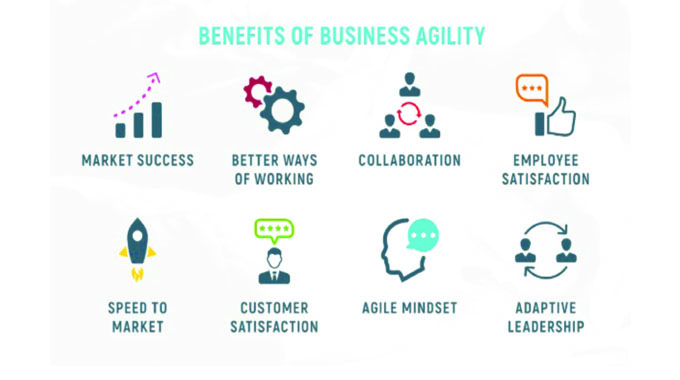
EntrepreneurshipMatters-Dr Kudzanai Vere
Survival in this current VUCA business environment calls for a high level of entrepreneurial agility. Organisations that survived and continues to thrive in this Covid-19 scourge were and are able to flex, adapt and respond quickly and effectively to threats and opportunities found in the internal and external environment.
Organisations shifted from physical offices to virtual offices at the behest of the pandemic and this was a great boost to tech companies such as Zoom, Google and Microsoft as providers of the much needed enhancers.
Online sales increased phenomenally under the circumstances than ever before.
Business agility is the ability of an organisation to adapt quickly to market changes with rapidity and greater flexibility.
Agile organisations adapt and lead change in a productive and cost-effective way without compromising quality of their deliverables while at the same time keeping their competitiveness.
Entrepreneurial agility embraces the agile philosophy and it is embedded in its people, culture, structure and technology. Consequently, an agile business is customer centric.
The word agile was borrowed from Middle French and Latin word agilis, from agere which means “to drive, be in motion, do, and perform”. Its Latin roots gave me the impetus to align it with entrepreneurship.
In contemporary times, it was popularised in software development. In 2001, 17 software developers met to discuss lightweight development methods.
They published the “Manifesto for Agile Software Development”, which covered how they found “better ways of developing software by doing it and helping others do it”.
At its core, agile exhibits behaviours of rapidity, trust, flexibility, empowerment and collaboration.
On agility, Paul Allen says, “It is the ability to act quickly and with economy of effort in accurate response to change and also to initiate change for business advantage.”
Paul’s view of agility also draws into the roots of the word that speaks of the drive, motion and performance.
Put simply, agility is all about the ability to respond fast to eventualities and keeping one’s mind open to new things. Practically, it would mean that all entrepreneurs should be agile in order for their them to succeed.
Agility in entrepreneurship is a lifestyle, a mindset that forces one to ideate and innovate, adapt and rise above any difficult challenges, fosters learning, communicates and collaborates with influencers, thinks and works strategically, values people and builds culture.
I will look into the core tenets of agile with regard to entrepreneurship and that is rapidity, trust, flexibility, empowerment and collaboration.
Flexibility
As alluded to earlier on, the word agile was popularised in software development where a lot of flexibility, iterative processes and change is constant. This should be the case in entrepreneurship. Agility is incremental and not a once-off thing thus the need for flexibility.
The business environment is ever changing and has become highly volatile and uncertain. Change is taking place at the speed of lightning. An entrepreneur needs to embrace change and come up with coping strategies.
What does stepping back or tuning in to the 2020 lock down measures means to the entrepreneur? The travel bans and shorter hours of working acts as stimulants into the entrepreneur’s decision making process. How does it affect business and what are the strategies going forward? Flexibility is of paramount importance.
Rapidity
Executional speed and accuracy is an important distinctive agile factor that entrepreneurs must have. Speed and accuracy boost productivity and enhances customer satisfaction.
A lackadaisical approach to business and entrepreneurship is not only damaging, but retrogressive.
This approach is rampant in Government-owned institutions which should be overhauled, re-oriented and restructured in line with performance expectations.
Rapidity is an important aspect of entrepreneurial agility.
Organisations set goes which have within them an issue of time as part of SMART (Specific, Measurable, Attainable, Realistic and Time bound). This means time is of essence in an organisation’s production and performance matrix.
Trust
Trust is a virtue that is built over time and through continuous working and dealing together. The greater part of business is sustained through trust. Without trust, the rate at which the wheels of business turn is compromised.
Most of the contracts that are signed in business are all hinged on trust that the other party will comply and deliver whatever is agreed upon. Entrepreneurship evolves around this critical agile factor.
Empowerment
The ultimate value in agile development is that it enables teams to deliver value faster, with greater quality and predictability, and greater aptitude to respond to change.
Agility is team work that emanates from responsibility.
Empowered teams dominate certain areas of the workflow. It is the working together of such teams that brings greater quality and swiftness in achieving results.
Empowered teams derive internal satisfaction and motivation to do more. There is intrinsic motivation that comes from being in charge.
Collaboration
Nothing beats the power of numbers. Collaboration removes hurdles caused by lack of certain skills and expertise. Much is achieved through mutually beneficial linkages. Entrepreneurship is not a lone journey.
Collaborations take the form of backward and forward collaboration whereby an entrepreneur joins hands with suppliers and customers respectively in a bid to maximise on output.
Agile mindsets, therefore, embraces frequent communication and face-to-face interactions. Customers and suppliers have the opportunity to see the work being delivered, share their input and have an impact on the end product.
In summing up, agility can be equally applied in entrepreneurship as is in software development.
The writer Dr Kudzanai Vere, the founder of Kudfort, Tengesa Online, Premium Business Network International and the Institute of Entrepreneurs Zimbabwe is an entrepreneur, author and transformational speaker in the areas of entrepreneurship and personal development. Dr Vere have trained more than 5 000 entrepreneurs globally in the areas of innovation, organisation development, practical business management and ideation. You can contact him on +263719592232 or email [email protected]



 Online Reporter