admin
admin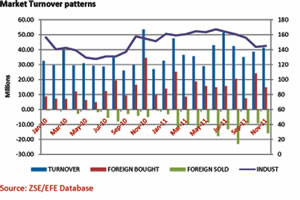
political environment.
Most companies managed to raise funds for recapitalisation but output and production levels remained low while other capital injections fell through.
The year was expected to be a period of recapitalisation and capacity consolidation. But it had its own difficulties, emanating from global financial markets problems hampering capital inflows and the regulatory framework.
On dollarisation, the Zimbabwe Stock Exchange was not fazed by global downturns. But it finally gave in with both the industrial and mining indices trading at their lowest.
Foreign participants have remained in a net inflow position which was to change in 2011 on the back of the shake-up in global financial markets, precipitated by the debt crisis in Europe and the subsequent downgrading of the US debt by global rating agencies.
The consequent liquidity crunch in the associated markets saw global players recalling funds from emerging markets, precipitating a surge in outflows from March 2011.
Market capitalisation opened the year at US$3,9 billion and went on a steady rise, largely propelled by the foreign inflows. But there was tightened liquidity on increased outflows midway through the year, which saw the market take a knock month-on-month from July 2011, with the only marginal gain coming through in November.
Statistics from the ZSE show that most of the counters are closing the year trading at their 52-week lows with the industrial index now 8,40 percent down year-to-date, with only three days of trading left in the year.
The resources index, on the other hand, has been the hardest hit on the market as four of the listed firms, except Falgold, have been plagued by unremitting recapitalisation issues.
To date, the mining index is already down a staggering 59,27 percent and last traded at 80,54 points last week Friday.
Mining stocks, heavily plagued by recapitalisation issues, dominated the fallers’ list with miners RioZim topping after shedding 84 percent.
The company’s proposed recapitalisation and debt restructuring were rejected by shareholders.
Perennial under-performer starafrica, which went for a US$20 million recapitalisation before rationalising operations, lost 82 percent of its shareholders value to trade around US1,26c.
In the year of such heavy losses, the torch-bearers on the market posted more than impressive performers with eight stocks in the triple digit gains led by Fidelity. The firm rallied 445,45 percent and is trading at US12c, riding on heightened excitement on the release of solid full-year performance.
The ZSE is expected to close the year firmly in the negative while market heavyweights that generally drive the markets are set to close either in the red or in the marginal gains.
Getting into 2012, equities are likely to remain in the negative territory until liquidity positions improve.
However, analysts expect performance from the ZSE, at current price levels, to attract investment.


 Online Reporter