Chronicle Editor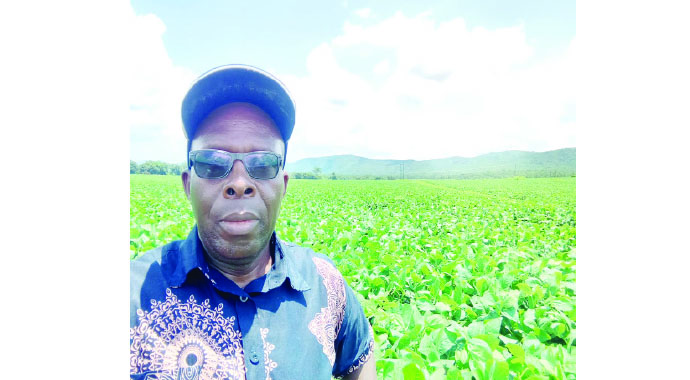
Oliver Kazunga, Senior Business Reporter
FORMER Zimbabwe National Chamber of Commerce (ZNCC) chairman, Mr Luxon Zembe is one of the farmers that have entered into a soyabean outgrower scheme with Bulawayo-based United Refineries Limited, putting 50 hectares under soyabean in Mazowe.
The soya bean farming project by Mt Pisgah Estate trading as Luxon Zembe was started last year in Mazowe, Mashonaland Central province.
In a recent interview, Mr Zembe who is running the project together with his wife, Charity, told Business Chronicle they were expecting a minimum yield of three tonnes per ha.
“We are in an outgrowers’ contract with United Refineries Limited (URL) where we have planted 50 hectares of soyabean.
“Our target is a minimum of three tonnes per hectare, we hope and trust we will be able to achieve and so far, so good, it’s looking good as the crop is at flowering and podding stage.
“We planted it on the 28th of November last year and this is our first project with United Refineries and we have found them to be very organised and responsive to the needs of the farmer,” he said.
According to official figures from agronomist, the break-even yield level for soyabean is about 1,7 tonnes/ha.
In 2019, URL chief executive officer Mr Busisa Moyo announced that his organisation together with its strategic partners was implementing a US$30 million soya bean outgrowers’ alliance scheme to boost the crop’s output in the country.
The initiative is meant to augment the processing of cooking oil in the country and stockfeed as well as reducing Zimbabwe’s import bill.
As part of the Agriculture Recovery Plan, the Government last December announced the pre-planting producer prices for 2021/2022 summer cropping season for soyabean at $125 530,17 per tonne while that for maize was pegged at $58 553,25 per tonne, traditional grains ($70 263,90) and sunflower ($150 636,20).
Under their partnership, Mr Zembe said URL has supplied them with all the inputs on time and thus the project has been successful in terms of implementation.
“When there are challenges, they are available, they organise experts to talk to the farmers virtually or physically.
“They organise farm visits to various farms on the project to share ideas and knowledge and experience and this is what makes the project a success.
“Over and above, obviously it rains because it is important for us to get sufficient rains and so far, the weather has been good and we are looking forward to a good yield.
We are expecting harvesting the crop mid-April depending on the weather conditions and how quickly they will dry, but we should be able to harvest the crop by mid-April,” he said.
Mr Zembe said they were growing the crops on leased farms in Mazowe’s Pearson and Jumbo areas and was appealing to Government to be given A2 State land for farming on account of his high level of production and faithful payment of loans.
“I also have fully paid up five tractors, 80 and 90 horse power, four row planters, three by three disc reversable ploughs, two by 24-disc harrows, boom spray and good overhead irrigation equipment.
“Now we require centre pivot to up-scale my production to 200ha for both summer and winter crops. Key success factors are vision, passion, good equipment, good and timely input support scheme, good soils, good rainfall patterns, good crop management, and well looked after work force,” he said.
A renowned businessman in his own right, Mr Zembe said soyabean is a strategic crop whose production should be boosted to reduce the country’s import bill, creating employment as well as sustaining the manufacturing sector.
He said soyabean provides one of the most edible oils adding that soya chunks have also become an attractive food item to a lot of people.
“Soyabean is even important in providing animal feeds, so it is a strategic food crop not only in Zimbabwe, but worldwide and it is important that we put resources into its production otherwise, we will spend a lot of money importing by-products that we get from value addition of soyabean.
“Soyabean, also sustains our manufacturing industry as you know 60 percent of our manufacturing industry’s inputs come from agriculture and this is one of the good examples that sustain the cooking oil manufacturing industry and other by-products like animal feed,” said Mr Zembe. — @KazungaOliver



 Online Reporter