Chronicle Editor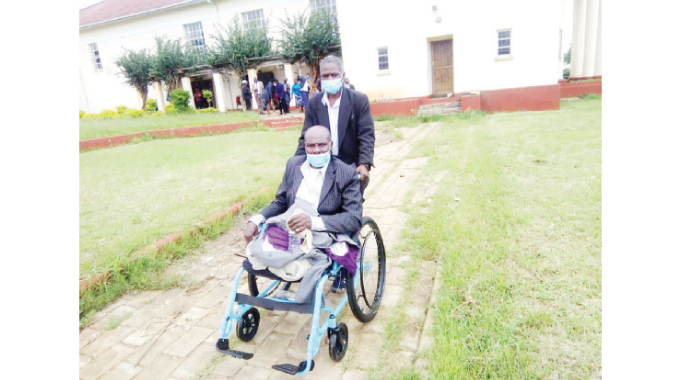
Blessing Karubwa, Features Reporter
HE woke up one morning with a pain on his left leg and suspected that it was just a trifling ache.
That, however, was to be the genesis of a lifelong tribulation for Mr Samuel Mhlanga (83) of Matolokisi village, in Umzingwane district, Matabeleland South province.
Though he thought it was just a negligible pain, it persisted and could not allow him to sleep peacefully triggering thoughts that he maybe he was bitten by a ‘creature’ in his sleep.
“It was in 2002 when I started feeling waves of heat on the top part of my left leg. Initially I thought it was just slight pain, but as weeks passed, I began to sense that it was not ordinary. Like in any African setup, it remained a family issue, but we could not hide it any longer as the situation was getting out of hand. Every time before I went to sleep, I was forced to put my leg in a bucket filled with cold water so as to calm the heat.
“As if that was not enough, my wife suddenly fell sick and died during those days and I was left with no-one to take care of me as my two daughters are married. I had to be taken care of by one of my daughters who took me in and I stayed with them for quite a number of years. The pain continued and it developed into a full-blown wound. It was only when I visited the hospital that I was diagnosed with cancer,” said Mr Mhlanga.
He said the diagnosis meant they had to raise money so that he gets treated, but it wasn’t easy and that led his leg being amputated to stop the spread of cancer, which confined him to a wheelchair.
He couldn’t afford to buy assistive technology and so he used to make use of wooden walking sticks. Assistive technology is a generic term that describes tools used by people with disabilities to accomplish tasks.
The worst was not yet over for Mr Mhlanga as the cancer started again which led to a second amputation.
A Chronicle news crew last week visited Umzingwane District where the Rotary Club was donating wheelchairs to a number of people living with disabilities. Mr Mhlanga was one of the beneficiaries.
“Ngithi iNkosi ilibusise bantwabami (God bless you, my children) I had been really bothering my son-in-law, I always call out for help whenever I want to visit the toilet. Most people who are disabled can’t afford to buy assistive technologies, life would’ve been easier for me if I had a wheelchair,” he said.
He also highlighted the issue of transport and said there was none that catered for people like him to travel alone.
His son-in-law, Mr Sipho Moyo (61) said they have either been using a wheelbarrow or lifting him from one point to another and that was not as comfortable as using a wheelchair.
Mr Sipho Khumalo (25) who also benefited said he did not go to school not because his parents could not afford, but because locally there were no schools catering for people like him.
“My parents had managed to buy me a wheelchair. I was prepared to go to school and learn like others. I gave up because every day I had to ask for people to lift me so as to enter the classroom as it had no ramp,” he said.
Mr Mpilwenhle Dube (23), a vendor, said it was rare to find people like him learning up to tertiary level, a move which he said should be a cause for concern to stakeholders including the Government.
“I was learning at King George High School in Bulawayo where I dropped out in 2014 because of financial constraints. I am now selling amaputi, amaHello and sweets so as to make a living. I also want to go to school, but it is unfortunate that our schools for people like me are quite expensive than others. Society is not catering for us; we feel neglected and unwanted. I have heard some saying they are getting funds from the Government, but some of us are not getting the funds. We see and hear of that in newspapers,” said Mr Dube.
He said he wanted to be a farmer and still wants to study courses related to farming.
Umzingwane constituency legislator, Brigadier General (Rtd) Levi Mayihlome, said society usually focuses on able-bodied people while forgetting those who were disabled.
He said the district had more than 1 000 disabled people who were in need of assistive technologies.
“People living with disabilities (PLWD) have varying needs. Some need wheelchairs, crutches, walking sticks, hearing aids and some need capacity building so that they can do things for themselves in their respective communities. Society usually focuses on people who are able bodied while forgetting those who are disabled and this has been unfortunate,” said Rtd Brig Gen Mayihlome.
National director of disability affairs Dr Christine Peta, said President Mnangagwa launched the National Disability Policy and the Government has a number of programs intended to assist people with disabilities which include provision of assistive devices, school fees payments and healthcare facilities.
She said so far, over 1 000 people with disabilities have applied for assistive technologies, which have already been disbursed.
She also encouraged caregivers and parents not to hide PLWD, a move which has resulted in most of such people in rural areas being left out when others are benefiting.
She further encouraged people with disabilities to apply for assistive technologies through their district offices.
“They apply through our district offices and we pay for those assistive technologies, we serve people with disabilities in all the ten provinces of Zimbabwe be it in rural or urban areas. They write a quotation and the district office will send to us, the accounting department, we pay and then we phone the client that we’ve paid. We do not work in isolation; we work with other Government ministries because the policy that the President launched is calling for collaboration with other Government ministries,” said Dr Peta
She said according to the Constitution, all buildings should be accessible to persons with disabilities.
“It is provided in the Constitution that all facilities should be accessible to people living with disabilities. That outlines the thinking of the Government and this is the way we’re moving towards. We want to implement the provision and ensure that all facilities are accessible and comfortable for people living with disabilities,” she said.
Dr Peta said there should be entrances and doors wide enough for anyone to go through whether a person is using a wheelchair or crutches. She said the Government was seriously working on that, including giving the blind the right to vote without assistance.
“Policy directs that the ballot paper should be translated to Braille so that a blind person would be able to read the paper in privacy, but in instances where PLWD may choose to be accompanied by other persons we’re saying that they should be accompanied by a person of their choice.
“We do offer seed funding to persons living with disabilities to start their own projects within the communities. So, every year, we’ve PLWD applying through their district offices. We’re moving from the charity model of disability where they should not be seen and thought of as people who should just beg and live on donations. We’re saying they’ve a right to work, to start their own projects and contribute to national development,” said Dr Peta. – @ TichaKarubwa


 Online Reporter