Chronicle Editor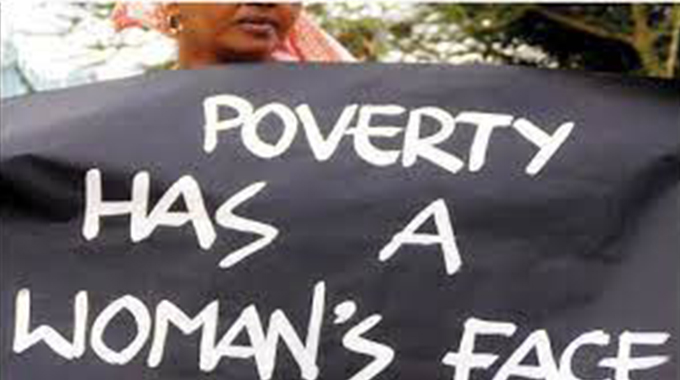
This is an assertive question that demands you to examine the view that women suffer the most from poverty than other groups.
To examine is when you look closely at that assumption. Think and write about the detail, and question it where appropriate. How do you question it?
You do so by displaying whether or not women among other groups, are the most silent victims of the pandemic of poverty. Since we have the absolute term “most”, how about other groups such as children, underclass, old age, or the disabled? At least women are able-bodied then how about the disabled? This makes a critical student to indicate that there are other groups that suffer the most as well from poverty even more than women. Give enough description or information to make something clear or easy to understand.
Poverty according to United Nations (1995) is a condition characterised by severe deprivation of basic human needs such as food, shelter and education.
The view that women suffer the most from poverty has been backed up by feminist perspective in the sense that women are said to be the most affected by discrimination in the field of work.
Their dependency on men makes them victims of poverty, their biological makeup also reduces them to the trap of poverty and educational failure which reduces their value. Also, women are said to be the weakest hence poverty is the face of women.
However, it can be argued that although women are said to be the victims of poverty, the feminist perspective has put a blind eye and a deaf ear to other groups which suffer the worst from poverty more than women such as children, people living with disabilities, old age and even men.
Hence, the below write up seeks to examine the feminist view that women suffer the most from poverty.
As conceived by feminist perspective, women suffer the most from poverty due to educational failure which has reduced their value. According to Kelly, women than other groups, have low educational passes due to inequality at school which makes them have no market value in a male-dominated space. Liberal feminists argue that some educational policies are not fair to women. For example in the event of teenage pregnancies at school, a girl child has a high likelihood of being expelled or to expel herself leading to a school dropout. For example, The Herald newspaper cited that from the overall figure, 157 male and 5 747 female pupils dropped out of school due to pregnancy in 2021. Without education, the integrity and dignity of women is reduced. Hence educational inequalities eliminate women from competition with men which is enough evidence to say that women suffer the most from poverty through educational failure which reduces the market value. However, the above view can be criticised in the sense that at least women have access to education and they are able to take care of themselves unlike the disabled persons.
Thus, in this regards, disabled persons may be considered as suffering the most from poverty than women. This is because some of them receive no education due to stigma, physical barriers and are excluded in the field of the workplace (Maphosa,2017).
Therefore, this submission has indicated that disabled persons suffer the most from poverty as compared to women because some of them can not be able to walk for themselves.
The feminist perspective further asserts that women suffer the most from poverty in the sense that women depend more on men for survival. This drags them into poverty as recipients of male earnings.
This dependency of women on men is due to a patriarchal culture that denies women an opportunity to work. According to Ravazi, poverty in this context is the face of women that has reduced them to beggars which affects their overall well-being. Henceforth feminists concluded that women suffer the most from poverty than other groups. Their dependency results in sexual and physical abuse thereby affecting their overall well-being. However, it can be argued that not all women depend on men ushering to the fact that in recent years, a number of women are now independent and highly qualified to own the means of production. Critically depending on men means that women do not suffer from poverty since they have a bigger share from male earnings.
Thus males are seen as suffering largely from poverty as they have to provide all to women. In most cases, patriarchy has made males to prioritise women through sacrifices that have drained their pockets. Hence, women have been rescued by men from poverty and most males have been dragged into poverty by women through this dependency.
It is sociologically insightful that women suffer the most from poverty because of their biological make up which exposes them to poverty.
As posed by radical feminists such as Firestone (1972), it is the biological state of women to carry pregnancies and breastfeed babies which make them in need of more calcium than other groups.
Such a responsibility is an anti-drought resistance for women hence a catalyst for poverty. In this view, it can be argued that the biological makeup of women is one of the reasons why women are said to be suffering the most from poverty.Tatenda Chihota is a Zimbabwean sociology scholar.



 derick.khumalo