Online Reporter
Sikhulekelani Moyo, [email protected]
ECONOMISTS have commended the continuous drop in inflation, calling upon authorities to find ways to enhance the use of Zimbabwe Gold (ZiG) and displace the United States dollar as the nation works towards establishing a mono-currency by 2030.
This comes after the national statistics agency, ZimStat, revealed that the ZiG month-on-month inflation rate was 0,0 percent in January 2026, shedding 0,2 percentage points from the December 2025 rate of 0,2 percent.
The ZiG year-on-year inflation rate (annual percentage change) for January 2026, as measured by the all-items ZiG Consumer Price Index (CPI), was 4,1 percent, shedding 10,9 percentage points from the December 2025 rate of 15,0 percent.
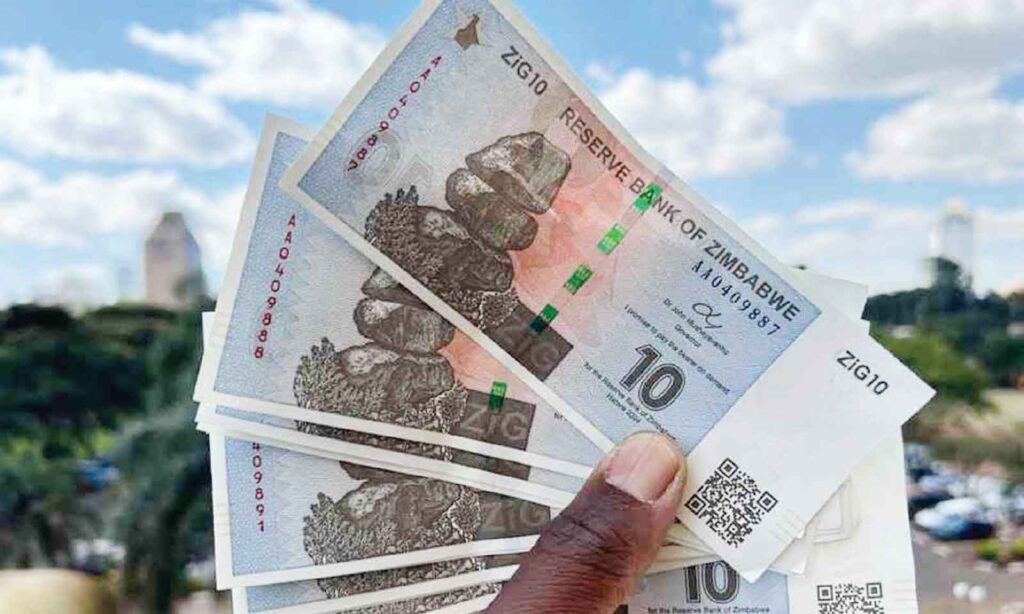
The weighted month-on-month inflation rate was 0,2 percent in January 2026, gaining 0,1 percentage points from the December 2025 rate of 0,1 percent. ZimStat also stated that the weighted year-on-year inflation rate for January 2026 was 1,8 percent, shedding 11,5 percentage points from the December 2025 rate of 13,3 percent.
In response to these figures, economic analyst Mr Farai Mutambanengwe said the inflation data continues to show a decline, particularly regarding annual rates. He noted that while month-on-month rates have consistently remained low over the past year, this is now translating into annual figures, with the ZiG rate down to approximately 4,1 percent.
“The figures are commendable considering where we are coming from. Instability in terms of the exchange rate and inflation has been a huge problem, so that has been contained. However, when you look at those numbers, they are actually very low, which in itself could indicate a problem regarding economic growth or the possibility of recession.
But overall, it is a positive development,” said Mr Mutambanengwe.
“The only issue now is that we need increased use of the ZiG within the general population and the markets; currently, for most people, the ZiG has become virtually non-existent.

“What the central authorities need to work on is the gradual displacement of the US dollar. To achieve that, we need a convergence of interest rates — the official versus the market rate.”
He argued that the country should move away from a fixed official exchange rate in favour of a market-determined one to create the necessary conditions for displacing the US dollar from the broader economy.
“It is not going to be an easy process because there has already been resistance to de-dollarisation due to the traumas of the past, but it is a necessary step if we are to move towards the goal of using our own local currency as the primary medium within the economy,” added Mr Mutambanengwe.
Zimbabwe is actively working towards transitioning to a domestic mono-currency system by 2030. The Reserve Bank of Zimbabwe (RBZ) has outlined a “de-dollarisation roadmap” in the National Development Strategy 2, aiming to develop a domestic currency like ZWG to regain control over monetary policy, manage inflation, and foster long-term economic planning.
The transition is expected to be a multi-stage process rather than an overnight shift, with the goal of achieving durable macroeconomic stability and a unified exchange rate system.
Another economist, Mr George Nhepera, said the country has achieved a remarkable feat by recording single-digit inflation of 4,1 percent, which is comparable with other SADC countries and even some developed nations.
He said this is a clear signal of price stability, which serves as an anchor for other fundamentals such as interest rates and financial safety.

“With gold at a record high price level, our local currency is now poised for long-term stability and value preservation,” said Mr Nhepera.
“When His Excellency President Mnangagwa spoke about the need to introduce a structured currency backed by gold, many people were sceptical, yet it was one of the wisest decisions made by the President.
“It is now directly linked with Vision 2030 of an upper-middle-class society with its own stable currency.”
Nevertheless, Mr Nhepera cautioned that despite these economic gains, the country should resist any temptation to introduce a mono-currency ahead of the 2030 target. Instead, he suggested focusing on industrialisation and innovation to improve the supply of goods, productivity and investment promotion.