Online Reporter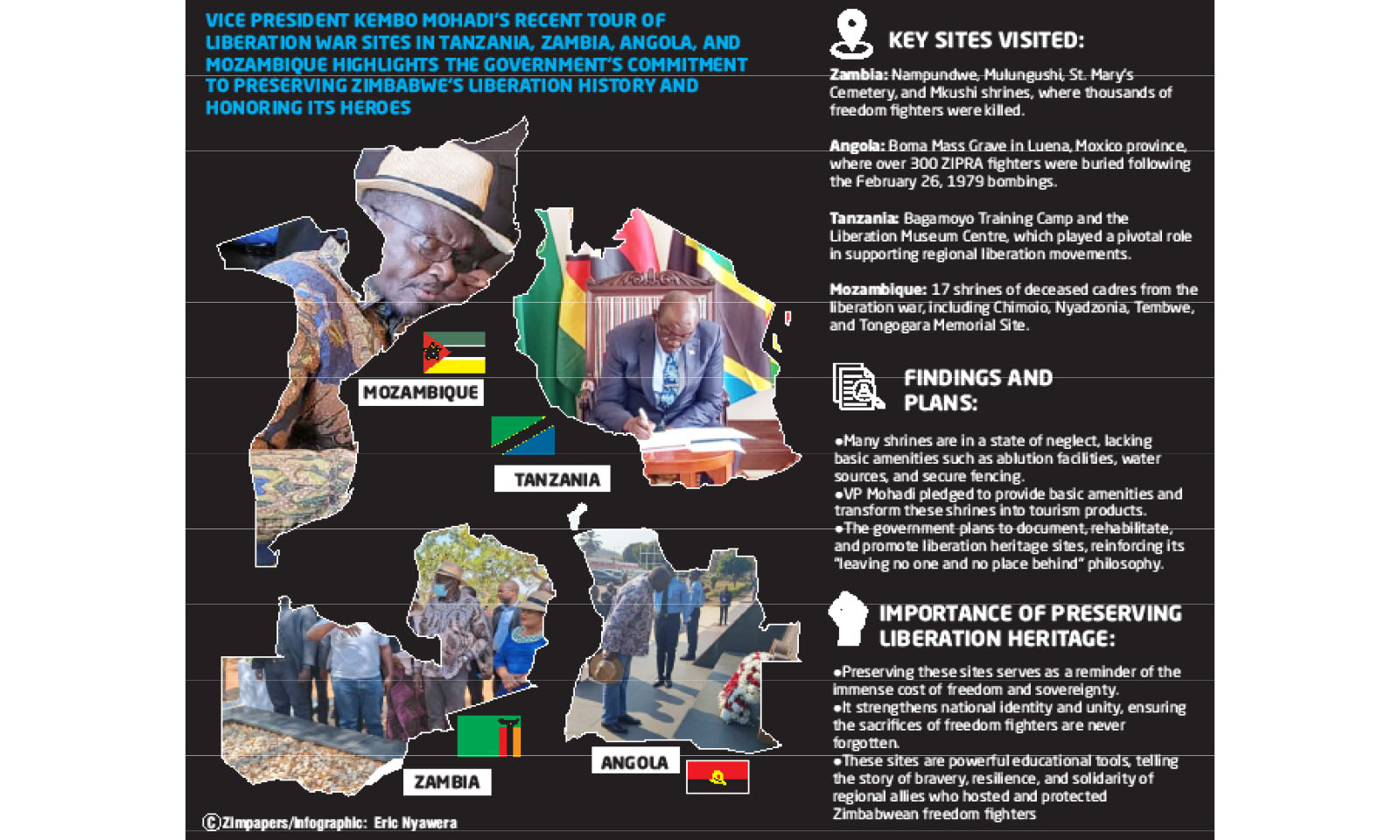
Zimpapers Politics Hub
VICE PRESIDENT Kembo Mohadi recently embarked on a tour of liberation war sites in Tanzania, Zambia, Angola and Mozambique.
The tour was part of an intensified Government drive to document, rehabilitate and promote liberation heritage sites.
The Second Republic plans to preserve the legacy of Zimbabwe’s liberation struggle by restoring and maintaining sites of national historical importance, both within and beyond the country’s borders.
This demonstrates a commitment to ensuring that the legacy of the struggle, including the contributions of all who participated both at home and abroad, is recognised and honoured.
During the 14-year struggle for independence, Rhodesian Security Forces launched air and ground strikes at training camps of liberation fighters, as well as refugee camps in neighbouring countries.
Many of the thousands killed in these attacks were buried in mass graves.
In Zambia, VP Mohadi toured Nampundwe, Mulungushi, St Mary’s Cemetery and Mkushi shrines, where thousands of freedom fighters were killed. Some Zambian police officers and military personnel were also killed while trying to rescue fighters in besieged camps.
In Angola, VP Mohadi visited the Boma Mass Grave in Luena, Moxico province, where over 300 ZIPRA fighters were buried following the February 26, 1979 bombings. He also met with traditional leaders and locals in the area.
In Tanzania, he toured the Bagamoyo Training Camp, which was later transformed into the Kaole Wazazi College of Agriculture, as well as the Liberation Museum Centre.
President Mnangagwa was among 59 cadres from Frelimo (Mozambique), six from Southern Rhodesia (now Zimbabwe) and five from South Africa who pioneered the first military camp in Bagamoyo in 1963.
Tanzania played a pivotal role in supporting regional liberation movements by providing military training facilities in locations such as Mgagao, Morogoro, Bagamoyo, Kongwa and Nachingwea, among others.
VP Mohadi concluded his visit in Mozambique, where there are about 17 shrines.
Among the sites are mass graves at Chimoio, Nyadzonia, Tembwe, Nyangao (Beira), the Tongogara Memorial Site and Changara.
However, at other shrines, including Madulu, Mapai, Barrage, Chibavava, Navonde, Espungabera and Save, the remains of those who were either killed or died of illnesses are still lying in unmarked graves.
The Vice President noted that many of these shrines lack basic amenities such as ablution facilities, water, good road network, rolls of honour and secure fencing.
In an interview on the sidelines of the tour at the Chimoio Shrine, he said: “There are a lot of less important things that we can sacrifice resources in order for this initiative to be undertaken. For example, the responsible ministry, the Ministry of Home Affairs and Cultural Heritage, can make use of the money collected from gambling to ensure that boreholes, ablution facilities and other amenities are in place at these shrines.”
The nation, he added, needs to do more to honour these heroes.
“The question from some of us who lived through this war is: Are we doing enough? The answer in many circumstances is that we are not. We surely need to do more.”
He said the sacred shrines needed to be transformed.
“For example, Mutare will be hosting the annual ZANU PF conference and a lot of people will be flocking to this place (Chimoio Shrine) because it is near, and perhaps the biggest of them all. However, many people would be ready to visit all the other shrines only if proper facilities were in place and the shrines are adequately marketed to young Zimbabweans to appreciate their history.”
The theatre of Zimbabwe’s liberation struggle was not confined to the country’s borders.
It also extended to Frontline States, which were determined to ensure the liberation of their fellow brothers and sisters.
A timeless story
VP Mohadi said the story of Zimbabwe’s liberation struggle must be continuously told, especially to the youth, to ensure the sacrifices made are never forgotten.
“It must be talked about in all social spaces regularly so that our young ones can understand what we mean when we say this country’s liberation war was nourished by human blood. This is what we mean . . .
“This is how we should make our own war for independence a crucial story. Let us not be brainwashed into thinking that this is not important.”
Thousands of young men and women paid the ultimate price in training camps and refugee settlements on foreign soil that became sites of brutal attacks by the Rhodesian regime.
By rehabilitating and preserving the shrines, Zimbabwe is reaffirming its commitment to history and demonstrating that the lives lost in the struggle will never be forgotten, regardless of where they fell.
Visiting these sites is crucial for national memory and unity. For many Zimbabweans, especially the youth, the liberation war is a distant historical event. Bringing these sacred places to life through preservation and promotion allows them to connect with the immense sacrifices made for their freedom.
These shrines serve as powerful educational tools, telling the story of bravery, resilience and solidarity of regional allies who hosted and protected our freedom fighters.
So, those who lie in unmarked graves across the region deserve the same profound respect and honour as that accorded to heroes buried at the National Heroes Acre. The sites dotted across the region are sacred grounds that remind the new generation of the immense cost of freedom and sovereignty.
They serve as a reminder that the freedom we enjoy today was bought at a very high price.
By ensuring the final resting place of freedom fighters are well-maintained and accessible, Zimbabwe is fulfilling a sacred duty and making a powerful statement that the country will not abandon its sons and daughters who died while serving the nation, even if they lie far from home.


 Bongani Ndlovu