admin
admin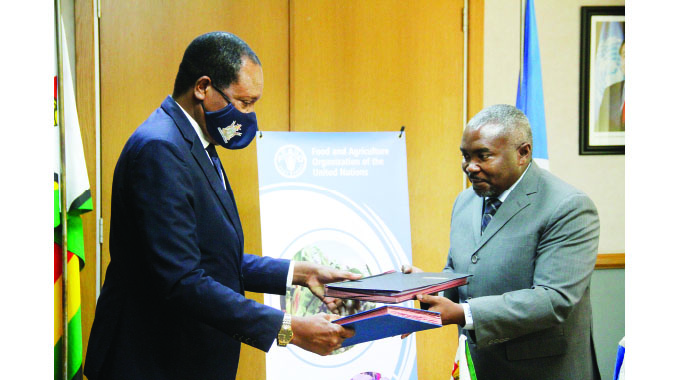
Precious Manomano-Herald Reporter
Zimbabwe’s Country Programming Framework 2022-26 to transform agriculture and sustainable food security and systems in the country was signed yesterday by the Government and the Food and Agricultural Organisation (FAO).
The signing ceremony showed the commitment to the efforts aimed at transforming Zimbabwe’s food and agriculture sector, as the country is well positioned to achieve the objectives of the National Development Strategy 1 and Vision 2030.
The CPF will deliver integrated support in three priority areas, which are building resilience to climate change, agricultural threats and crisis, sustainable management of natural resources and environmental protection and promotion of inclusive and agri-food systems.
Lands, Agriculture, Fisheries, Water and Rural Development Minister Dr Anxious Masuka said the partnership will go a long way in improving the agriculture sector and food systems in Zimbabwe.
“I am very pleased to be part of this ceremony today because it marks the strong relationship with FAO and transformation of the agricultural sector,” he said.
“It is also aligned to NDS1 and agriculture food security and transformation strategy launched by President Mnangagwa in 2020. I want to highlight that the current programming framework, the agriculture and food systems transformation strategy, is based on not leaving anyone behind. Because Zimbabwe’s economy is agro-based, 61 percent of the population resides in communal areas.”
FAO Sub regional Coordinator for Southern Africa and FAO Representative to Zimbabwe Dr Patrice Talla said the country was seized with a number of challenges that included low levels of access to technology, innovation and mechanisation and poorly performing input and output markets.
“Through the country programming Framework FAO will roll out interventions aimed at increasing agricultural productivity, value addition, access to markets, technology finance and income opportunities while making efforts to promote youth engagement as well as supporting the diverse roles and inclusion of women and other vulnerable groups to socio-economic risks in agriculture, fisheries and forestry sectors,” she said.
Dr Talla said FAO would support the roll out of strategic interventions that encouraged private sector investment into agrifood systems.
The Agriculture and Food Systems Strategy, a strong component of the National Development Strategy 1, envisioned the attainment of a US$8,2 billion agricultural industry by 2025, but this was achieved within a year in 2021.
This record growth in agriculture is partially responsible for Zimbabwe’s record-breaking annual economic growth of 7,8 percent confirmed for last year, the highest in Africa in the year.
The Agriculture and Food Systems Strategy was launched in 2020 as an integral part of the national development agenda being driven by President Mnangagwa.
The approach is anchored on enabling agriculture policy and the regulatory environment to facilitate the flow of investment into the sector; appropriate agriculture investments for productivity, food security and resilience; efficient agricultural knowledge, technology and innovation system; and the agriculture sector coordination for responsive planning, implementation monitoring and evaluation.



 Online Reporter