Online Reporter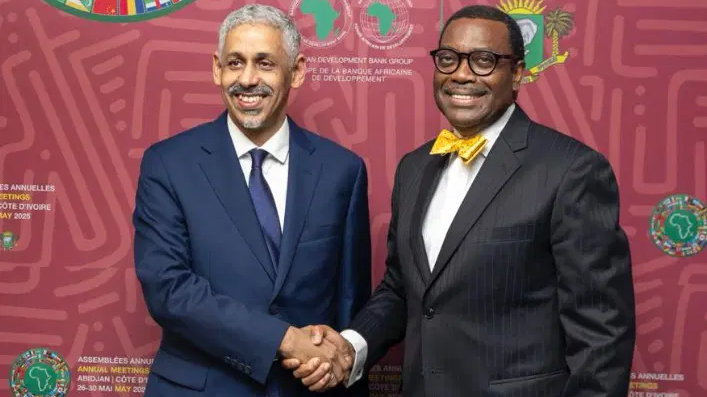
Lloyd Makonya
Correspondent
THE corridors of the African Development Bank (AfDB) witnessed a historic moment early this week as Dr Akinwumi Adesina, after a transformative decade at the helm, handed over leadership to Mauritanian economist, Dr Sidi Ould Tah.
The transition, not only closes a chapter defined by bold vision and impact, but also opens a new one shaped by fresh perspectives and ambitious goals for Africa’s development trajectory.
Dr Adesina, who assumed office in 2015, leaves behind a legacy that has reshaped Africa’s foremost development institution into a more robust, globally respected financial powerhouse. Under his stewardship, the bank’s capital base swelled from US$93 billion to well over US$300 billion, enabling unprecedented investments in infrastructure, agriculture, energy and social services.
His High-5 Agenda — Power Africa, Feed Africa, Industrialise Africa, Integrate Africa and Improve the Quality of Life for Africans — became the Bank’s defining strategy, impacting hundreds of millions of lives across the continent.
Reflecting on his journey, Dr Adesina remarked at his farewell address: “When I took office, I said we would make the African Development Bank the pride of Africa and the envy of the world. Together, we did that. We delivered electricity to millions, gave women and youths the tools to thrive and stood firmly with Africa during crises.
“The numbers tell part of the story, but it is the dignity restored to African lives that matters most.”
One of the notable hallmarks of Adesina’s leadership was his advocacy for debt sustainability across Africa, with Zimbabwe emerging as a key beneficiary of his diplomatic and economic ingenuity.
He championed dialogue around arrears clearance and fiscal reforms, pressing for solutions that balanced economic stability with national dignity.
“Zimbabwe’s future must not be mortgaged by its past,” Adesina once declared in Harare.
“Our role is to create pathways for nations to rise again, free from the heavy burden of unsustainable debt.”
As he steps aside, the mantle passes to Dr Sidi Ould Tah, elected as the ninth president of the AfDB in May 2025. A seasoned economist and development financier, Dr Tah is no stranger to continental challenges.
During his tenure as head of the Arab Bank for Economic Development in Africa (BADEA), he credited with quadrupling the bank’s balance sheet, secured top-tier credit ratings and significantly expanded support for African SMEs and infrastructure.
“His fluency in Arabic, French, English, Spanish and Portuguese underscores a Pan-African and global outlook essential for today’s interconnected development landscape.
Outlining his vision at the inauguration, Dr Tah pledged a decisive focus on mobilising large-scale financing for Africa’s future.
“Our continent requires more than hope, it requires bold, innovative financing that matches its potential,” he said.
“My vision is to mobilise over US$400 billion annually, lower borrowing costs for African nations and unlock the immense capacity of our entrepreneurs, women and youth. We will build on the foundations laid by my predecessor, but we must also move faster and smarter in an era defined by climate risks, technology and global uncertainty.”
Dr Tah further emphasised the importance of inclusivity in Africa’s development journey.
“The informal sector is the beating heart of African economies. We cannot ignore it.
“By formalising, supporting and financing small businesses, we can create millions of decent jobs and transform local innovation into global competitiveness.”
The leadership change comes at a sensitive moment. With shifting global aid dynamics, rising climate-related vulnerabilities and funding cuts from traditional partners, the AfDB faces new challenges that demand both continuity and innovation. Adesina’s decade provided stability, credibility and growth.
Dr Tah’s era will be judged by his ability to sustain that momentum while navigating financial headwinds and reimagining Africa’s development model for the future.
For Zimbabwe, and indeed for much of Africa, the transition is one of cautious optimism. Adesina exits having amplified Africa’s voice on the global stage, positioning the continent not as a recipient of charity but as an engine of opportunity. Tah enters with a mandate to deepen that transformation, anchoring his leadership in inclusivity, resilience and financial creativity.
In the words of Dr Adesina: “Africa’s story is still being written and I am proud to have been part of its chapters of progress.”
And in Dr Tah’s confident response: “The next chapters must be about scale, speed and sustainability. Africa’s time is not tomorrow, it is now.”
As the African Development Bank turns the page, the world watches with keen interest, and Africa looks inward with renewed hope.