admin
admin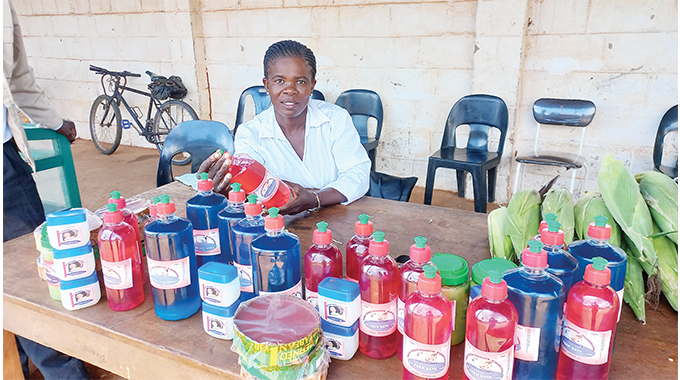
Sukulwenkosi Dube-Matutu, Matabeleland South Bureau Chief
GOVERNMENT through the Smallholder Irrigation Revitalisation Programme (SIRP) is assisting rural farmers to start projects as part of efforts to boost their income and alleviate poverty in line with the rural industrialisation agenda.
Through rural industrialisation, Government hopes to stem rural to urban migration, which saps growth from the African countryside, transferring it to towns and cities.
Rural industrialisation, which hinges on the Second Republic’s devolution policy, involves nurturing agro-processing start-up enterprises in rural areas through financial and technological support via venture capital funding and Government agencies.
Fresh Food Enterprise farmers in Insiza District who are also plot holders at Silalabuhwa Irrigation Scheme, are some of the beneficiaries under the SIRP.
They are running a viable detergent-making business which was established in January last year.
Under the programme, farmers were trained and offered raw materials to produce the detergents.
The group has 24 members who are producing detergents, petroleum jelly and floor polish among other household products, and supplying local shops and villagers.
The project has assisted the villagers with a sustainable source of income. Silalabuhwa Irrigation Scheme was rehabilitated under the SIRP programme.
Launched in November 2017, SIRP is a seven-year programme funded by International Fund for Agricultural Development (IFAD), OPEC Fund for International Development (OFID) and the Government, which contributes to the resilience of smallholder farming communities in the country.

The programme assists in the revitalisation of irrigation schemes across the nation through rehabilitation of infrastructure. The SIRP aims to revitalise 6 100 hectares in 152 existing smallholder irrigations schemes in the semi-arid zones of four provinces of Matabeleland South, Manicaland, Masvingo and the Midlands.
Over 27 700 poor rural households are expected to benefit during the course of the programme.
The programme will cover some 46 percent of the country’s estimated total irrigation-equipped area of about 13 000 hectares. It will improve productivity and climate-resilient crop production under both rain-fed and irrigated conditions, through diversification of crops and increased adoption of improved varieties, combined with climate-smart agricultural practices and, most importantly, enhanced access to markets.
Fresh Food Enterprise vice-chairperson, Ms Sihle Sibanda said the SIRP programme chipped in with assistance to help start the project which is now self-sustainable.
“SIRP came in last year in January and trained us on how to make cleaning detergents, floor polish and petroleum jelly among other products. They also gave us raw materials as a start-up which we used to make our first products,” she said.
“From there we realised profits after selling and then used the money to buy more ingredients and our project is now self-sustainable. We are able to buy raw materials and continue producing more products.”
Ms Sibanda said they buy their raw materials from Bulawayo.
“We have petroleum jelly, foam bath, floor polish, pine jelly and dish washing liquid. Our main customers are the villagers, but we also sell to local shops in bulk,” she said.
Ms Sibanda said their products have become popular and in high demand in their locality.
Another project member, Mr Sergeant Nkomo said the detergent-making project has helped them to feed their families.
Mr Nkomo said they set up a sales and marketing committee, which is responsible for handling sales and searching for customers.
“The training we got from SIRP wasn’t only for detergent making, but it also covered the business side. We were taught on how to run our business as an enterprise so that we can record significant returns,” he said.
“We then decided to come up with a structure that could help us which is the sales and marketing committee. This business had helped us to sustain our family and it’s a reliable source of income for us.”
Ms Judith Dube, who is also part the project, said they named their group Fresh Food Enterprise as part of their long-term plan to also venture into food production.
She said the group intends to venture into jam making. – @DubeMatutu



 Online Reporter