Lovemore Kadzura
Post Reporter
AS preparations for the 2026/27 summer cropping season gather pace, farmers across Manicaland are racing against time to complete Pfumvudza plots and position themselves for a season expected to be shaped by below-normal rainfall and high temperatures.
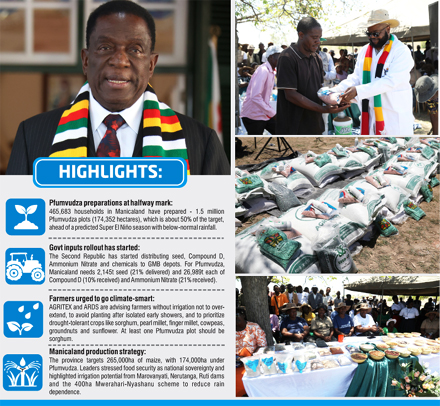
A total of 465 683 households have so far prepared nearly 1,5 million Pfumvudza plots against a target of 2 794 098, translating to approximately 174 352 hectares under climate-smart conservation agriculture.
While the figures reflect encouraging progress, farmers are being urged to match their ambitions with careful planning as forecasts point to possible Super El Niño conditions, which could result in reduced rainfall availability and prolonged dry spells.
The Second Republic under President Mnangagwa has already begun distributing critical agricultural inputs, including agro-ecological-specific seed varieties, fertilisers, chemicals and vegetable seed packs, to Grain Marketing Board (GMB) depots across the province ahead of the planting season.
Manicaland has set a maize production target of 265 000 hectares, of which 174 000 hectares are expected to be cultivated under the Pfumvudza programme.
The province requires 2 145 tonnes of seed for Pfumvudza plots, with 21 percent of the allocation already delivered.
It also needs 26 989 tonnes of Compound D fertiliser, of which 10 percent has been received, while 21 percent of the required 26 989 tonnes of Ammonium Nitrate has already been dispatched.
The input rollout follows the launch of the Pfumvudza/Intwasa and Summer Inputs Distribution Programme in Buhera on Monday by the Minister of State for Manicaland Provincial Affairs and Devolution, Advocate Misheck Mugadza.
The programme is now being rolled out to the province’s remaining districts, starting with Mutasa and Chipinge, to ensure beneficiaries can access free Presidential inputs within reasonable walking distance of their homes.
Agricultural experts have urged farmers, particularly those without irrigation facilities, to be realistic in their planning by focusing on land they can adequately manage rather than overextending cultivation into areas where moisture may be insufficient.
Farmers in drier agro-ecological regions have been encouraged to prioritise drought-tolerant and early-maturing crops such as sorghum, pearl millet, finger millet, cowpeas, groundnuts and sunflower, while limiting maize production to suitable areas with more reliable moisture or irrigation facilities.
They have also been advised against planting immediately after isolated early showers and instead to seek guidance from Agritex extension officers while adhering to Pfumvudza conservation agriculture principles designed to retain soil moisture.
Manicaland Provincial Agricultural and Rural Development Advisory Services (ARDS) director, Mr Nhamo Mudada, said preparations have intensified across the province, with expectations that targets will be achieved as input distribution gathers momentum.
“About 50 percent of the expected Pfumvudza plots have already been prepared, and we expect further progress as inputs continue to be distributed. The trend is encouraging and shows that farmers are responding positively to the programme,” he said.
Mr Mudada said traditional grains will play a critical role in safeguarding food security during the anticipated dry season.
“The season, as forecast by the Meteorological Services Department, is expected to experience reduced rainfall amounts and uneven distribution. Farmers across regions one to five are encouraged to dedicate at least one Pfumvudza plot to sorghum, which remains one of the most suitable crops under moisture-stressed conditions.
“We are also strongly promoting millet production. Traditional grains are naturally resilient to drought and should be grown in all regions. Maize should largely be reserved for areas with irrigation or adequate moisture availability. After establishing the three mandatory Pfumvudza plots, farmers are encouraged to add sesame plots as an additional income-generating crop,” he said.
Minister Mugadza assured farmers that Government will provide inputs to all beneficiaries who have prepared their plots, while warning that any abuse of the programme will not be tolerated.
He said climate change and the threat of an El Niño-induced drought made climate-smart agriculture more important than ever.
“The 2026/27 agricultural season presents significant challenges due to climate variability and the forecast risk of an El Niño-induced drought. We must prepare thoroughly, adopt climate-smart agricultural practices and strengthen drought mitigation measures, including strategic grain reserves, climate-proofed production systems, livestock protection programmes, water harvesting and irrigation development,” he said.
The Minister described Pfumvudza as a vital intervention for improving household food security through proper land preparation, moisture conservation, correct plant populations and timely planting.
“Food security is not merely an agricultural objective. It is a matter of national sovereignty, economic stability and human dignity. Every household must play its part by preparing land early, conserving water and implementing recommended farming practices,” he said.
Minister Mugadza also called on stakeholders to ensure that inputs reach intended beneficiaries on time and are used productively.
He commended community-based food security initiatives such as Zunde raMambo and the ongoing mobilisation of grain donations to national reserves.
The Minister further highlighted the importance of irrigation development in reducing dependence on rainfall.
“Buhera is endowed with valuable water resources, including Marovanyati, Nerutanga and Ruti dams. These resources must be harnessed to expand irrigation, horticulture, fish farming and employment creation. The development of approximately 400 hectares under the Mwerahari-Nyashanu Irrigation Scheme presents an important opportunity to reduce dependence on rainfall and increase productivity,” he said.
Buhera West legislator, Honourable Tafadzwa Mugwadi, said farmers in the district have embraced Pfumvudza and are increasingly adopting traditional grains suited to low-rainfall conditions.
“Buhera receives limited rainfall and our agriculture must therefore be scientific. Pfumvudza is tailor-made for dry regions such as ours. We are also encouraging farmers to embrace traditional grains because they can withstand the anticipated drought,” he said.
Chief Chitsunge said the programme has transformed livelihoods in the district by improving harvests and reducing dependence on food aid.
“Since the introduction of Pfumvudza, farmers in Buhera have recorded improved yields. In the past, communities relied heavily on purchasing grain or receiving food aid, but households are now harvesting meaningful yields from their fields. Farmers must continue following guidance from Agritex officers if these gains are to be sustained,” he said.
Ends
Farmers brace for El Niño challenge