

 daniel chigunwe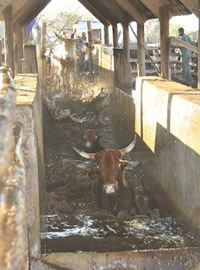
Obert Chifamba
Agri-Insight
IS it strategic ignorance or sheer lack of knowledge when some farmers claim that they are not taking their cattle for dipping because someone, somewhere, told them that dip tanks had in recent times become the nucleus for the spreading of tick-borne diseases and the pest itself?
Or is there something they are trying to communicate?
This is the million dollar question the Department of Veterinary Services should be seized with answering at the moment to curb a potential return to the January disease holocaust that has claimed in excess of 500 000 head of cattle not so long ago.
Department of Veterinary Services chief director Dr Nyika has since threatened legal action against such farmers, saying if they continued refusing to take their livestock for dipping they would be prosecuted, adding that it was mandatory for farmers to take their cattle for dipping to end January disease.
Staff from the department has teamed with Agritex extension officers to launch extensive awareness campaigns on the dangers of not taking cattle for dipping and has been provided with motor cycles to ease mobility challenges.
It is disturbing to note that there are farmers out there who want to pretend not to know the important role of dipping cattle in the battle to eradicate ticks and therefore deliberately distort facts to suit their personal whims.
Such farmers are not only doing themselves a disservice, but shooting down all the efforts the country is making to rebuild the national herd after years of decimation courtesy of a plethora of problems, chief among them tick-borne diseases and droughts.
One sober reality is that the same farmers’ cattle will eventually contract tick-borne diseases and possibly die, which will leave the farmers without one of their most treasured assets.
Essentially, this means that they will have lost a valuable that usually comes to their rescue in times of financial or sometimes social distress in which they will require to either slaughter or sell one or two.
It is time Government revises the current penalties for such offences and make them a bit stiffer and more deterrent so that all stakeholders work together to achieve the goal of eliminating deaths inspired by ticks.
Government recently introduced tick grease through the Presidential tick grease scheme to augment the potency of plunge dips on tick control.
Beneficiaries of the tick grease programme should be taught to apply it effectively so that they begin to see the benefits of using it.
Tick grease is meant to be applied on the tick’s common feeding sites which are the ears, base of the horn, under the tail, and tail brush and is effective when used to supplement intensive cattle dipping programmes.
Improper application of the grease is tantamount to not having used it at all, as it will not make any impact, hence the need for farmers to get expert advice on how it should be correctly administered.
Some farmers are now reportedly in the habit of just spraying their livestock at home while others are applying tick grease alone and not taking their animals for dipping where their full bodies get immersed in the water mixed with acaricides.
Commonly known as Theileriosis, January disease is common between December and March and is spread through the bite of the brown ear tick.
The highest number of cases of theileriosis tend to be encountered in January when traditionally the rainfall activity will be high, hence the common name ‘January Disease.’
Farmers are expected to take their cattle for dipping so that ticks do not mature to the stage of transmitting diseases and also when spraying, farmers should ensure the animal is totally soaked.
The tick greases programme is therefore meant to supplement intensive cattle dipping programmes in areas prone to the disease.
Intensive dipping will require the cattle to be dipped three times in two weeks with tick grease being applied in-between the dipping sessions.
Farmers need to check their cattle 48 to 72 hours after dipping to see if ticks will be dropping, before applying tick grease.
January disease prone provinces such as Midlands and Mashonaland West have not fully recovered from the scourge with fresh cases in which some cattle have died being reported recently.
Mashonaland West, for instance has been hard-hit by tick-borne diseases such as Theileriosis, better known as January disease, red water, heart water and gall sickness and has recorded massive cattle deaths especially from the year 2019 to the present with outbreaks seeming to be continuing.
According to the Department of Veterinary Services, 63 percent of cattle deaths in Mashonaland West province were caused by red water whose clinical signs usually show around two weeks after infection.
Theileriosis on the other hand usually thrives during the months of January and February and has been reported throughout 2021 to date.
While it would be folly to attribute all tick-borne inspired cattle deaths to arrogant farmers, it is only fair to also look at the failure by the Department of Veterinary Services to adhere to the dipping calendar due to the unavailability of dipping chemicals as one of the major contributing factors.
Such a situation has naturally resulted in the department failing to control tick populations in both communal and resettlement areas with farmers consequently failing to adhere to dipping regulations.
Of course foreign currency shortages have also played a big role in the disruption of dipping cycles even after farmers had paid their dipping levies but the attitude of the farmer still plays a larger role in the entire matrix.
If farmers can work together in their communities to buy chemicals and bridge the gaps that appear when the Department of Veterinary Services fails to get foreign currency to procure chemicals, they will do themselves a solid and save their animals from dying.
The other crucial observation that can easily escape most people’s attention when analysing cattle deaths inspired by tick-borne diseases is that unsanctioned cattle movements are also guilty of spreading ticks even in areas where farmers observe strict dipping regulations.
Farmers themselves should be vigilant and always ask for permits from those bringing cattle into their localities from other areas.
Cattle movements have to involve the Department of Veterinary Services’ authorisation to ensure diseases and vectors are not spread in the process.
The redeeming factor, however, is that not all is gloomy as statistics show that cases have been on the decline in recent seasons.
During the 2019/20 agricultural season, there were 46 715 tick borne disease cases and 33 514 deaths, while in the 2020/21 period, 25 036 cases were recorded and 12 503 deaths, indicating a 62,7 percent decrease in cattle death.



 Online Reporter