

 admin
admin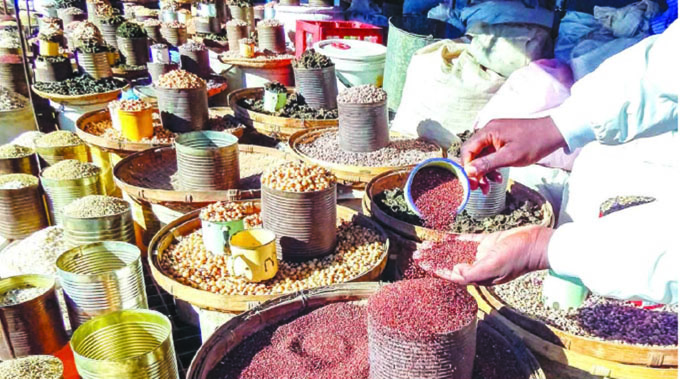
Precious Manomano-Herald Reporter
The area planted under traditional crops this year has increased as farmers diversify to ensure they have more food for themselves and a crop they can sell to the Grain Marketing Board for more money.
The Government’s push not to leave anyone or any place behind in its development programmes will see farmers in dry regions benefiting from value addition of traditional grains with input schemes put in place in areas considered bad for maize farming.
The move, which is anchored in the Traditional Grains Growth Plan that seeks to boost food security and incomes, is also in sync with the country’s vision of becoming an upper middle income economy by 2030.
Traditional grains are crops indigenous to Africa and specially suitable for marginal and vulnerable areas highly susceptible to the changing climate, although farmers in other areas are welcome to grow them as markets develop.
Use of traditional grains, associated with value creation in the agro-processing segment of the agri-food value chain, will largely benefit farmers in agro-ecological regions four and five where there are erratic rainfall patterns.
According to the pre-harvest crop, livestock and fisheries assessment for the present summer season by the Ministry of Lands, Agriculture, Fisheries, Water and Rural Development, farmers planted 180 661ha of pearl millet compared to 157 634 ha last year. Finger millet planting stands at 33 208ha compared to 21 242ha last year, groundnuts is at 331 262 ha compared to 261 758ha last year and bambara nuts jumped to 131 421 ha compared to 120 203ha last year.
Farmers also planted 55 944ha of soyabean compared to 51 488 ha last season and sorghum stood at 319 759ha compared to 344 882.
Under the Presidential Input Scheme (Pfumvudza/Intwasa programme) this season, the Government was targeting 312 890ha under traditional grains such as sorghum and pearl millet with a projected combined yield of 318 383 tonnes. This followed a decision to dramatically lower the risk of a wipe-out of crops in the drier zones by ensuring that all Government input support in those zones was moved from maize, where most years the crop will fail, to traditional grains, where some harvest is guaranteed.
Recently, Agricultural and Rural Development Advisory Services (ARDAS), chief director Professor Obert Jiri said the crop condition and situation is much better than last year, adding that the northern part is much better in terms of maize and the southern part is much better in terms of traditional grains.
The value attached to traditional grains had been so low that some were viewing the crops as varieties for the vulnerable.
But traditional crops such as sorghum, millet and rapoko are slowly becoming popular as people are becoming aware of their high nutritional value and improvement in technology which has seen the introduction of machinery for processing them.
Zimbabwe Indigenous Women Farmers Association Trust president, Mrs Depinah Nkomo said most farmers were now considering traditional crops because of favourable returns.
“I encourage farmers to grow traditional grains as they perform better than maize and grow even under drought. We are also sure of food security if we also prioritise traditional grains farming,” she said.
Recently, Zimbabwe Commercial Farmers’ Union president Dr Shadreck Makombe said farmers were diversifying to traditional crops because of their higher demand on the market and the awareness campaigns being carried out on the importance of healthy foods. “More people are now health-conscious with some restaurants now even serving traditional foods. Long back, demand for traditional food was low, as the food was perceived to be for the poor. Now the affluent are the ones who demand traditional food and this has increased the demand for the food on the market,” he said.
Production of crops this season was financed through the Government’s Pfumvudza/Intwasa programme, private sector contracts and self-financed farmers.



 Online Reporter