dyton mupawaenda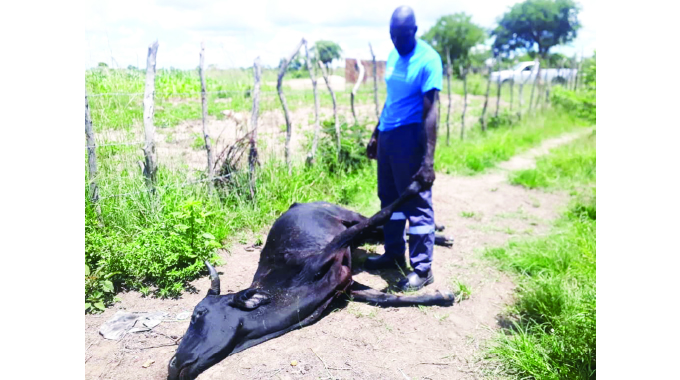
Obert Chifamba–Agriculture Editor
WITH the tick-borne disease Theileriosis expected to reach its peak in January, (hence the name January Disease), Government has urged farmers to be extra vigilant and regularly inspect their cattle for the presence of ticks while religiously following their dipping calendar.
This comes as the country moves to avoid a repeat of recent seasons in which close to a million cattle were lost to tick-borne diseases prompting the Government to introduce a raft of measures that included the adoption of the 5-5-4 dipping rota, the Presidential tick-grease programme and the construction and rehabilitation of dip tanks across the country.
According to the Ministry of Lands, Agriculture, Fisheries, Water and Rural Development’s Farmer Advisory notes issued on Friday, cattle dipping remains the single most effective control measure against all ticks and tick-bone diseases, hence the need to remind farmers that dipping of cattle is mandatory by law and cattle should be dipped at least once a week to control ticks and tick-borne diseases during the rainy season.
“The rains are now upon us. Most parts of the country are receiving good rains to support cropping and pastures. The good rains, however, bring with them an increased activity of ticks resulting in tick-borne diseases such as the notorious January Disease affecting cattle if not prevented,” read the notes.
Dipping should be repeated when cattle are rained on within 24 hours of dipping. They should also be inspected for ticks two to three days after dipping, especially inside the ears, under the tail, on the udder and the tail brush.
The Ministry further urged farmers to apply tick grease on these tick feeding sites in between dipping sessions and inspect their cattle twice a day – in the mornings and evenings for any signs of illness (depression, weakness, off feed and lagging behind) and report immediately to the nearest veterinary office.
January Disease is a notifiable disease in Zimbabwe and if a farmer suspects it on his/her farm, he/she is compelled by law to report this to the Department of Veterinary Services (DVS). The disease is controlled through legislation, Animal Health (Theileriosis) Regulations, 1976.
In the event of an outbreak, a quarantine order is instituted for 28 days with a 5-5-4 dipping interval effected concurrently with the application of tick grease during that period.
“Early reporting improves treatment success rates, but prevention is better than cure as treatment outcomes are not always successful. Farmers should bring all their animals for dipping to avoid unnecessary, preventable cattle deaths. By operation of the law, anyone who does not dip their cattle, or whose cattle are tick infested, can be prosecuted,” the communiqué warned.
January disease is a disease that usually affects cattle. It is common between December and March. Of late it has been known to occur all year round but increases significantly as from November, reaching a peak in January.
It usually occurs in high rainfall areas and also in low rainfall areas such as Chiredzi where it is transmitted from buffaloes.
It can be controlled through regular dipping and tick grease application, vaccinating animals and allowing minimal exposure to ticks during low risk period to encourage building of immunity in calves.
Farmers must work closely with their veterinarians to get the best advice for their circumstances. The use of anti-parasitic drugs can be effective if treatment is done early while reducing stress on affected animals is very important to control the severity of the disease and the number of animals developing clinical signs.
This can be achieved through milking cows once a day, minimised handling, walking cattle at their own pace, where necessary, good quantity and quality of feed and maintenance of optimal trace element levels.
It is also crucial to minimise nutritional or disease stress to animals to reduce chances of animals developing severe disease while ensuring good nutritional and health status of calves during the first year of life.
To become infected cattle must be bitten by a tick, which is carrying the disease.
Theileria is not spread by direct animal-to-animal contact and does not affect other species, or humans. It is spread through the bite by the brown ear tick.
Animals affected by the diseases are usually noticeable through swelling of the lymph nodes under the ears and on the shoulder, cloudiness of the eyes, difficult breathing with froth exuding from the nose and the mouth, weakness, pale or yellow (jaundice) mucous membranes, that is, the gums, inside the vulva and the white around the eye.
The animals also show signs of depression, do not eat, lose weight or condition, become prone to abortions and produce low milk volumes. They eventually collapse and die.



 Online Reporter