Chronicle Editor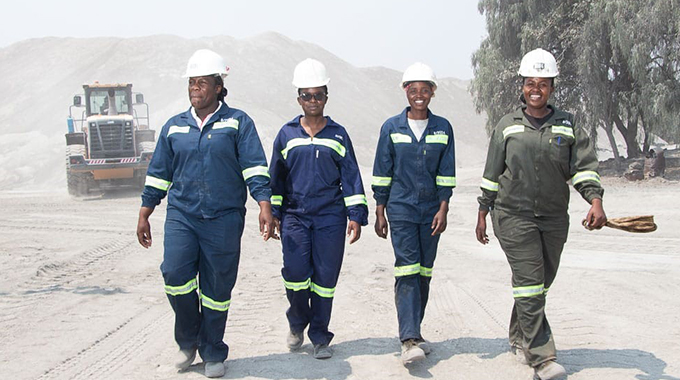
Nqobile Tshili, [email protected]
THE thriving infrastructure development under the Second Republic, coupled with an enabling environment at Bulawayo-based Asphalt Products, has created fertile ground for female engineers to excel in road construction.
The Government’s increased investment in road rehabilitation projects has placed local companies at the forefront and empowered local professionals, including female engineers, to showcase their skills.
While in most companies female engineers are rarely given the lead role, Engineer Francis Mangwendeza, the founder and chief executive of Asphalt Products, has taken a bold step to provide female engineers the limelight to lead major production lines within the civil construction company. Mangwendeza has no regrets in entrusting the female staff, saying they have proven beyond doubt their capabilities.

“We have taken a deliberate policy where we employ females and train them. For example, our asphalt plant based at Davies Granite is probably the only one run by an all-female team. The manager and the operator there are both female. It has worked out very successfully for us. Even on the civil side, 50 percent of our employees are female,” said Mangwendeza. He said his wife influenced him to trust female professionals to lead projects.
Youthful chemical engineer Catherine Mkandhla, a production manager with Asphalt Products in charge of bitumen emulsions and premixes, said infrastructure development projects have enabled her to prove herself in the industry.
“The increase in the number of construction projects during the tenure of the Second Republic has seen an increase in the demand for our products, particularly premixes, which led to the acquisition of two more asphalt plants (a 20-tonne per hour and subsequently an 80-tonne per hour plant). I was given the opportunity to spearhead the installation and commissioning of these two plants, which gave me a chance to work with a team of diverse skills,” said Mkandhla.

“This increase in the level of activity stimulated growth and necessitated hiring more workers. Slowly but surely, female skilled workers began to take up the challenge and fill the gaps that had been created. This created a ripple effect as more women are beginning to realise if we did it, they can also do it.”
She said she leads a dynamic team of women who ensure that the country receives value for money on road infrastructure development projects.
“Currently, I am leading a team of five ladies drawn from various engineering disciplines. Two are from automotive engineering.
“A diesel plant fitter who does repairs and maintenance of our mobile and fixed plants and an auto-electrician who takes care of all our electrical systems. We outsource the services of a female instrument and control technician,” she said.
“We also have a female Asphalt plant operator who ensures production is done in line with mix designs stipulated by road design engineers. We have a civil engineer who conducts tests on all our products to ensure they comply with quality standards.”
Mkandhla, who is also a member of the Zimbabwe Institution of Engineers, said mentoring other female professionals was important for promoting gender inclusivity in a male-dominated field.
“This is a call I do not take lightly and intentionally ensure we share our knowledge and expertise with young new employees and women. Having women in leadership positions creates role models that will inspire inclusivity and go on to become mentors to future female leaders. In order to promote fairness, it is very critical to have women in leadership positions as it closes the gender gap in decision-making processes.
“Women ought to participate in making decisions that affect them. Furthermore, women bring in different perspectives and experiences that will help in constructing a more diverse and rich organisation. Various studies have shown that gender-diverse organisations tend to perform better financially, realising more profits.”

She commended management at Asphalt Products for creating an enabling environment ensuring that women can express themselves without hindrance.
“The company has created a safe working environment where discrimination, bullying, harassment, and any other ills against women are not tolerated. This is ingrained in our company policies and every employee is made aware during induction.
“Moreover, maternity leave is given and nursing mothers are given flexible work arrangements. We also have access to equal opportunities as our male colleagues.
The presence of women in various departments across the board is a testament to that,” she said.
Mkandhla is celebrated by her subordinates for her leadership qualities, with asphalt production controller Thenjiwe Luphahla, who initially worked as a general hand, saying she was inspired by her and requested to be taught how to run the control room.
“Mostly these things are done by men and as women we are very few in this industry. Being a lady in this industry is challenging but also motivating. Thanks to engineer Mkandhla, she is the one who inspired me. After seeing her work, I requested that she teach me and she held my hand and took me through all the processes up until now I can operate on my own,” said Luphahla.
Luphahla said working with men who are general hands sometimes comes with challenges, especially when she is supposed to give them instructions.
“Working with men is a bit of a challenge. Those societal expectations that women should be submissive to men is a challenge. Now I can stand my ground. We have a lot of men who are here providing menial labour and giving instructions to them is a challenge. But I have to be firm for them to work and also for me to complete my tasks,” she said.
One of the male trainees at the asphalt production plant, Simon Sibanda, a student at Bulawayo Polytechnic, lauded being under female mentorship, saying he has been able to learn more.
“I’m studying for my national diploma and I’m in my final year. I work under the supervision and mentorship of Catherine Mkandhla. Under her leadership, I think I have been able to grasp more than what I learnt during my third year. She is fierce but kind and is always willing to teach us more,” said Sibanda.
Mangwendeza said while the company has provided more females to lead the technical works, he is still encouraging them to take general labour as part of gender inclusivity.
“We have a female engineer running a project for us in Plumtree. Our administrative staff is composed of 50 percent females and we also try and encourage females to join our general labour force where they can.
‘But there isn’t interest there because some of the work that we do is masculine and needs the male species more than the female species as strength is needed to execute it. But there are some areas where females can excel.
And it is our hope and wish that as we move forward we see a balance in the technical spheres,” said Mangwendeza. — @nqotshili



 Online Reporter