Online Reporter
Sukulwenkosi Dube-Matutu, [email protected]
AS the festive season approaches, worry weighs heavily on Ms Nonhlanhla Ndlovu, a mentor for young girls on HIV-related issues in Bulilima District. Her concern stems from the heightened risks of HIV and sexually transmitted infections (STIs) that typically surge during this period.
She is racing against time to complete her syllabus and ensure her class is equipped to withstand the pressures that come with the return of injiva.
Ms Ndlovu said the festive season brings numerous social events that pose risks for young girls, including soccer tournaments and overnight parties. She said that, out of desperation, some girls engage in unprotected sexual activities during this time, putting them at risk of contracting HIV and STIs in exchange for money or small gifts.
Meeting her group weekly, Ms Ndlovu discusses a range of HIV-related topics with non-school-going girls aged between 10 and 24 who undergo a year-long training programme. She has served as a mentor for four years.
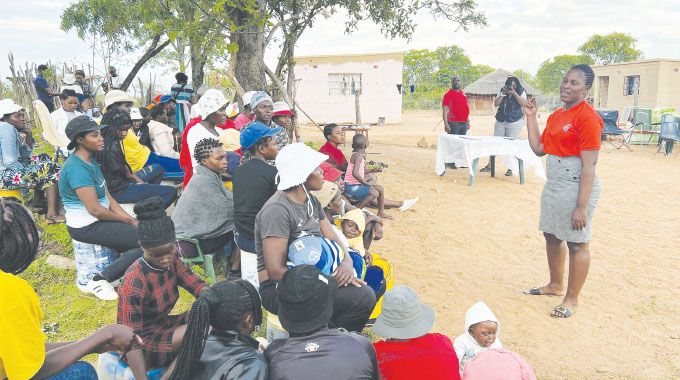
“As the festive season approaches, I get worried because the girls are faced with a lot of temptations, which arise when the injivas come back. There are a lot of social events that take place during the festive season, such as sports tournaments, parties and shows. The young girls attend these events and end up engaging in sexual activities sometimes without protection,” she said.
“This exposes them to HIV and STI infections and even teenage pregnancies. Through my Sista2Sista sessions, I try to empower the young girls with information that can assist them to make responsible decisions such as condomising, using contraceptives and saying no.”
Ms Ndlovu said various factors, such as poverty, lack of parental guidance and limited knowledge, expose girls to sexual exploitation. She takes 50 girls per year through her mentorship sessions and has seen a positive shift in their behaviour.
She said her role is to guide the girls through topics that equip them with knowledge to make informed decisions that help protect them from HIV and other risks.
Educating adolescent girls and young women is a key strategy in the fight against HIV and Aids, with the National Aids Council (NAC) implementing several initiatives, including the Sista2Sista model. Under this programme, ambassadors are trained to mentor groups of 50 girls and young women.
The Sista2Sista programme provides a safe space where girls meet with mentors and one another to discuss their challenges. They learn about sexual and reproductive health and rights, financial literacy and how to navigate complex social situations, including coercive relationships.
NAC Bulilima District Aids Co-ordinator (DAC), Mr Ronald Hanyane, said HIV education and targeted programming are critical as adolescent girls and young women remain the most affected demographic.
Bulilima District has the highest HIV prevalence rate in the country at 17,6 percent.
The district’s estimated HIV incidence is 0,26 percent, higher among females at 0,38 percent compared to 0,17 percent for males. Youths aged 20 to 24 accounted for most new STI cases recorded between January and August this year. According to NAC statistics, 186 cases were recorded in this age group — 93 males and 93 females.
In the 25 to 29 age group, 162 new STI cases were recorded, with males contributing 92 and females 70. For teenagers aged 15 to 19, 109 cases were recorded, comprising 66 females and 43 males. Among adults aged 30 to 34, males accounted for 61 STI cases and females 38.
Adolescent girls aged 15 to 19 also accounted for the majority of Antenatal Care (ANC) bookings in Bulilima, making up 33 percent of the total. Young girls made up 400 of the 1 207 bookings, while 18 bookings were recorded for children aged between 10 and 14 from January to August.
“The high HIV incidence rate and high STI cases among adolescent girls and young women, as well as adolescent pregnancies and child marriages, continue to be a concern in our district,” said Mr Hanyane.
“That is why we have programmes such as the Sista2Sista model, which is targeted at girls and young women between the ages of 15 and 24 years.
“The statistics that we have as a district are a clear indication that adolescent girls and young women face the highest risk when it comes to HIV infections. That’s why it’s important to have programming that is targeting youngsters, such as the Sista2Sista programme.” — @DubeMatutu