admin
admin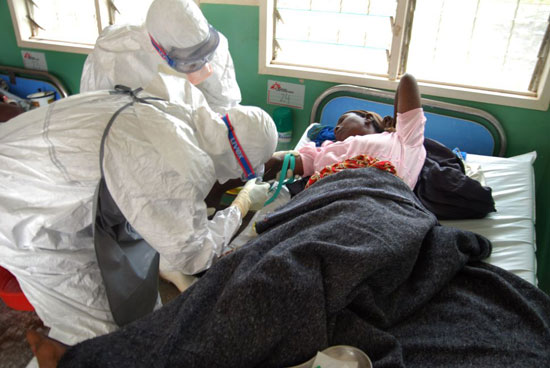
Geneva. — Global aid agency Doctors Without Borders said yesterday it would begin unprecedented trials on patients in west Africa to test Ebola drugs and the use of survivors’ blood as therapy.
The trials in Guinea are aimed at rushing out an emergency therapy to battle an epidemic which has taken more than 5 000 lives since December.
“This is an unprecedented international partnership which represents hope for patients to finally get a real treatment against a disease that today kills between 50 and 80 percent of those infected,” said Annick Antierens, who is coordinating the trials for the medical charity, known by its French initials MSF.
The first trials are due to start in December and results could be available by February next year, MSF said.
Ebola, transmitted through bodily fluids, leads to haemorrhagic fever and — in an estimated 70 percent of cases in the current outbreak — death.
There is no specific treatment regime and, as yet, no licensed vaccine —although one of the leading candidates, known as ChAd3 and made by Britain’s GlaxoSmithKline, is being tested in Mali and elsewhere.
Patients’ best chance of survival, if their condition is caught early enough, is taking paracetamol for their fever, rehydrating and being kept well nourished.
The French National Institute of Health and Medical Research (INSERM) will trial antiviral drug favipiravir in Gueckedou, southern Guinea.
Meanwhile, the Antwerp-based Institute of Tropical Medicine (ITM) will lead trials of “convalescent whole blood and plasma therapy” at MSF’s Donka Ebola centre in Conakry, Guinea’s capital.
MSF is in discussion for a third trial, on antiviral brincidofovir, in Liberian capital Monrovia but has not yet been given the green light.
The drugs have been shown to work on other viruses, but not Ebola, Antierens told AFP.
“Either it is very efficient, and then it is a miracle drug . . . (or) it is not efficient at all, and this is very much possible. We have reason to believe that that is not the case, but it is still very much possible,” she added.
She added that there could be “an intermediary result, whereby it’s promising and we’re not sure if it will be efficient for every patient”.
Ebola, which emerged in Democratic Republic of Congo in 1976, is one of the most aggressive pathogens known to humankind, and victims tend to die a few days after showing symptoms. — AFP.


 Online Reporter