Online Reporter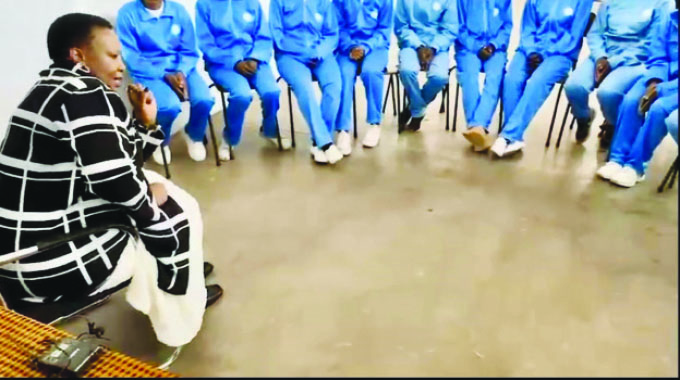
Blessings Chidakwa-Herald Reporter
FIRST Lady Dr Auxillia Mnangagwa recently held a heartfelt, soul-searching motherly session with female drug survivors at Angel of Hope Drug and Rehabilitation Centre in Mbare, where they bravely shared their harrowing journeys into addiction and their fight to break free.
The mother of the nation listened intently, her presence warm and encouraging, as the women recounted how drugs pulled them into a dark world they never imagined they would enter.
Their stories, cutting across backgrounds, shared a common thread that drugs do not discriminate by gender, touching the lives of young women across all walks of life.
Among them were a qualified teacher, a tertiary education dropout in her final year, beauticians, entrepreneurs, mothers and wives.
In this intimate and heart-to-heart session, these brave survivors not only bared their wounds, but also had their hope rekindled by their recovery and the unwavering support of leaders like the First Lady, who opened the Angel of Hope Drug Rehabilitation Centre.
Inside the tranquil halls of the centre, a motherly figure, Dr Mnangagwa, sat in a close circle with a group of 16 young women undergoing their rehabilitation journey. All spoke of the havoc addiction wreaked, hallucinations of snakes crawling in their rooms, violent outbursts, undressing in public, miscarriages, and fractured marriages.
The young women opened their hearts and shared painful stories, confessions of broken girlhoods, stolen futures and lives nearly lost to the ruthless grip of drugs such as crystal meth, dagga, broncleer and alcohol abuse.
Their voices, steady yet raw, told of once broken dreams, lost careers, and shattered families all shattered by the grip of addiction.
One by one, the young women spoke, some holding back tears, others speaking with trembling resolve as they narrated how their lives had spiralled into chaos. A woman from Norton, who once battled a severe addiction to crystal meth, recounted the disturbing hallucinations she used to experience.
“My husband was the one who would wake me up to take the drugs. We would go four to five days without sleep,” she said.
“I used to hallucinate; sometimes I would see a snake in the room. Whenever I saw it, I would chase everyone out, including my seven-year-old child. I would become violent, even assaulting my parents and siblings.” She smiled as she shared how far she had come.
“Since coming here, all of that is now in the past. I’m truly grateful to the First Lady for transforming my life.”
Another survivor, a 26-year-old woman from Kuwadzana who dropped out of tertiary education, spoke about how alcohol abuse, especially drinking toxic, illicit brews known as tumbwa, nearly destroyed her life.
“I couldn’t go a day without drinking. When I got drunk, I would dance in bars and go home with strangers. On my worst days, I would undress in public only to realise it when I sobered up,” she confessed.
“I would wake up trembling, with a splitting headache and nausea. I couldn’t eat, and when I looked in the mirror, I no longer recognised myself. My skin had lost its glow and my health was deteriorating.”
Now, however, she beams with hope.
“Today, I have an appetite, one plate isn’t enough! My skin is healing and I am regaining my natural complexion. I am so grateful to the First Lady for giving me this second chance.”
A 24-year-old woman from Chitungwiza shared how drug abuse and an abusive relationship led to deep depression and a stillbirth.
“I used to lock myself in a dark room for days, just me and the drugs. I cut myself off from the world. Even my child I left her with my parents and would go days without checking on her,” she recalled.
“One day, my boyfriend hit me with a hammer, breaking my leg. The relationship was toxic, but I stayed in it just for the love of drugs.”
Her life has now taken a positive turn.
“Since coming here, I have changed completely. I now talk to people, I am confident again, and I feel healthier. The First Lady gave me my life back,” she said with a smile.
A woman from Gokwe said drug abuse made her aggressive and disrespectful to her family.
“I would take drugs, then return home at 3am, while everyone was asleep. I would wake them up, demanding food. I was so stubborn that no one could tell me what to do.”
She added, “I was married, but the marriage collapsed. My in-laws feared my violent behaviour.”
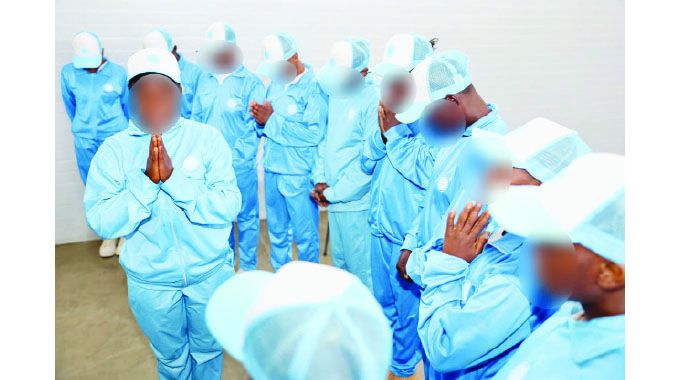
Female patients at Angel of Hope Drug rehabilitation centre say a word of prayer during their intercative meeting with First Lady Dr Auxillia Mnangagwa in Mbare.
A 26-year-old teacher shared how her life spiralled after a friend convinced her to leave her job and travel to a neighbouring country.
“I ended up working at a massage parlour during the day and doing night shifts too. I complained about being tired and they gave me an unknown substance to keep me awake,” she said.
“After that, I felt like I didn’t need sleep anymore, but I started having hallucinations, hearing voices from nowhere. I nearly died from an overdose and had to be admitted to the hospital.”
A 31-year-old woman from Mabvuku, who abused BronCleer, said drugs ruined her life despite having a loving and supportive husband.
“I used to go to work, but I started skipping shifts and eventually quit altogether. My husband kept trying to help me, he even gave me money to start a business and sponsored trips abroad, but I wasted everything,” she said.
“At one point, I started cheating on him with a foreigner who gave me money to support our child. But instead, I spent it all on drugs.”
First Lady Dr Mnangagwa said she came in her capacity as a mother with a desire that women will now make it in life.
“The bond between a mother and her children is unbreakable. A mother is always concerned about her child’s needs for shelter, food, and clothing,” she said.
“Each time I come here, it is because you are always on my mind. My heart aches for you. Be patient during this rehabilitation phase; it is a process, not a punishment.”
Dr Mnangagwa encouraged the women to remain strong and resilient, reminding them that success does not come on a silver platter.
“A woman must never be a slave to her circumstances. Do not accept failure, fight to overcome every obstacle,” she said.
The First Lady also warned them against returning to destructive habits, urging them to let their changed behaviour serve as a testimony of hope and transformation for others.
“You are the first role models from this centre, showing that a woman does not belong on the streets where she is vulnerable to abuse. Do not let your body be treated like a toilet, used by everyone.”
“Value yourself. Your body is sacred. There is a bright future ahead of you. Let your natural talents flourish. Some of you wanted to run away when you first arrived, but now you have just a few days left to endure, because greater things lie ahead.”
Dr Mnangagwa also urged them to stay connected to institutions such as churches, where they can be guided and moulded positively into society.
The trendsetting Angel of Hope Drug Rehabilitation Centre, opened by the First Lady, Dr Mnangagwa, is situated at the Stodart Arena.
It accommodates up to 200 patients, providing a secure environment with a holistic approach blending social amenities, basic education, medical treatment, social support through counselling, and rigorous physical activity.
Under the guidance of trained coaches, patients engage in workouts and therapeutic interventions aimed at naturally flushing toxins from their bodies, while simultaneously tackling behavioural issues including rebelliousness and disrespect.