

 admin
admin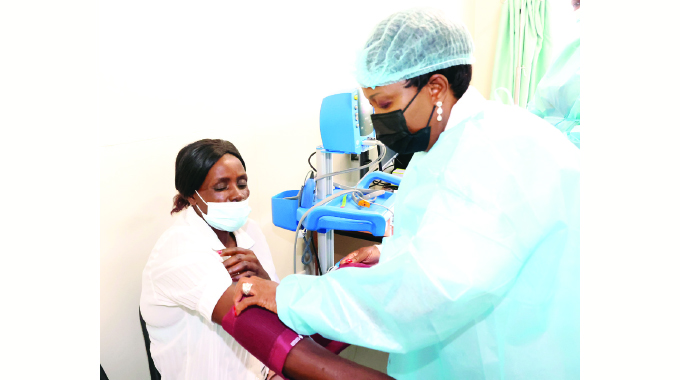
Tendai Rupapa Senior Reporter
HEALTH Ambassador First Lady Dr Auxillia Mnangagwa, who obtained a Certificate in Industrial Basic First Aid from the Zimbabwe Red Cross Society, yesterday visited the recently opened Stoneridge Health Centre in Harare where she attended to patients and interacted with the community to create awareness on non-communicable diseases (NCDs).
NCDs, such as heart disease, cancer, chronic respiratory disease, and diabetes, are the leading cause of death worldwide and represent an emerging global health threat. Clad in her Red Cross uniform, Dr Mnangagwa listened to queries from patients while writing them on the patient’s card, checked their pulse, temperature and blood pressure which she recorded before referring them to the doctor’s room for treatment.
Amai Mnangagwa is committed to saving lives as witnessed by the various programmes she undertakes countrywide, therefore, the first aid training equipped her with the requisite knowledge to provide basic care for patients anywhere, anytime.
During her studies at the Red Cross, she underwent the lifesaving skills training through theory and practical such that yesterday she effortlessly conducted her duties at the health centre and the patients she served were satisfied with her services and know-how of health issues and general equipment.
The state-of the-art health centre which was opened by the President in May this year, boasts consultation rooms, female/ male wards, a paediatric ward, prenatal and postnatal ward, Labour ward, theatre room with datex anaesthetic machine, an imaging room, rehabilitation rooms and a pharmacy.
People were also being tested for Covid-19 and being vaccinated, HIV testing, among many other health checks.
After touring the facility and attending to patients, Dr Mnangagwa had an interface with the community.
In her remarks she said it was pleasing to note that the Government’s thrust was to continue to improve healthcare facilities throughout the country and ensure the whole nation runs with the President’s mantra, “leaving no one behind”.
“Through the Government devolution programme, development continues to take place in the Harare Metropolitan province as evidenced by the construction of an administration block at Mabvuku Polyclinic.
“I am reliably informed that Mabvuku Polyclinic previously experienced water shortages, but this is now a thing of the past as the clinic now has sufficient boreholes running water.
“Going around this institution you will note that Stoneridge Health Centre is well equipped with state-of-the-art equipment, with a capacity of 20 beds to cater for male, female and children’s wards, a theatre, and a maternity wing. Residents of Stoneridge should be excited because this world-class facility is the first of its kind and is a replica of those that are being rolled out to all districts of the country, notably all the rural districts.
“Imi veStoneridge ndimi maita nhangaruvanze, matungamira panyaya dzehutano (You Stoneridge residents have become the pioneers in health issues).
“This is a state-of-the-art facility. It is yours and you should take good care of it. It is well equipped hapana chisimo (everything is here),” she said to applause.
The Government’s focus on good health for all Zimbabweans, the First Lady said, is noted through developmental programmes in the province, such developmental programmes include works such as construction of a dental clinic at Tariro Clinic, laundry equipment installed at Beatrice Infectious Diseases Hospitals and incinerators constructed at Hatcliffe, Mbare, Beatrice and Wilkins hospitals.
To further show that more development was taking place in the province, the First Lady said land had been identified for the construction of two new clinics in Chitungwiza and three new clinics were under construction in the Harare City Council domain that is Chitubu, Marlborough and Sunningdale as well as construction of Mabvazuva Clinic in Epworth, which was now finished and awaits equipment to be operational.
“Izvi zvinoratidza kuti hurumende yedu inokoshesa nyaya dzehutano. My visit today is aimed at ensuring that Stoneridge community and the Zimbabwean population at large are made aware of the various non-communicable diseases (NCDS) that can easily be controlled but are killing many people due to ignorance and sometimes late screening.
“Non-communicable diseases (NCDS), include hypertension (BP), diabetes mellitus, cancer of the breast, for both men and women, cancer of the cervix, mental health, prostate cancer and chronic respiratory diseases. People with high blood pressure are at risk of heart diseases or stroke. Therefore, it is important for us to have constant health checks. It is also important to utilise screening, prevention and treatment services early.
These are the leading cause of death worldwide and represent an emerging global health threat. Deaths from NCDS now exceed all communicable disease deaths combined. This is why i came today to raise community awareness. Utilise health centers around you,” said.
The high burden of NCDS among working age group, she said, leads to high healthcare costs, limited ability to work, and financial insecurity.
“NCDS can affect vulnerability to illness, and the ability of the health systems to handle health threats. High rates of NCDS perpetuate poverty, strain economic development, and burden fragile health systems, making countries less resilient when emergencies, like infectious disease outbreaks or natural disasters, occur. Integrating non-communicable diseases in global health security approaches is important in addressing emergencies and ongoing health needs, increasing health equity, and building trust among partners.
“Some important facts to note about NCDs include, every two seconds, a person dies prematurely from an NCD, 85 percent of premature deaths occur in low- and middle-income countries. Low- and middle-income countries are estimated to surpass $500 billion per year in economic losses due to ncds.
“Every $1 invested in proven ncd interventions in low and lower middle-income countries will generate at least $7 in increased economic development or reduced health care costs by 2030, tobacco use, physical inactivity, the harmful use of alcohol and unhealthy diets all increase the risk of dying from an NCDS.
“Detection, screening, and treatment of ncds, as well as palliative care, are key components of the response to ncds,” she said.
Non-communicable diseases (ncds), also known as chronic diseases, she added, tend to be of long duration and are the result of a combination of genetic, physiological, environmental and behavioral factors.
She said people of all age groups, regions and countries are affected by NCD’s.
The First Lady encouraged people to observe Covid-19 protocols of masking up, washing hands and observing social distance.
“Covid-19 is still prevalent. Let us remind ourselves that the Covid-19 virus is still with us. We should be vaccinated and get the booster shot. Myself, I got all my three jabs. Vaccines are there to protect your health to prevent diseases. Let us all follow the protocols to keep the virus at bay. We grew up being vaccinated against diseases, the same with Covid-19 vaccines. Do not listen to what some people say against vaccination on social media. I urge you to have constant health checks against diseases, including NCDs so that you commence treatment early,” she said.
Dr Mnangagwa urged communities to eat healthy traditional foods and dry vegetables like pumpkin leaves for future use.
Amai Mnangagwa took time to discuss with the community on social issues affecting them.
An elderly woman decried poor dressing among young girls of today.
“We are sick and tired of our daughters who are walking in the nude. Even in the presence of their fathers they wear mini skirts. They can’t sit properly and the boys are ruined by drugs. Thank you for coming to teach and talk to us and our chidren,” she said.
The First Lady weighed in saying: “As mothers we are worried vanasikana because you resemble us and when you walk in the nude you embarrass us. We want you to be well-behaved.”
An elderly man said children of nowadays were dressing badly in the name of fashion.
“These children’s dressing is difficult to understand, all in the name of fashion. They say they are moving with the times and we are ancient. Does modernity mean we throw away our culture as blacks? The boys are putting on five trousers at once. We wish you continue with your Nhanga/Gota/Ixhiba programme,” he said.
“Where is mutoriro coming from? It is ruining our children,” the First Lady asked.
A drug survivor opened up.
“I am a drug survivor Mhamha. I took mutoriro and brains were affected. When taking mutoriro you inhale the smoke and not swallow because if you swallow you go mad,” he said.
Mrs Tracy Mazhambe said children were making drugs in boarding schools.
“Boarders are making drugs. They burn soap and inhale the smoke. We also heard that they are mixing certain cereal and certain juice and leave the mixture to ferment before drinking it. We are sitting them down before they leave for school teaching them good morals,” she said.
The First Lady said it was imperative for community members to watch over their children and also fish out those selling drugs.
“Let us all be police officers in our communities and work with the police to end the drugs menace. As parents let us have time with our children teaching them good manners. Let us follow our culture. If a neighbour counsels your child, do not take offence because the child belongs to all of us.”
She encouraged drivers to follow road rules and promote safety during the holidays.
Stoneridge Health Centre Matron Getrude Zhakata paid tribute to the First Lady for her visit.
“Amai came and attended to the sick who were happy with the work she did. She did BP and temperature checks, weighed the sick before directing them to the doctor and where they were supposed to collect their medicines.
“She emphasised that regular health checks are critical. As nurses we never told her what to do but she was doing it alone showing that she grasped what she was taught at Red Cross. Speaking with the community, she made it clear that people must consume healthy food and shun drugs like mutoriro which ruin people’s lives,” she said.
Some of the patients who were attended to by the First Lady shared their experiences.
Ms Shorai Kunyenya said: “I came here sick and was attended to by the First lady who did a BP, temperature and pulse checks. She took notes from what I told her regarding my sickness before referring me to the doctor.
“The First Lady showed great knowledge of what she was doing. As a woman, I am inspired by her and would like to enroll with Red Cross so that I can help people, including my immediate family,” she said.



 Online Reporter