Online Reporter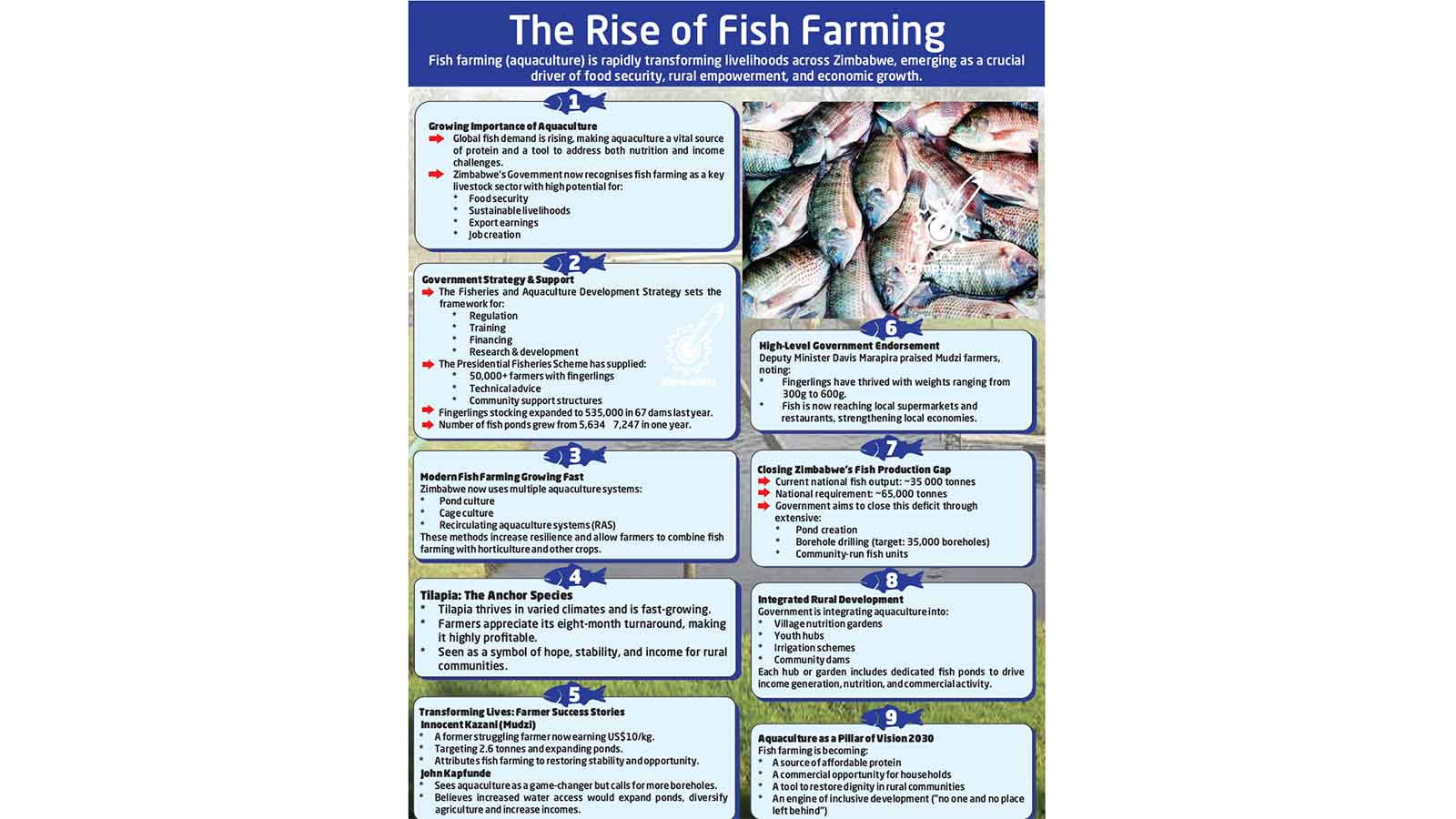
Precious Manomano-Herald Reporter
FISH farming has increasingly become a transformative force in Zimbabwe, improving the lives of local communities and opening new avenues for economic development.
With the rising global demand for fish, aquaculture is emerging as a vital source of protein, addressing both nutritional needs and economic challenges.
The Government’s concerted efforts in this sector not only tackle food security, but also empower Zimbabweans to innovate and create sustainable livelihoods.
Government has recognised aquaculture as a critical form of livestock production with immense potential to contribute to sustainable livelihoods, food security and economic growth through diverse export earnings.
The Fisheries and Aquaculture Development Strategy aims to provide a comprehensive framework focusing on regulatory measures, capacity building, financing mechanisms, and research and development to ensure the sustainable growth of the aquaculture sector.
Historically, fish farming has roots tracing back to ancient civilisations in China, Egypt and Rome.
However, modern advancements have revolutionised these practices, making them more efficient and viable.
The Second Republic of Zimbabwe is committed to ensuring that fish farming aligns with the nation’s broader development agenda. This includes leveraging refurbished irrigation schemes and community gardens to create viable commercial fishing hotspots across the country.
The Presidential Fisheries Scheme has played a pivotal role in this growth, providing over 50 000 farmers with essential fingerlings, technical support and guidance.
This initiative encourages various fish species to thrive in Zimbabwean waters. Among the most common is tilapia, which can adapt to a range of climatic conditions and is particularly appealing to farmers for its quick turnaround time.
“Tilapia grows well in almost any weather and can be harvested in just eight months. For many of us, this is not just a fish; it symbolises hope and a path toward stability,” said an enthusiastic tilapia farmer.
Diverse methods of fish farming are utilised in Zimbabwe, including pond culture, cage culture, and recirculating aquaculture systems. Each method brings unique benefits and contributes to increasing food security, particularly in rural areas where traditional fishing may not suffice.
Farmers can establish fish farming operations alongside other agricultural practices, creating integrated systems that foster resilience against climate change and economic hardship.
For instance, Mr Innocent Kazani’s story serves as a testament to the transformative potential of aquaculture. Once a struggling farmer in Mudzi, battling with the harsh conditions of dry terrains, Kazani found hope and stability through fish farming.
“I managed to sell my first batch at US$10 per kilogramme. This is absolutely wonderful,” he said, his eyes gleaming with optimism.
“Fish farming has opened new doors for us. I am now aiming for 2,6 tonnes of fish and plan to add three more ponds. The possibilities feel endless. This is a chance for me, my family, and my community to thrive,” he continued, reflecting on the profound impact that this venture has had on his life.
Another farmer, Mr John Kapfunde, shares a similar narrative, but believes that the potential for growth remains untapped.
“If the Government could intervene by drilling more boreholes, it would significantly increase our capacity to establish even more fish ponds. This would enable us to diversify our agricultural practices and even venture into horticulture. The potential is immense,” he suggested, highlighting the desire for greater support to expand aquaculture initiatives in rural Zimbabwe.
Lands, Agriculture, Fisheries, Water and Rural Development, Deputy Minister Davis Marapira, recently visited the Mudzi projects and described the successes observed there as a beacon of what rural empowerment can achieve.
“What we witnessed here is nothing short of a remarkable success story. The fingerlings we introduced are thriving, allowing farmers to harvest fish weighing 300, 400, 500, and even 600 grammes. This not only benefits individual farmers but creates a ripple effect that strengthens the entire community. Fish from these farms are making it to local supermarkets, restaurants, and community markets, bolstering the local economy.”
Despite these advancements, Zimbabwe faces a national fish production deficit, with current output hovering around 35 000 tonnes, significantly below the national consumption requirement of 65 000 tonnes.
He said Government is pulling out all stops to ensure that fish farming grows to contribute effectively to the national agenda of boosting food and nutrition security and income generation in line with the fisheries and aquaculture development strategy.
“We are pulling out all the stops to make sure fish farming contributes to our development agenda, a strategic move that has led to an increase in the number of fish ponds from 5 634 last year to 7 247.
Government is promoting fish farming through pond systems and innovative water management strategies that can effectively support both aquaculture and broader agricultural practices.
Presidential Fisheries Programme is evolving into a community-led movement that significantly improves the lives of Zimbabweans. By providing food security and economic opportunities, this initiative fosters a climate of hope where families can invest in their futures.
With the successful stocking of 535 000 fingerlings across 67 dams last year, this programme is helping families put food on the table, send children to school, and restoring dignity in communities that have long been neglected by development.
The commitment to aquaculture in Zimbabwe is reshaping lives, turning challenges into sustainable opportunities, and paving the way for a future where fish farming is a vital component of national growth and resilience.
Dams, ranging from small farm dams up to major national projects were originally built for power, irrigation or urban water supplies, but will now be used more fully by introducing fish farming.
The Presidential Fisheries Scheme is aimed at improving access to affordable protein at household level, while enabling commerce from the sale of surplus production.
Government will establish business units at youth hubs, village nutrition gardens and irrigation schemes all with a fish production component, to promote a business approach to agriculture and leave no one and no place behind.
Fingerlings will be distributed riding on the Presidential Borehole Scheme targeting to sink 35 000 boreholes countrywide.
Village business hubs will each have their pair of fish ponds.
The introduction of community gardens that accommodate two fish ponds and the dams being built across the country have opened many opportunities that have the potential to turn commercial and generate income for the participating households.