malvernmugadzikwa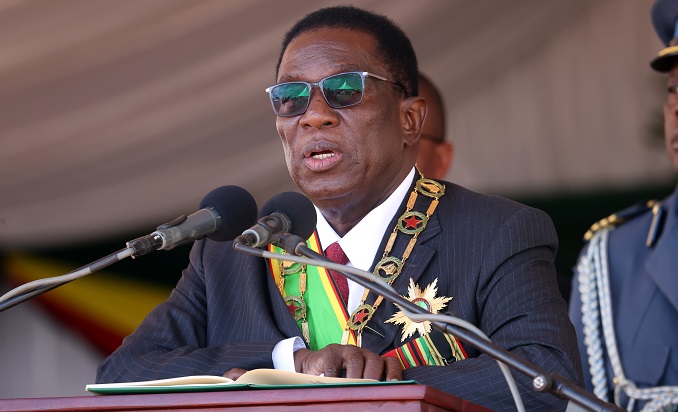
Zimpapers Politics Hub
Ranga Mataire
ON five different key events during the months of May and June, President Mnangagwa has consistently pushed forward one message — Africans must shake off the dependency syndrome if they are to modernise and develop their respective countries.
First, the President made the call on June 10, 2024 at the Africa Fertiliser and Soil Health Summit held in Nairobi, Kenya, where he said the continent needs to use its raw materials to produce its own fertiliser and save billions of US dollars on imports.
In his own words, the President said: “It is regrettable that despite the inherent potential, Africa currently spends billions of dollars in food and fertiliser imports per year.” His second call was on June 16, 2024, when he spoke about his vision of an upper middle-income economy during a tour of presidential villas currently under construction in Mt Hampden for dignitaries who will attend the 44th SADC Heads of State and Government Summit in Harare in August.
The President expressed satisfaction with the progress being made, saying he intended to “produce a new city that is better than Dubai, so our children should not be going to Dubai; they should be coming to see the new city, the ED new city”. A third key event at which President Mnangagwa called for self-reliance and self-determination was on Africa Day, May 25, 2024. In his message for the 61st Africa Day commemorations, the President called upon the continent to be innovative and produce the goods it requires, including being able to feed itself.
“Gone are the days where we approach the world with begging bowls for aid, with its attendant conditionalities. Africa’s collective experience in politics and economic development is testimony that it is none but ourselves who have the burden to move Africa forward,” President Mnangagwa said.
He was to reiterate the same message at the 59th African Development Bank Annual Meetings in Nairobi, Kenya, on May 29, 2024, when he challenged delegates to have a mindset shift, from being mere consumers to producers. “Africa as a continent has resources to develop, modernise and industrialise. It has taken us, though, a long time to move focus from former colonial masters and focus internally,” he said.
He also urged delegates to collaborate in speeding up the modernisation and industrialisation of the continent.
The fifth key event where President Mnangagwa stressed his decolonisation agenda was in St Petersburg, Russia, where he attended the 27th St Petersburg International Economic Forum on June 7, 2024.
Addressing a plenary session at the forum, President Mnangagwa said the continued marginalisation of the Global South was untenable.
“It is regrettable and unacceptable that the collective West continues to pursue hegemonic tendencies that blatantly violate the sovereign equality of nations, justice and fairness as embodied in the United Nations Charter. There is general consensus that unipolarity has no place in modern global politics and economic international relations,” the President said.
What is prompting President Mnangagwa to push for this decolonial agenda?
What are the material conditions on the ground that seem to perpetually hamstring the African continent? In order to appreciate the import of President Mnangagwa’s decolonial agenda, one has to go back into history. As a conscious student of history, he is aware of the fact that the attainment of independence by Libya in 1951 marked the beginning of the end of colonial rule in Africa, culminating in South Africa’s black majority rule in 1994.
A fierce debate ensued upon the “end” of colonial rule about the degree to which the newly independent countries controlled their international relations or, rather, controlled their means of production. On one side was the “dependency school of thought”, while on the other was the “decolonisation school of thought”.
The “dependency school of thought” argued that newly independent countries needed assistance in shepherding their respective countries to reflect the new political, economic, social and cultural dynamics.
But this sort of help had its downside in that the granting of economic, political, military and cultural freedom did little to disentangle the ties African countries had with their former colonial masters.
This conceptualisation is often referred to as neocolonialism and is aptly demonstrated by the relationship between France and its former colonies, which is defined by policies designed to maintain what French policymakers refer to as their “chasse garde” — an exclusive hunting ground.
Direct colonial rule has been replaced by a series of neocolonial relationships that permitted domination — albeit in a subtler form — of African international relations. However, the “decolonisation school of thought” argued that legal independence was but the first step of an evolutionary process allowing African leaders to assume greater control over their countries’ international relations.
The proponents of this thought advanced the view that, although external influences were extremely powerful in the immediate post-independence era, layer upon layer of foreign control is slowly peeling off.
The most common pattern of legal independence are the concerted efforts by countries to assert their national sovereignty in military, economic and cultural realms. As enunciated by I. William Zartam, one of the foremost proponents of the “decolonisation school of thought”, “there is a natural progression to the removal of colonial influences (in a country pursing a decolonial agenda) in terms of its policies . . . (but) the speed at which this is implemented is varied”.
It is this school of thought that President Mnangagwa belongs to. Through experience, he has seen that “none but ourselves” can develop our country. This partly explains his development dictum of “Nyika inovakwa nevene vayo”.
So, how is Zimbabwe pushing the decolonial agenda?
Land
One fundamental act undertaken by Zimbabwe to untangle colonial bondage was distributing land to landless Zimbabweans. It was a revolutionary act meant to make the black majority owners of the means of production and ensure food security. More than 300 000 households benefitted from the land reform exercise, drawing the ire of former colonial power Britain, which mobilised its Western allies to impose sanctions on Zimbabwe.
The imposition of sanctions was meant to soften the political ground for regime change. All such efforts have, however, failed.
Judiciary
One of the steps undertaken in ensuring that the Judiciary reflects the aspirations of the black majority was a complete overhaul of the bench. Previously, the Judiciary was dominated by Rhodesian remnants, who passed skewed judgments on land, favouring white former commercial farmers. Today, the bench is made up of jurists who clearly understand our laws and collective historical, social and cultural experiences.
The same reforms were undertaken in the police force, the military and correctional service — all critical institutions of governance.
Infrastructure
After the imposition of sanctions by the West, the Government of Zimbabwe had to devise home-grown solutions to fund economic development and growth.
It has taken a lot of resilience, but the efforts are bearing fruit, as exemplified by the unprecedented infrastructure development in terms of roads, dams, revamping of international airports and mechanisation of agriculture. These national projects are a clear testimony of a country shaking off dependency on foreign aid to chart its own development trajectory.
Education
Instead of producing “colonial clerks” who perpetually seek employment, the Government remodelled the education sector to churn out personnel capable of producing goods and services for the nation through Education 5.0.
Education 5.0 refers to a heritage-based philosophy of higher education that encompasses five critical components: teaching and learning; community service; research; innovation; and industrialisation.
In his foreword accompanying the Ministry of Higher and Tertiary Education, Innovation, Science and Technology Development’s Education 5.0 blueprint, President Mnangagwa emphasised: “To achieve Vision 2030 of Zimbabwe being an upper middle-income economy, the performance of the higher education sector will be under spotlight to deliver goods and services through education, science and technology development.”
President Mnangagwa’s clarion call for Africa to chart its own development trajectory is born out of an appreciation that the major impediment to Africa’s development is a dependency syndrome that has rendered Africans “perpetual hewers of wood and drawers of water” over the years.


 Online Reporter