Online Reporter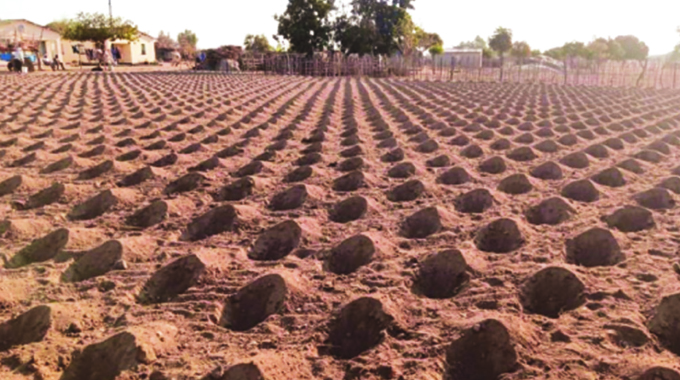
Precious Manomano
FARMERS under the Pfumvudza/Intwasa programme have so far prepared five million plots ahead of the 2025/2026 summer cropping season, representing half of the Government’s target for the year.
The Presidential Inputs Support Programme, which anchors the Pfumvudza/Intwasa model, is expected to benefit three million households nationwide, with each household encouraged to prepare at least two to three plots.
Last year, farmers prepared 11,9 million plots. The authorities, however, expect 15 million plots this season if the current momentum continues.
Land preparation under the climate-proofed conservation farming programme involves clearing and marking small plots measuring 39 metres by 16 metres, digging planting holes or basins, applying manure or fertiliser and covering the soil with mulch to conserve moisture.
Farmers are also urged to construct storm drains and infiltration pits to manage water and prevent soil erosion.
This model is designed to ensure high yields even under erratic rainfall patterns.
Parts of the country received light showers last week, though the Meteorological Services Department has cautioned that while the outlook for the season remains favourable, the onset of rains may be delayed.
Farmers have intensified land preparation in anticipation of the first effective rains later this month.
Permanent Secretary in the Ministry of Lands, Agriculture, Fisheries, Water and Rural Development Professor Obert Jiri said enthusiasm for the programme remains high across the country.
“We are deep in preparations for summer. Farmers have expedited the preparation of Pfumvudza plots, which is critical,” he said.
“So far, we have five million plots countrywide. As we continue with our climate-proofing at household level, we must see every household doing two or three plots, which will give us 15 million plots.”
The Government is distributing input packages through the Grain Marketing Board (GMB), with each household receiving seed, basal and top-dressing fertiliser, herbicides and technical guidance on agronomic practices.
A major emphasis this year is on agro-ecological tailoring, a strategy that matches crop varieties to specific farming regions.
In wetter Regions 1 and 2, maize will remain the dominant crop, though farmers are also being encouraged to diversify with small grains.
In drier Regions 4 and 5, and parts of Region 3, the focus will shift towards sorghum, millet and other drought-tolerant grains.
Pfumvudza/Intwasa was introduced in 2020 to enhance food security.
It promotes small-plot, high-input, high-output farming that conserves water and soil fertility.
By focusing on properly prepared plots rather than large areas of poorly managed land, the programme has helped households consistently achieve higher yields despite climate change challenges.
Farmer organisations have welcomed both the early preparations and timely distribution of inputs.
Zimbabwe Commercial Farmers Union president Dr Shadreck Makombe said the initiative has proven its worth.
“Pfumvudza/Intwasa results are improving every year, so early distribution will give farmers more confidence in farming.
“We are expecting another bumper harvest this coming season because Pfumvudza/Intwasa has never disappointed since it was introduced. It has been a successful story benefitting both small-scale farmers and commercial farmers,” he said.
Zimbabwe Indigenous Women Farmers Association Trust president Mrs Depinah Nkomo is optimistic the programme will ensure another bumper harvest.
“This will increase yields and incomes, reduce grain imports and expand national hectarage,” she said.
So far, nearly three million farmers have been trained in conservation agriculture techniques.
Under this year’s roll-out, each household will manage three plots, supported with crop-specific input packages that include water retention enhancers, pesticides and fall armyworm control solutions.
Chiefs, headmen and village heads will also benefit under the Zunde RaMambo scheme, which reserves 10 plots for chiefs, seven for headmen and five for village heads, covering nearly 15 000 hectares of maize and sorghum nationwide.
Extension workers will establish farmer field schools in every village — around 35 000 in total — to serve as demonstration and learning centres.
In addition, new distribution committees are being created in wards where inputs were abused in the previous season to ensure accountability and fairness.