admin
admin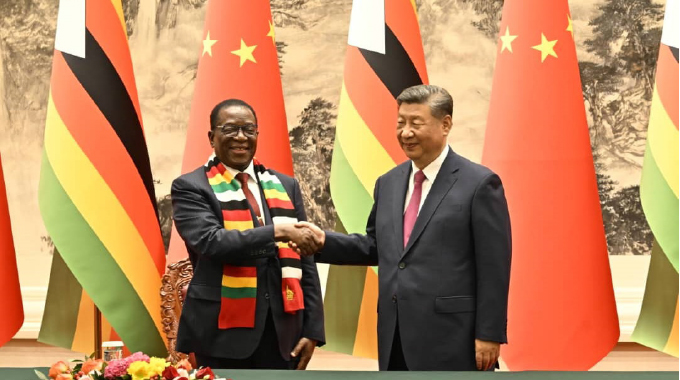
Nick Mangwana
Government Up Close
THE Forum on China-Africa Co-operation (FOCAC) was held in Beijing, China last week, and Zimbabwe was one of the over 50 countries participating.
The Zimbabwean delegation was naturally led by His Excellency the President, Cde Emmerson Mnangagwa. As with all such engagements, there are some who seek to dismiss or misrepresent them as exercises in futility. Then there are others who genuinely fail to grasp the importance. In this instalment, we aim to do justice to the question, why did the Zimbabwean delegation go to the FOCAC Summit in China?
Firstly, it is crucial to recognise that no country is an island, and given the dynamic nature of geopolitics, a nation such as Zimbabwe needs mutually beneficial partnerships with those countries that are more advanced than it is in terms of development. In line with this thinking, Zimbabwe and China upgraded their diplomatic relations to a Comprehensive Strategic Partnership level in 2018.
Let’s start by explaining what is meant by framing a relationship as a Strategic Comprehensive Partnership in international relations.
This is a higher level, long term bilateral relationship between two countries that encompasses a broad range of areas including but not limited to political co-operation, economic co-operation, security co-operation, cultural exchanges and international co-ordination. It is clear that this level of partnership is deep and multifaceted and involves high level meetings with strong commitments to collaboration and shared interests. President Mnangagwa just had to be there.
Come to think of it, no serving American president has ever visited Zimbabwe since Independence, but President Xi Jinping came to Zimbabwe in December 2015, making him the most prominent global leader to visit our country in many years. That speaks volumes about the level of partnerships between the two countries.
The significance of China at the global stage cannot be overstated. China is the world’s second largest economy and has emerged as a major driver of global growth and innovation. It has a vast population which is a major market for many goods which Zimbabwe produces and will be addressed more expansively later in this piece. It’s rapid technological advancement makes it a critical player in shaping the global economics, international relations and geopolitics.
Zimbabwe is already leveraging on these critical traits. In terms of trade between Zimbabwe and China, the balance has been positive for Zimbabwe over the past five years, as the country has been exporting more to China than it has been importing.
Last year, the country recorded its highest exports to China, realising a whopping US$1.7 billion. Products that were exported include tobacco, macadamia nuts, cotton and minerals. And in the same year, Zimbabwe made its first ever direct export of citrus fruits (oranges) to China, raking in US$469 000. The entrepreneurs and farmers among us should already be seeing opportunities here. There are vast untapped market opportunities for our products here.
And what is it that we import from China? No price for guessing that it is mainly motor vehicles, construction machinery, mining equipment as well as communication technology and devices. This is because China is more technologically advanced than us and of course many other countries and is therefore a suitable supplier for our needs as a developing nation that is experiencing a construction and farming boom.
Besides the profitable trade, China is also involved in tangible investments and projects in Zimbabwe, which makes it logical to value them as Comprehensive Strategic Partners in the comity of nations. In recent years, that country has invested over US$2 billion in several projects in Zimbabwe.
To name a few, some of the Chinese-run projects in Zimbabwe include; construction of the New Parliament building, extension of the Robert Gabriel Mugabe International Airport, refurbishment of the Victoria Falls airport, expansion of Hwange Unit 7 and 8, establishment of the Manhize steel plant and construction of several dams among many other projects and programmes. China is one of Zimbabwe’s largest trading partners and the forum offered an opportunity to expand bilateral trade and attract investment in key sectors such as agriculture, mining and manufacturing.
Is there anyone who doubts the need to revamp our railway system? Well, among the 17 Memoranda of Understanding inked at FOCAC 2024 was one on the recapitalisation and upgrading of our logistics company, the National Railways of Zimbabwe (NRZ). There was another on building a railway line between Harare and Chitungwiza and another on modernising the National Sports Stadium which of course was built by the Chinese in the 1980s.
Zimbabwe is prioritising building a digital economy, hence its licensing of Starlink to provide fast and reliable internet on its territory. But there is no question that there is a need for a digital transformation partnership.
And it can be argued that signing an MOU with Huawei on strengthening digital transformation partnership was a genius move. China has advanced technology and expertise in areas such as 5G and Artificial Intelligence (AI). In terms of technological advancement, Zimbabwe needs to accelerate and leapfrog its digital economy.
The MOU that was signed seeks to strengthen this digital partnership, attract Chinese technology so as to create jobs in the digital space as well as increase Zimbabwe’s global competitiveness. Collaborating with China in the digital space can help our people improve their digital literacy, kick-start our e-commerce and bridge the rural to urban digital gap which is one of our key deliverables towards Vision 2030 of building an upper middle economy in the next six years.
I realise we have just focused on four MOUs that were signed when His Excellency met his counterpart, President Xi Jinping. Let’s give you a comprehensive list of them; Establishment of the Investment and Co-operation Working Group; Cooperation Plan on Synergising the Belt and Road Initiative with Zimbabwe’s Vision 2030; Exchange of Cooperation in the Field of Economic Development; MoU on Establishing a Working Group on Unimpeded Trade; Framework Agreement on Economic Partnership for Shared Development; Protocol for Phytosanitary Requirements for Export of Zimbabwean Fresh Avocado to China; MoU on Joint Promotion of Cooperation in the Mining Industry; Treaty on Mutual Legal Assistance in Criminal Matters; MoUs on Media Exchange and Co-operation, MoU between China Media Group and the Ministry of Information, Publicity and Broadcasting Services; MoU on Co-operation on Entry and Exit Animal and Plant Quarantine; Letters of Exchange on the Feasibility Study for Upgrading of Irrigation Facilities Project; Letters of Exchange for Human Resource Development Cooperation in Railways Management; Agreement on News Exchange and Cooperation between Xinhua News Agency and New Ziana; MoU between China Media Group and Zimbabwe Broadcasting Corporation, and MoU between China Media Group and The Herald of Zimbabwe.
Clearly from the above and the President’s full workload in China, one could see that the President is using every minute of the day and ounce of energy towards improving the lives of the Zimbabwean people.
As for the actual summit, the triennial event is not a talkshop as some might mistakenly believe. The Forum on China-Africa Co-operation was established in 2000 to foster dialogue and co-operation between China and African countries. The Summits serve as platforms where countries exchange ideas and formulate pragmatic frameworks based on mutual respect and win-win outcomes. It is envisaged that through this forum, sustainable development will continue to be promoted in Africa. And for 15 consecutive years, China has been Africa’s largest trading partner.
This in contrast to the hegemonic approach from some Western Countries such as the United States, which seek to establish what they call “American Corners” in Zimbabwe which they want to portray as cultural centres for promoting American values and interests. We all know what that means, don’t we? These are spaces for promoting US interests alright but beyond this innocuously sounding generalisation, we perceive them as platforms for promoting American propaganda, influence and soft power directly on the Zimbabwean people.
One wonders whether it is acceptable in the United States for Russia to establish Russian Corners all over the US! Won’t they be accused, for example, of cultural imperialism if innocence is the chosen interpretation or centres for surveillance if espionage is the interpretation? How about efforts to promote certain political interests including interferences in internal affairs including the promotion of specific political ideologies? One wonders, but alas we digress. Let’s refocus on China as I conclude.
Zimbabwe’s participation at FOCAC is crucial to our economic development, infrastructure development and global standing. In 2008, UN Security Council sanctions proposed by Britain and United States failed because China and Russia vetoed the move, making all sanctions on the country illegal at International Law. Zimbabwe will never forget. We take this as China’s support to Zimbabwe’s territorial integrity and sovereignty. When we fought our war of liberation, China was there with us giving material and skills support. It was a poor country experiencing its own challenges but out of the little it had, it shared with the Zimbabwean people. We will never forget. Now going through all the business transacted at FOCAC 2024, Zimbabwe got opportunities to unlock new funding and investment opportunities and for a country under sanctions, that’s no small matter. Zimbabwe got an opportunity to deepen its relationship with the People’s Republic of China and seized it. Now the country can accelerate its progress towards an upper middle income society even before 2030 as pronounced by President Mnangagwa. The partnership between Zimbabwe and China is game changer for this country.
As His Excellency highlighted, “No country is immune from today’s complex challenges. Likewise, it is critically important that we continue to scale up collaboration and co-operation to tap into the immense opportunities presented by new technologies, diverse skills and global capital that exist in jurisdictions that have modernised ahead of us, such as China”.
Nick Mangwana is the Permanent Secretary for Information, Publicity and Broadcasting Services



 Online Reporter