Chronicle Editor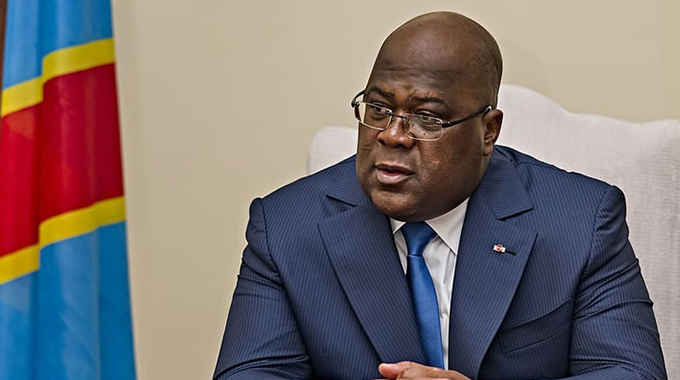
The Democratic Republic of Congo (DRC) is located in Central Africa. The country has a 40-km coastline on the Atlantic Ocean but is otherwise landlocked. It is the second largest country on the continent; only Algeria is larger.
The capital, Kinshasa, is located on the Congo River about 515 km from its mouth. The largest city in Central Africa, it serves as the country’s official administrative, economic, and cultural centre.
The country is often referred to by its acronym, the DRC, or called Congo (Kinshasa), with the capital added parenthetically, to distinguish it from the other Congo Republic, which is officially called the Republic of the Congo and is often referred to as Congo (Brazzaville).
President: Felix Tshisekedi
Currency: Congolese Franc Official Official Language: French
Population: 102 262 808
Size of Country: 2 344 885 square kilometres

Independence
DRC gained independence from Belgium in 1960. From 1971 to 1997, the country was officially known as the Republic of Zaire, a change made by then ruler General Mobutu Sese Seko to give the country what he thought was a more authentic African name.
“Zaire” is a variation of a term meaning “great river” in local African languages; like the country’s current name, it refers to the Congo River, which drains a large basin that lies mostly in the republic. Unlike Zaire, however, the name Congo has origins in the colonial period, when Europeans identified the river with the Kingdom of the Kongo people, who live near its mouth. Following the overthrow of Mobutu in 1997, the country’s name prior to 1971, the Democratic Republic of Congo, was reinstated. Congo subsequently was plunged into a devastating civil war; the conflict officially ended in 2003, although fighting continued in the eastern part of the country.
Resources
DR Congo is rich in natural resources. It boasts vast deposits of industrial diamonds, cobalt, and copper; one of the largest forest reserves in Africa; and about half of the hydroelectric potential of the continent.
Borders
DRC is bounded to the north by the Central African Republic and South Sudan; to the east by Uganda, Rwanda, Burundi, and Tanzania; to the southeast by Zambia; and to the southwest by Angola. To the west are the country’s short Atlantic coastline, the Angolan exclave of Cabinda, and Congo (Brazzaville). The country’s major topographical features include a large river basin, a major valley, high plateaus, three mountain ranges, and a low coastal plain. Most of the country is composed of the central Congo basin, a vast rolling plain with an average elevation of about 520 metres above sea level. The lowest point of 338 metres occurs at Lake Mai-Ndombe (formerly Lake Leopold II), and the highest point of 700 metres is reached in the hills of Mobayi-Mbongo and Zongo in the north. The basin may once have been an inland sea whose only vestiges are Lakes Tumba and Mai-Ndombe in the west-central region.
Climate
Most of Congo lies within the inner humid tropical, or equatorial, climatic region extending five degrees north and south of the Equator. Southern Congo and the far north have somewhat drier sub-equatorial climates. The seasonally mobile intertropical convergence zone (ITCZ) is a major determinant of the climate. Along this zone the trade winds originating in the Northern and Southern hemispheres meet, forcing unstable tropical air aloft. The air that is forced upward is cooled, and the resulting condensation produces prolonged and heavy precipitation. In July and August this zone of maximum precipitation occurs in the north; it then shifts into Central Congo in September and October. Between November and February, the southern parts of the country receive maximum precipitation.
People
More than 200 African ethnic groups live in the DRC. Of these, Bantu people constitute a large majority of the country’s population. They entered the territory of modern Congo between the 10th and the 14th century from the west and north and established kingdoms that were flourishing at the time of European penetration after the 16th century. The major kingdoms were those of the Kongo, Teke (Bateke), Luba, Pende, Yaka, Lunda, Songe, Tetela, and Kuba people. Major cultural clusters today include the Mongo (in the centre of the country), the Kongo (west), the Luba (south-central), the Lunda (south), the Bemba (southeast), and the Kasai (southwest). Bantu people in the north and northeast include the Ngala, the Buja, the Bira, the Kuumu, and the Lega (Rega).
Languages
More than 200 languages are spoken in Congo. Communication between groups has been facilitated by four “national” languages: Swahili, Tshiluba (Kiluba), Lingala, and Kongo. French is the official language and the language of instruction, business, administration, and international communications. The four national languages are used in regional commerce and on the radio. The use of Lingala is growing rapidly: under Mobutu it was the official language of the military, and it is widely spoken in Kinshasa, where it is used in popular music, as well as along the lower Congo River. Traditional African religious beliefs in a supreme being, the power of the ancestors, spirits of nature, and the efficacy of magic have been greatly influenced by the introduction of Christianity in Congo. There is a very sizable Christian population, the largest proportion of which is Roman Catholic. Other Christians include Protestants and followers of the local sect of the Church of Jesus Christ on Earth Through the Prophet Simon Kimbangu (Kimbanguist Church). The remainder of the African population continues to adhere to traditional African beliefs or follows Islam. The foreign community includes Hindus and Muslims.
Economy
At independence in 1960, the formal economy of the DRC was based almost entirely on the extraction of minerals, primarily copper and diamonds. Most of this economic activity was controlled by foreign companies, such as the Belgian Union Minière du Haut-Katanga (UMHK), whose assets in 1965 were valued at nearly $US430 million. By that time, UMHK was one of the largest single sources of Congolese governmental revenue and accounted for a large proportion of the country’s foreign exchange earnings. Domestic agriculture is the main source of food and income for the majority of the population. Agriculture, animal husbandry, fishing, and forestry combined provide employment for more than three-fourths of the lab our force and, on average, account for more than two-fifths of Gross Domestic Product. Although the country is rich in agricultural potential, deterioration of the transportation network and agricultural services since independence have led to a return to subsistence agriculture and a collapse of market production. Foodstuffs such as cereals and fish are imported in increasing amounts. Coffee is the chief agricultural export. In the humid equatorial region, cassava (manioc) and rice are the basic food crops. Peanuts (groundnuts), oil palms, and fruit trees are also important, while robusta coffee is the main cash crop. In the eastern highlands, yams, beans, and sweet potatoes are used as food crops, while arabica coffee and tea are export commodities. Corn (maize), an important subsistence crop, is grown widely but chiefly centred on the southeast. Vegetable growing is widespread throughout Congo. Livestock and poultry are kept in every province. Cattle are raised mainly in the east and the south. Pigs are kept in the west and sheep in the eastern highlands. Other domestic animals include chickens, geese, pigeons, and rabbits. Commercial meat production is limited, however, and the country depends upon imports to fulfill its requirements. The country’s main economic resource is its mineral deposits; mining produces almost nine-tenths of total exports. The abundance of minerals in Katanga province was among those factors that attracted European powers to Congo in the 19th century. Minerals found in Katanga include copper, cobalt, zinc, cassiterite (the chief source of metallic tin), manganese, coal, silver, cadmium, germanium (a brittle element used as a semiconductor), gold, palladium (a metallic element used as a catalyst and in alloys), uranium, and platinum. The region west of Lake Kivu contains cassiterite, columbotantalite, wolframite (a source of tungsten), beryl, gold, and monazite (a phosphate of the cerium metals and thorium). Lake Kivu also harbours vast reserves of methane, carbonic, and nitrogen natural gases. There are deposits of iron ore and gem-quality diamonds in south-central Congo, while the central regions are rich in industrial diamonds. In the northeast, there are gold, coal, and iron-ore deposits; there are prospective deposits of gold, monazite, and diamonds in the north-western regions as well. Coastal Congo contains bauxite, gold, and offshore deposits of petroleum. The limestone deposits that occur throughout the country are considered to be among the richest in Africa.
Politics
Congo’s civil war (1998 – 2003) was essentially ended by a power-sharing agreement that created the transitional constitution of 2003, which provided for a transitional government that consisted of representatives from various rebel groups, the previous government, the political opposition, and civil organisations. A new, formal constitution, approved by referendum in 2005 and promulgated in 2006, significantly devolved power to provincial administrations. Under it, the president is to be elected to no more than two five-year terms and must share power with the Prime Minister, who is to be named from the legislature’s largest party. The legislature is bicameral, consisting of the National Assembly and the Senate. The Popular Movement of the Revolution (Mouvement Populaire de la Révolution; MPR) was the sole legal political party from 1970 until 1990.
It was presided over by then President Mobutu and had branches at every administrative level throughout the country. The MPR splintered into factions after Mobutu was overthrown in 1997. At the time of the transitional government, some of the most prominent political parties were the People’s Party for Reconstruction and Democracy (Parti du Peuple pour la Reconstruction et la Démocratie; PPRD); the Union for Democracy and Social Progress (Union pour la Démocratie et le Progrès Social; UDPS); the Democratic Social Christian Party (Parti Démocrate Social Chrétien; PDSC); the Popular Movement of the Revolution–Fait Privé (Mouvement Populaire de la Révolution–Fait Privé; MPR-FP), a faction of Mobutu’s original party; the Congolese National Movement–Lumumba (Mouvement National Congolais–Lumumba; MNC-L); the Forces for Renovation for Union and Solidarity (Forces Novatrices pour l’Union et la Solidarité; FONUS); the Congolese Rally for Democracy (Rassemblement Congolais pour la Démocratie; RCD); and the Movement for the Liberation of the Congo (Mouvement pour la Libération du Congo; MLC). The last two parties represented former rebel groups. The Union for Democracy and Social Progress (UDPS) party of President Tshisekedi won the majority of seats in the country’s recent elections. Women have held various posts within the government, including ministerial positions and seats in the national and provincial assemblies. In 2024, Judith Suminwa Tuluka became the first woman to be appointed to the post of prime minister. On the whole, however, women as well as ethnic minorities are underrepresented in government.


 Online Reporter