Online Reporter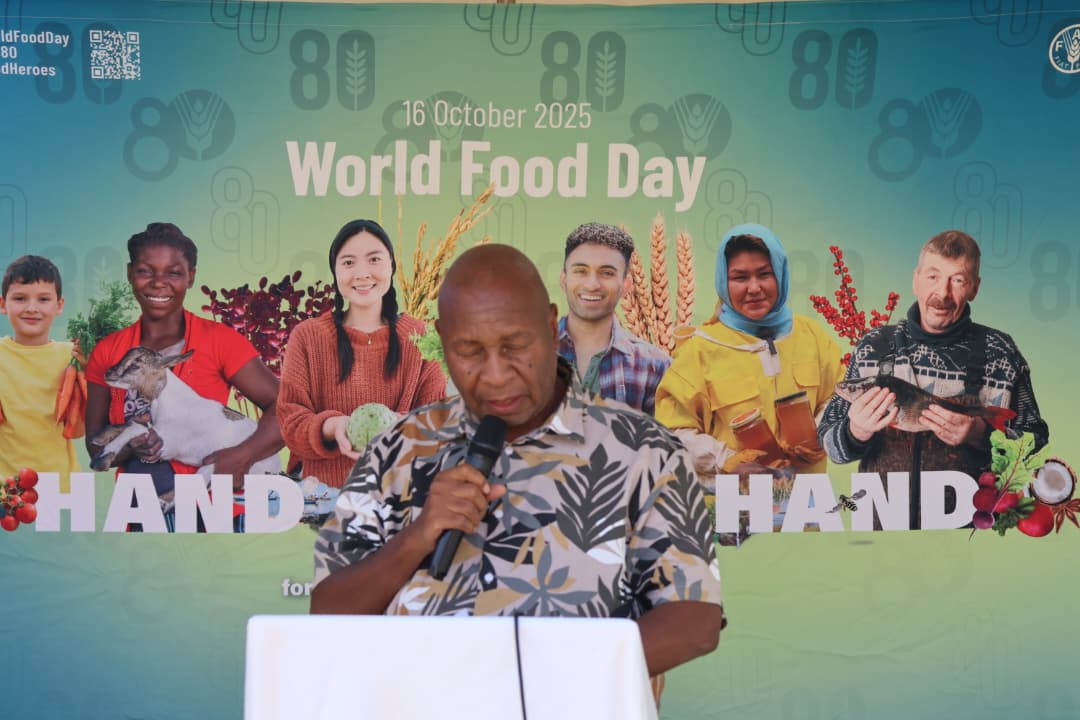
Theseus Shambare
FOOD assistance to vulnerable communities is not an act of charity but an investment in dignity, peace and opportunity, Government and development partners said during the 2025 World Food Day commemorations at Matopos Research Institute in Matabeleland South on Thursday.
Running under the theme “Hand in Hand for Better Foods and a Better Future,” the event brought together Government ministries, development agencies, researchers and community groups, all underscoring that food security is a fundamental human right and the foundation of national stability.
Public Service, Labour and Social Welfare Minister Edgar Moyo said the commemorations were a timely reminder that food support must uplift communities, safeguard livelihoods and empower people to build resilience.
“Food is more than sustenance — it is dignity, peace and opportunity.
“Every household that is supported, every farmer that is capacitated and every community strengthened brings the nation closer to lasting food security,” said Minister Moyo.
He said the Second Republic, working with partners, had expanded social protection programmes, scaled up climate-smart agriculture practices and strengthened early warning systems in anticipation of climate shocks.
Lands, Agriculture, Fisheries, Water and Rural Development Permanent Secretary Professor Obert Jiri said Zimbabwe’s agricultural transformation was anchored on empowering smallholder farmers, who form the backbone of national food production.
He said the Presidential Inputs Support Scheme — particularly its flagship Pfumvudza/Intwasa conservation agriculture model — had been pivotal in building household-level resilience.
“Through Pfumvudza/Intwasa, we are improving productivity from the same land, ensuring that even in poor rainfall seasons farmers can harvest enough.
“The Presidential Inputs Scheme has provides fertiliser, seed and training to millions of farmers, enabling consistent production across all agro-ecological regions,” said Prof Jiri.
He said this support, complemented by irrigation development and value-chain modernisation, was positioning Zimbabwe to sustain national food stability while strengthening rural economies.
FAO Subregional Coordinator for Southern Africa, Dr Patrice Talla, said the organisation’s collaboration with the Government had been instrumental in strengthening production, nutrition outcomes and community resilience.
“This year we celebrate 80 years of the United Nations and FAO — eight decades of advancing the idea that every person has the right to adequate food.
“Our partnership with Zimbabwe continues to support climate-smart innovations, farmer training and improved extension services to ensure sustainable food systems,” Dr Talla said.
World Food Programme Zimbabwe Representative and Country Director, Ms Barbara Clemens, said hunger persists globally not because food is insufficient but because of inequality, climate shocks and weak systems.
She said Zimbabwe had made notable progress through reforms that expand production and enhance social protection.
“Over the past year, WFP supported nearly one million people through lean-season assistance, cash-based transfers and food distributions,” Ms Clemens said.
“But beyond emergencies, we are helping communities adapt to climate shocks, supporting smallholder farmers to access markets and strengthening national systems.”
She commended the Government’s irrigation expansion and grain procurement strategies, saying they were solid foundations for restoring Zimbabwe’s regional food leadership.
Officials stressed that zero hunger requires collective responsibility — from private-sector investment and community-driven solutions to youth leadership and sustained partnership among Government and development agencies.
“We reaffirm our commitment to working ‘hand in hand’ to build a food-secure Zimbabwe where every family can live with dignity, hope and opportunity,” she said.