

 Online Reporter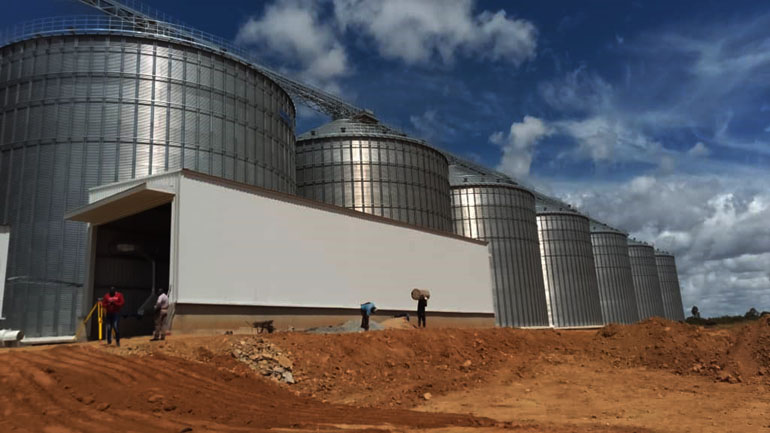
Lovemore Kadzura
Post Reporter
MANICALAND is on the verge of another milestone, with the construction of Artificial Intelligence powered smart silos at the Grain Marketing Board (GMB) Timbers Mills Depot in Headlands now 86 percent complete.
The development marks significant progress in the Government’s drive to modernise grain storage and management through advanced technologies that boost monitoring, efficiency, and quality control.
The facility will be the province’s second set of smart silos, following the commissioning of the GMB Mutare site last year by President Emmerson Mnangagwa.
With a combined capacity of 56 000 metric tonnes, the new silos are designed to transform grain handling by enabling real time monitoring, reducing post harvest losses, and safeguarding national reserves.
Engineers on site confirmed that installation of AI driven monitoring systems is at an advanced stage, with major structural works — including the seven silos, conveyance systems, and mechanical installations — already completed.
Electrical works are progressing, and the powerhouse is ready for roofing. Outstanding tasks include the installation of a dryer, construction of the bagging warehouse, and completion of ancillary facilities such as offices, canteen, ablution blocks, access roads, and fencing.
Acting Manicaland Provincial Mechanisation Engineer, Engineer Farai Nyamhunga, said the project is expected to be completed by June 2026.
“Works are now at 86 percent. The seven silos each have a capacity of 8 000 metric tonnes. Most of the major works are done, and we anticipate commissioning later this year once the remaining installations are finalised,” he explained.
The Headlands smart silos form part of a broader Government initiative to strengthen food security under Vision 2030 by rolling out modern storage infrastructure across key agricultural regions.
Once operational, the facility will bolster strategic grain reserves, cushion farmers against losses, and ensure Zimbabwe meets its food security targets.
Engineer Nyamhunga said the setting up of the silos in Headlands is strategic as it is a major source of maize, wheat and soya beans, and the facility is close to the highway, and is also serviced by the railway line, making transport logistics smooth.
“The positioning of these silos in Headlands resonate with the fact that Makoni District has the greatest hectarage of grains such as maize and wheat, among others.
‘‘It was a logical and strategic decision to set up these smart silos there to reduce the transportation costs incurred by farmers ferrying grain to GMB Rusape.
‘‘The GMB Timber Mills is accessible by both rail and road networks, which will help in the movement of bulk grain during the times of imports, exports or inter-provincial movement in times of needy,” said Engineer Nyamhunga.
GMB Timber Mills, due to its strategic location, also serves farmers from Mashonaland East Province, particularly those in the proximity Macheke area of Murehwa District, where there is also high production of maize and wheat.
Member of the House of Assembly for Headlands Constituency, Honourable Farai Mapfumo, applauded President Mnangagwa for facilitating the construction of the smart silos, describing it as a major step towards food security under Vision 2030, anchored on the Food Storage Systems and Rural Transformation Strategy Number Two 2026 to 2030, and the National Development Strategy (NDS2).
“The construction of the new GMB Timber Mills smart silos in Headlands could not have come at a better time as the constituency is the breadbasket of the province in terms of major grain production.
‘‘Hence, these smart silos and driers will go a long way in combating the adverse impacts of global warming and climate change, which were affecting farmers’ turnaround time and the transition to wheat and other crops’ land preparations due to moisture content levels being too high at delivery time to GMB.
‘‘Now with these high-tech silos, that will be a thing of the past. This is one way of putting into practice President Mnangagwa’s mantra of leaving no one and no place behind, especially as the surrounding marginalised small-scale farming community and commercial farming sector feel honoured by the New Dispensation, since logistics to the alternative Rusape GMB were eating into profits and congesting the depot. This is indeed development being witnessed at grassroots level, and as Headlands Constituency, we thank the President for the great step towards a food-secure Vision 2030,” said Honourable Mapfumo.
He said the landmark development will transform agriculture in Headlands Constituency by slashing post-harvest losses, ensuring grain quality, and giving farmers timely market access.
“It will anchor rural development through improved infrastructure, jobs, and commercialisation of small-scale farming, while reducing transport costs to Rusape GMB.
‘‘Critically, the smart silos strengthen food security and value-chain efficiency, propelling the constituency’s contribution towards Vision 2030’s goal of an upper-middle-income society built on modernised and climate-resilient agriculture,” said Honourable Mapfumo.
The initiative is part of Government’s broader vision to strengthen national food security, reduce post-harvest losses, and boost agricultural productivity in line with Vision 2030.
The project is one among several others being implemented by Government as part of broader initiatives to construct such silos at 14 sites countrywide in two years, with the first two having been commissioned last year.
Boasting seven silos, the facilities have a combined capacity of over 56 000 metric tonnes and equipped with AI technology that enhances grain management to enable optimum monitoring of efficiency and quality control.
The modern facilities include dust extractors and an inbuilt 100-tonne-an-hour dryer, depending on the moisture content at intake. Similar infrastructure will be established in Masvingo, Rutenga, Marondera, Guruve, Mhangura, Rafingora, Bindura, Gokwe, Plumtree and other areas across the country.




To laymen everything automatic is AI driven but that is not correct. AI and Automation are related only because they are digitally based concepts. The algorithms are quite different. AI’s power lies in making machines use algorithms that simulate the human brains in diagnosing problems and making decisions and applying thought processes similar to what the human mind would do. Automation operates on rigid specific instructive computer programs that are designed to achieve specific but limited actions. Looking at what happens in these silos, one clearly sees that there is no AI application here. This is purely Industrial Automation designed to perform rigid and repetitive tasks through designed computer programs. It is therefore wrong to refer to these silos as AI driven. However “smart silos” is an appropriate term to use when compared to the old silos.