Online Reporter
Bruce Ndlovu, Sunday Life Reporter
IN 1962, a bizarre spate of crimes left police in Bulawayo scratching their heads.
On the night of 30 September, thieves expertly looted a shop, stealing valuable electrical goods. On that same night, two Ford cars — a Zephyr and a Consul — were reported stolen. One of the vehicles would later be found abandoned near Grey Prison.
Despite deploying their best detectives, police were stumped. The criminals seemed to vanish without a trace.
Then, in October, the thieves struck again. This time, they broke into the CABS offices in North End and made off with a large safe. Once again, two Fords — a Zephyr and a Consul — were taken on the same night.
With the city gripped by fear and intrigue, authorities were no closer to identifying the perpetrators. There were no credible clues. The only known criminal with a fondness for Ford vehicles was Aiden Diggeden. But there was one problem: he was already behind bars at Grey Prison, serving four years with hard labour — for stealing four Fords.
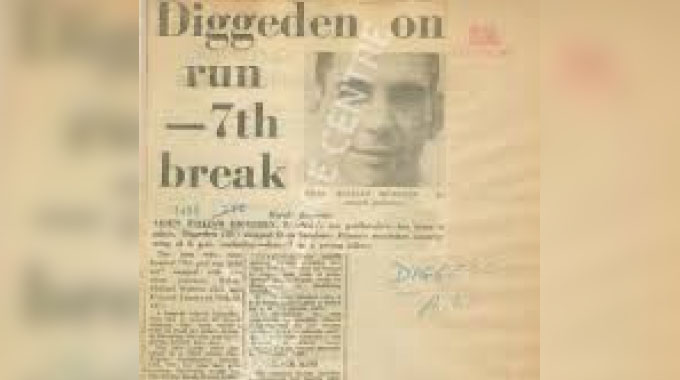
With their prime suspect supposedly locked away, police could only wonder how such crimes continued unchecked. That changed a few days later. During an attempted heist targeting $32 000 in wages being transported by rail, the thieves fled empty-handed. Two more Fords were abandoned — one again near Grey Prison. But this time, they left something behind: a set of keys. The keys belonged to Grey Prison.
Suddenly, everything made sense. Aiden Diggeden hadn’t been imprisoned at all. He had been hiding in plain sight — slipping out at night to steal and returning by dawn.
The legend of Aiden Diggeden
If you pitched Aiden Diggeden’s life to a Hollywood producer, they’d likely throw out the script for being too far-fetched.
A prisoner who sneaks out of jail by night to carjack and rob, only to sneak back in by morning? Unbelievable.
A man who later escapes to South Africa, becomes a national trampoline champion, all while continuing his criminal exploits? Absurd.
A fugitive living a James Bond-like existence, crisscrossing borders with fake passports, juggling sport, heists, and multiple aliases? Preposterous.
And yet — all of it is true.
Before notorious outlaws like Stephen Chidhumo and Edgar Masendeke made headlines for escaping prison, Aiden Diggeden had already written the book on jailbreaks, deception, and high-stakes crime.
Early life
Baptism records show that Aiden William Diggeden was born in Bulawayo on 21 October 1939 and baptised on 12 November at the Cathedral of St Mary.
His father, Francis, worked as an outfitter in the men’s department of the iconic Haddon & Sly Store. After divorcing Aiden’s mother, Iris Clark, Francis married Edna — a typist he met on the job — and the family moved to Gweru.
There, Aiden attended Chaplin High School.
While he was already a petty thief in school, his full-fledged criminal career began after leaving Chaplin. Back in Bulawayo, Diggeden developed a particular fondness for Fords, stealing four before his arrest and sentencing to four years at Grey Prison.
Escaping from within
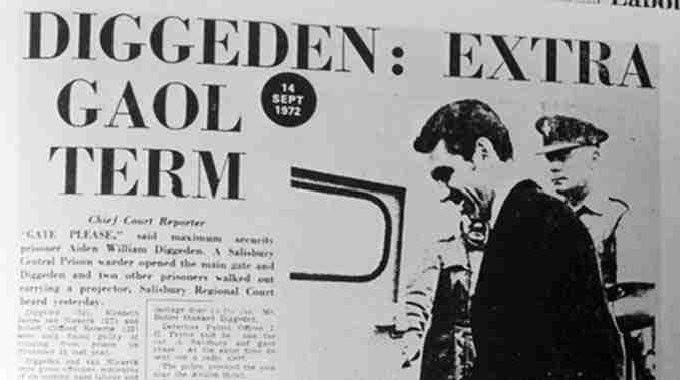
It was during that sentence that Diggeden elevated prison escape to an art form. Alongside fellow inmates Rinder and Scalding, he convinced a guard to hand over keys — keys later dropped during the bungled train heist that finally exposed him. By day, they were model prisoners. By night, they terrorised the city. Once his covert activities were uncovered, Diggeden knew another trial meant more time. He plotted a mass breakout from Grey Prison. When his accomplices chickened out, Diggeden went solo, vanishing into the night and resurfacing in South Africa.
There, he embraced a dual life: a criminal by trade and an athlete by choice, eventually emerging as South Africa’s national trampoline champion.
The return, the heists, the escapes
In 1966, Diggeden returned to Zimbabwe. Alongside an accomplice, James Terrence Dillman, he carried out robberies in Salisbury (now Harare) before heading back to Bulawayo. With police closing in, they stashed cash at Plaza Hotel and fled to Zambia — where they were arrested after committing more heists.
On 9 September 1966, he made headlines again — this time escaping during court proceedings at Zambia’s High Court in Lusaka.
Back in Bulawayo, police were ready. He was quickly rearrested and later sentenced to 13 years after pleading guilty to multiple charges. But if there’s one thing certain about Diggeden, it’s that prison sentences never stuck.
The Chikurubi masterpiece
At Chikurubi Maximum Prison, Diggeden plotted what’s now considered one of the most sophisticated jailbreaks in Zimbabwean history.
He discovered the prison’s master key and sketched it. In the prison workshop, he crafted a replica. On 31 January 1968, he stole civilian clothes, and with fellow inmate Lionel Baker, made his move.
Baker broke his leg mid-escape. To show that there is some honour among thieves? Diggeden carried him to the prison chapel and fashioned a bed from bench cushions. Baker never reported the escape.
At dawn, Diggeden walked to the nearby police depot, stole a bicycle, and cycled to Salisbury.
He was arrested again in Bulawayo on 7 February — this time while riding a bus to Esigodini.
Between 1970 and 1971, Diggeden made three more escape attempts. On one occasion, he walked out of prison dressed as a guard. Eventually, he served 12 years of an 18-year sentence.
Life after crime
Following his release in 1978, he was reportedly jailed again — for five years — for stealing from an employer.
After that, Diggeden disappeared from the public eye.
Some claim he’s alive and well in the UK, living under an assumed identity.
“He is alive and well, living under another name in the UK — and still as fit as ever at 84,” claimed Maggie Walton.
Whether truth or legend, Aiden Diggeden’s story remains one of Zimbabwe’s most audacious chapters in crime lore. A man who lived many lives — prisoner, escape artist, athlete, outlaw — and, quite possibly, a quiet pensioner living out his days as someone else entirely.