


 tawandamusarurwa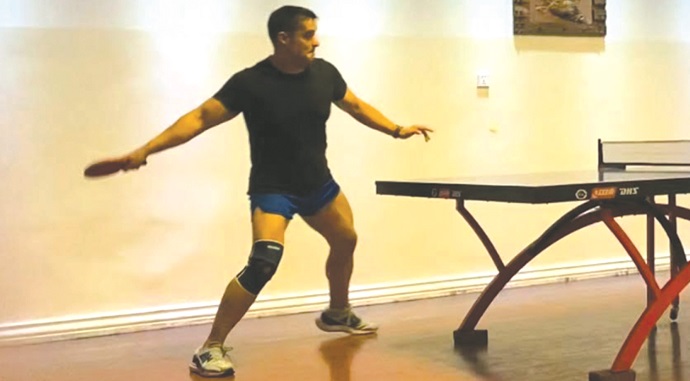
Langton Nyakwenda
THERE are three things that Vikram Singh values a lot — his family, work and, of course, table tennis.
In fact, the sport has kept him going for the past 30 years.
When he is not working, Singh, who is a general manger at a long-distance transport company in Msasa, Harare, loves to spend time with his wife and three kids.
But there is no doubt that table tennis has also taken most of his time since the early 1990s, when he first got hold of the bat.
What started as a pastime, thanks to a birthday present he got from a family member, turned out to be a worthwhile pursuit that has made Singh a local hero.
“I got a Chinese bat as a birthday present, and from then on, I went to Churchill School, where we formed a club with a friend and my brother Ajay,” he said.
“We then registered in the league; the 90s were quite vibrant.
“You had different people from all walks of life, people from embassies, and that sort of gave table tennis a rich heritage.”
Singh, who is a serial national championship winner, is still the top-ranked player in Zimbabwe.
The 47-year-old sits on top in the current rankings with 257 points, a massive 53 ahead of second-placed Brian Chamboko.
Tinotenda Fambira, who won the national championship after stunning Singh on April 30, is a distant third with 187 points. The gap in points between Singh and his opponents is so huge that he can take a three-tournament hiatus from the game and no one will overtake him.
Although he turns 48 this year, he is still good enough to compete.
The veteran lost 2-3 against 19-year-old Fambira, a player whom he thinks might scale greater heights if given “more exposure”.
“Fambira, in my opinion, needs a lot more practice. I would really like it if he can be sent out of the country for proper training,” Singh said.
Table tennis has had a stop-start progress since the early 1990s, when the sport gained popularity in the country.
The likes of Celso Ribeiro and Justice Muskwe were some of the pioneers but they have since retired from the game.
Yet Singh, who burst onto the scene as a 16-year-old in 1991, is still batting on.
He says he can play until “well past the age of 50”.
“By the age of 18, I had won three men’s singles tournaments, playing against the likes of Muskwe and Ribeiro, so that is when I became so passionate about the sport.” He then left for India for studies in the late 1990s, where he continued playing the sport.
He came back to Zimbabwe in 2004.
“Table tennis had sort of died; the country’s economy was not that vibrant and people had other things to do to make a living.
“Sport became more of a luxury,” he added.
“But there were some players playing, so the sport continued. Credit also goes to long-serving players like Chamboko and Takudzwa Mudonhi.
“He might be in his late 30s, but I feel Chamboko still has a lot to offer. In my opinion, Chamboko and Wang Liping are the only other players in Zimbabwe who play quality table tennis and understand spin.”
Around 2011 and 2012, local table tennis became a two-horse race between Singh and Chamboko.
“We dominated the finals but I started getting tired. I felt like I needed to give the youngsters a chance, but it was like the juniors wouldn’t let me.
“They said I was still winning, so I had to continue. So, I said to myself, as long as these guys are learning from me, I need to continue.” He would have loved to play at the 1995 All-Africa Games hosted by Zimbabwe but he had to concentrate on his studies.
However, he managed to represent the country at several Region Five Games since the turn of the millennium.
“I will carry on. I love the sport immensely.
“I think losing teaches you more than winning.
“I exercise regularly; it’s all in the effort you put in the game.”
The veteran has some advice for upcoming players.
“You cannot play the same game with everyone.
“Everyone has a different style; therefore, one size does not fit all, and you have to put that experience into use and make sure you adapt to win,” he said.



 Bongani Ndlovu
 Online Reporter