Online Reporter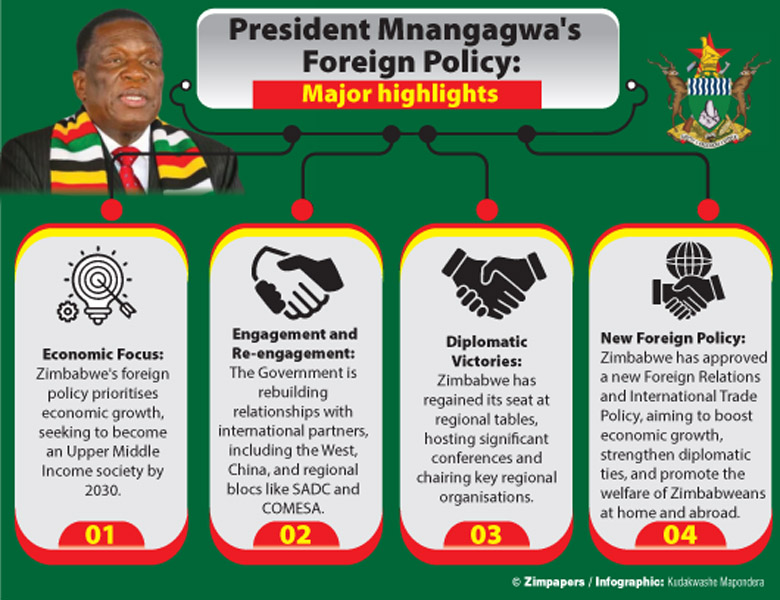
Dr Alexander M. Rusero & Ranga Mataire
FOR years, Zimbabwe lived under the dark shadow of international isolation, which was largely portrayed in hushed tones as a pariah state, dismissed as an outpost of tyranny, and economically strangled by illegal punitive sanctions.
That era cast Zimbabwe as a nation competing with its own reputation, fighting not only the economic cost of isolation but also the psychological weight of global doubt.
Yet, over the past few years, a different story has begun to take shape. Under President Mnangagwa, the country has embraced a diplomatic philosophy rooted less in megaphone defiance and more in strategic engagement.
It’s a pragmatic policy that focuses more on economic diplomacy, given the realities of Zimbabwe as a developing nation with an aspirational vision of attaining an Upper Middle-Income society by 2030.
This existential consciousness on the part of President Mnangagwa is aptly captured in his comments after meeting with Chinese government officials and investors way back in 2019 when he said: “After everything I have seen here, we don’t have in Zimbabwe; we are almost 1 000 years behind in terms of technology when we look at what is happening here . . . So we need to further cooperation in science and technology for us to leapfrog our technology.”
It’s a live-and-let-live pragmatic policy that has seen a shift from open confrontation to quiet, meticulous negotiation, and the results have started coming, subtle at first but increasingly too visible to ignore.
President Mnangagwa is an operator president, a typical testament to still waters that run deep.
Behind-the-scenes diplomacy has replaced old podium rhetoric, and bit by bit, the architecture of sanctions began to loosen, giving Zimbabwe a long-awaited breath of fresh international air.
The mere framing of Zimbabwe’s foreign policy as being a “friend to all and an enemy to none” and also being “Open for Business” clearly shows the Government’s intention to move from de-colonial confrontational rhetoric to mutually beneficial economic cooperation.
President Mnangagwa has articulated Zimbabwe as “a friend to all and an enemy to none” to underscore the country’s foreign policy thrust under the Second Republic’s “Engagement and Re-engagement” drive.
This is the core of Zimbabwe’s foreign policy doctrine, often used in conjunction with the national development philosophy: “Nyika inovakwa nevene vayo” (A country is built by its own people).
Consistently, the President’s foreign policy thrust is hinged on the country’s commitment to peaceful international relations and a non-aligned stance.
It also points to a new era of openness for business and a departure from previous diplomatic isolation, encouraging trade, investment, and tourism from all nations.
In general, the foreign policy thrust is anchored on Zimbabwe’s commitment to multilateralism and international cooperation, expressing Zimbabwe’s intention to build partnerships based on mutual respect and sustainable development, thereby fostering a positive image of the country on the global stage.
Resultantly, Zimbabwe’s global image, once painted in stark, unforgiving tones, has undergone an almost improbable transformation.
Where Zimbabwe was once described as troubled and inhospitable, the prestigious Forbes Magazine now boldly names it the number one tourism destination.
Such a reversal does not happen by accident; it speaks to a deliberate campaign to reposition Zimbabwe as a welcoming, safe, and culturally rich destination.
Mosi-oa-Tunya, masked in the colonial nomenclature of Victoria Falls, has reclaimed its global splendour; Hwange’s wildlife corridors again command attention, and Zimbabwe is no longer whispered about cautiously.
Our country is now spoken of with admiration by travellers seeking authenticity and wonder.
This is not merely a tourism victory; it is diplomatic rehabilitation through soft power.
Regionally, Zimbabwe has not only re-entered the room but taken its seat at the head of the table with renewed confidence.
The country’s tenure as chair of the regional grouping of the Southern African Development Community (SADC) came at a time when the region desperately needed steady, rational leadership.
Mozambique’s security crisis demanded delicate oversight; the Democratic Republic of Congo’s political environment needed calm navigation; and the unexpected political disturbances in Madagascar, originally slated to assume SADC’s chairmanship, created a regional vacuum that Zimbabwe stepped in to help manage.
Even South Africa, itself under immense internal pressure and under siege from global imperial designs, benefitted from Zimbabwe’s willingness to shoulder some of the region’s diplomatic load. This is not the behaviour of an isolated state seeking relevance; it is the work of a nation rediscovering its voice and exercising regional responsibility.
Zimbabwe’s diplomatic resurgence extended beyond SADC. By assuming the chairmanship of the Common Market for East and Southern Africa (COMESA), the country gained yet another platform to shape regional economic conversations. COMESA represents over half a billion people, a vast market whose integration could unlock new trade corridors, investment streams, and industrial opportunities.
For Zimbabwe to chair such a bloc signals trust, credibility, and recognition that the country is reasserting itself both economically and diplomatically.
Equally symbolic was Zimbabwe’s hosting of the Nordic-Africa Ministers Conference in Victoria Falls. For a group of nations known for their strict governance and developmental standards to choose Zimbabwe as their convening point is both a diplomatic endorsement and a geopolitical gesture.
It reflects a growing confidence in Zimbabwe’s stability and strategic importance while also highlighting Victoria Falls as a global meeting ground. Once again, the world was not just visiting Zimbabwe; it was doing business in Zimbabwe.
Of course, foreign policy is only as credible as the domestic foundation beneath it.
The stabilisation of the ZWL currency and the strengthening of national food security have been crucial in projecting the image of a country moving toward economic discipline.
With a more grounded currency backed by gold and reserves, and with agriculture beginning to show resilience even in challenging climatic conditions, Zimbabwe has strengthened its bargaining power internationally. A nation that can feed itself and stabilise its currency is easier for the world to trust.
These internal improvements have translated into renewed investor curiosity and a growing perception that Zimbabwe is a place where opportunities can once again be explored.
Taken together, these developments paint a portrait of a state steadily improving its attractiveness and reclaiming its place in the global ecosystem.
Zimbabwe is no longer knocking on closed doors; doors are opening.
The world is looking again, listening again, and engaging again.
This transformation remains a work in progress, and Zimbabwe must continue to refine governance, deepen reforms, and nurture investor confidence. But the trajectory is unmistakable: Zimbabwe is emerging from the fog of isolation into the sunlight of strategic relevance.
In summary, a closer look at President Mnangagwa’s foreign policy under the Second Republic reveals a consciousness on the part of the crafters of the four fundamentals in diplomacy alluded to by Hans J. Morgenthau in The Future of Diplomacy — a contribution he made in International Politics: Enduring Concepts and Contemporary Issues, a book co-authored by Robert J. Art and Robert Jervis (1992).
Morgenthau cited the need for diplomacy to be divested and not controlled by irrational doctrines, the need for diplomacy to be defined in terms of national interests, a look at the political scene from the view of other nations, and the need to compromise on issues that are not vital or have no direct impact on the sustenance of the nation.
Zimbabwe’s foreign policy crafters appear to have come across Morgenthau’s fundamentals as the country has sought to disentangle itself from inconvenient dogmas in pursuit of its own national interests.
Indeed, a new chapter is being written – cautiously, deliberately, but with real momentum. Zimbabwe is open to the world, and slowly, steadily, the world is opening to Zimbabwe. This is not something happening magically; someone is doing the magic, and that person is President Mnangagwa.