


 Online Reporter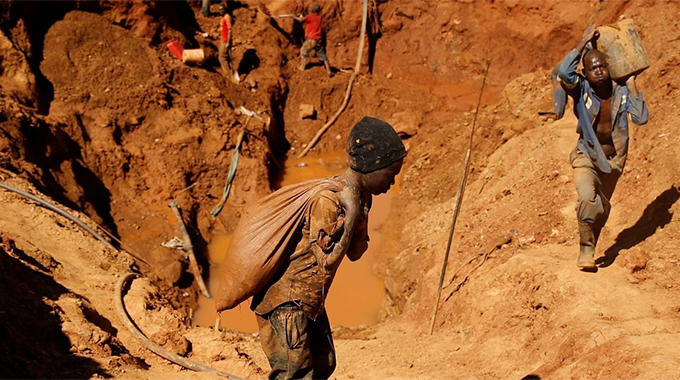
Nqobile Bhebhe
Zimpapers Business Hub
WHILE artisanal and small-scale miners (ASM) contribute significantly to Zimbabwe’s mineral output, especially gold, they operate largely outside formal structures and remain excluded from mainstream financial support.
Financial institutions perceive their operations as high-risk, creating a paradox — a sector vital to the economy but seemingly sidelined in policy and finance.
ASM operations are considered risky because of lack of formal registration, collateral and structured business models.
Without formal recognition, miners struggle to access machinery, safety training and environmental management tools.
However, formalisation allows miners to apply for loans, grants and investment partnerships.
It can also boost national revenue through better tracking and taxation of mineral output.
Latest statistics from Fidelity Gold Refinery (FGR) show that total gold deliveries for the first nine months of 2025 jumped by 37 percent to 32,9 tonnes, compared to 24,02 tonnes in the same period last year.
Small-scale miners delivered 24,45 tonnes of that total through September, a massive 67 percent growth from the 14,6 tonnes produced in the corresponding period a year earlier.
The sector now accounts for nearly 75 percent of the country’s total output.
In contrast, deliveries from large miners fell to 8,54 tonnes in the first nine months of 2025, a decline from the 9,55 tonnes produced a year earlier.
The Government’s interventions, such as allowing small-scale miners to retain 100 percent of their foreign currency earnings, have been key in supporting the sector.
Formalisation
Speaking during a planetGOLD Zimbabwe Annual Stakeholders Conference 2025, which ran under the theme “Building together for a Sustainable ASGM (Artisanal and Small-Scale Gold Mining) Sector”, NMB representative Mr Stewart Makenga underscored the need for formalisation as a crucial step towards improving access to funding for artisanal miners.
“I know a lot of people have concerns regarding us bankers and the financial sector. But let me start by acknowledging the role that the sector is playing. Special mention goes to artisanal gold miners,” said Mr Makenga.
“I know you have talked about its contribution — over 60 percent in terms of gold. I think this year it’s about US$3 billion. As a bank, we are taking note of that, and for us, there are a lot of opportunities because that’s the platform for us to go.”
However, Mr Makenga said financial institutions remain cautious in extending credit to artisanal miners due to compliance and accountability issues, as well as challenges with repayment.
“Formalisation is non-negotiable,” he stressed.
“As a bank, we rely on depositors’ funds — funds that do not belong to us. We must ensure that where we deploy those funds, the businesses comply with local statutes.”
While acknowledging efforts to support some small-scale miners, he indicated that it remains difficult to finance individuals who operate outside formal systems.
“For artisanal miners, notwithstanding what you are doing, it has been a challenge in terms of supporting you through funding. But we have, to some extent, supported some artisanal small-scale miners,” said Mr Makenga.
To mitigate risks, NMB Bank has been partnering with off-takers and cooperatives as intermediaries.
“We have collaborated with key off-takers because dealing directly with artisanal miners — some individuals, others cooperatives — carries risk. With cooperatives, the risk is minimal. So, we have funded off-takers who understand the operations better than we do,” he said.
The model, he added, has proved successful and is now being expanded to include women miners.
However, he said previous attempts to fund individuals had been unsuccessful.
“Dealing directly, in our previous experience, has not been fruitful. We have realised there was a lot of non-repayment and non-compliance.
As a result, we need to be innovative — that’s why we are now coming up with structures,” he said.
The Mines and Minerals Amendment Act seeks to address these challenges by integrating artisanal and small-scale miners into the mainstream economy.
The formalisation drive is expected to enhance access to finance, environmental management, worker safety and tax compliance.
Despite these efforts, representatives of the ASM sector argue that financial institutions lack adequate understanding of artisanal mining operations — a gap that perpetuates misconceptions about risk and repayment behaviour.
Negative perceptions
During a panel discussion on “Financing the Future of Responsible ASGM: Building Trust, Access and Market Linkages”, mining consultant Ms Kundai Chikonzi said the absence of formalisation and low financial literacy remain key barriers to accessing funding.
“There is a lack of formalisation within the ASM. The sector is highly informal, which makes it difficult to approach financial institutions for funding,” said Ms Chikonzi.
“Even if you are formalised, there is a lack of financial literacy. For you to access funding, you need proper records to prove operations. Most ASMs just deposit their gold and throw away the receipts, so there is no proper record-keeping.”
She also said negative perceptions within financial institutions discourage engagement with the sector.
“Just hearing that there is an ASM, banks assume these people will not pay back. That perception is a challenge, as is the lack of understanding of the sector . . . If you walk into a financial institution today, they ask you to pay after 30 days. But mining is different. It’s a cycle — you identify the resource, extract it and process it. Sometimes you mill and get nothing, but that doesn’t mean there is no resource. It just needs further processing,” she said.
Ms Chikonzi called for greater understanding and collaboration between banks and miners.
“There is a knowledge gap on the financiers’ side, and the regulatory framework is still inadequate. Both need to be addressed,” she added.
Young Miners Federation representative Mr Payne Kupfuwa said most young miners lack the collateral required to secure financial support.
“We suggest that the Minister of Mines and Mining Development, together with organisations like Fidelity Gold Refinery, come in as guarantors for young miners seeking to borrow money or acquire equipment,” said Mr Kupfuwa.
Government involvement, he said, could help deserving miners access meaningful financing.
“There should be a nexus between the Ministry of Mines and financial institutions so that deserving young miners can benefit. The ministry can conduct due diligence on behalf of financial institutions,” he said.
Mr Kupfuwa added that the federation continues to encourage formalisation and professionalisation of small-scale mining.
“Mining should be taken as a business, not a poverty-driven initiative or get-rich-quick scheme,” he said.
As Zimbabwe moves to harness the full potential of its artisanal mining sector, formalisation remains the bridge between opportunity and financial inclusion.
Stakeholders agreed that structured collaboration between banks, the Government and miners will be key to transforming artisanal mining into viable and bankable enterprises that contribute meaningfully to national development.



