admin
admin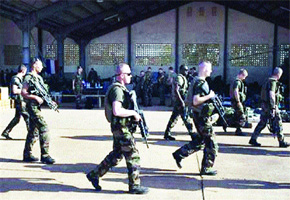
Western and regional powers are concerned the insurgents will use Mali’s north as a launchpad for international attacks.
West African defence chiefs were to meet in Bamako yesterday to approve plans to speed up the deployment of 3 300 regional troops foreseen in a UN-backed intervention plan to be led by Africans.
Speaking from a French military base in Abu Dhabi at the start of a day-long visit to the United Arab Emirates, President Francois Hollande said French forces in Mali had carried out further strikes overnight “which hit their targets”.
“We will continue the deployment of forces on the ground and in the air,” Hollande said. “We have 750 troops deployed at the moment and that will keep increasing so that as quickly as possible we can hand over to the Africans.”
He saw the African troop deployment taking “a good week”.
France plans to field a total 2 500 soldiers in its former colony to bolster the Malian army and work with the intervention force provided by the Ecowas grouping of West African states.
Foreign Minister Laurent Fabius — accompanying Hollande on a visit aimed at firming up trade relations and making progress on a possible sale of 60 French Rafale fighter jets — said he was confident Gulf Arab states would also help the Mali campaign.
Fabius said there would be a meeting of donors for the Mali operation most likely in Addis Ababa at the end of January.
He predicted the current level of the French involvement in Mali would go on for “a matter of weeks”.
Ecowas mission head in Bamako Aboudou Toure Cheaka said the West African troops would be on the ground in a week. Their immediate mission would be to help stop the rebel advance while preparations for a full intervention plan continued.
The original timetable for the 3 300-strong UN-sanctioned African force — backed by western logistics, money and intelligence services — did not initially foresee full deployment before September due to logistical constraints.
Senegal, Burkina Faso, Niger, Nigeria and Guinea have all offered troops. But regional powerhouse Nigeria, which is due to lead the mission, has cautioned that even if some troops arrive in Mali soon, training will take more time.
The plan is being fast-tracked after a plea for help by Mali’s government after mobile columns of Islamist fighters last week threatened the central garrison towns of Mopti and Sevare, with its key airport.
French Prime Minister Jean-Marc Ayrault said France’s goals were to stop the Islamist rebels, to “safeguard the existence of Mali” and pave the way for the African-led military operation.
US officials said Washington was sharing information with French forces in Mali and considering providing logistics, surveillance and airlift capability.
“We have made a commitment that al Qaeda is not going to find any place to hide,” US Defence Secretary Leon Panetta said as he began a visit to Europe.
As French aircraft bombarded mobile columns of Islamist fighters, other insurgents launched a counter-attack further to the south, dislodging government forces from the town of Diabaly, 350km from Bamako.
French intervention has raised the risk for eight French hostages held by al Qaeda allies in the Sahara and for 30 000 French expatriates living in neighbouring, mostly Muslim states. Concerned about reprisals at home, France has tightened security at public buildings and on public transport.
The UN said an estimated 30 000 people had fled the latest fighting in Mali, joining more than 200 000 already displaced.
UN Secretary-General Ban Ki-moon on Monday welcomed the French-led military intervention in Mali and voiced the hope that it would halt the Islamist assault.
Amnesty International said at least six civilians were killed in recent fighting in the town of Konna, where French aircraft had earlier bombarded rebel positions, and called on both sides to spare non-combatants.
France, which has repeatedly said it has abandoned its role as the policeman of its former African colonies, is among the toughest proponents of a speedier deployment of the African troops, and convened a UN Security Council meeting on Monday to discuss the crisis.
French UN Ambassador Gerard Araud told reporters after the meeting that the US, Canada, Belgium, Denmark and Germany had also offered logistical support for France’s Mali operation.
“I felt that all the members of the Security Council were expressing their support (for) and understanding of the French decision,” Araud said.
No Europeans or other African Union members were allowed in the defence chiefs meeting in Bamako yesterday, a Western diplomat said, requesting not to be named.
“They don’t want any French pressure at the meeting,” the diplomat said. — AP


 Online Reporter