admin
admin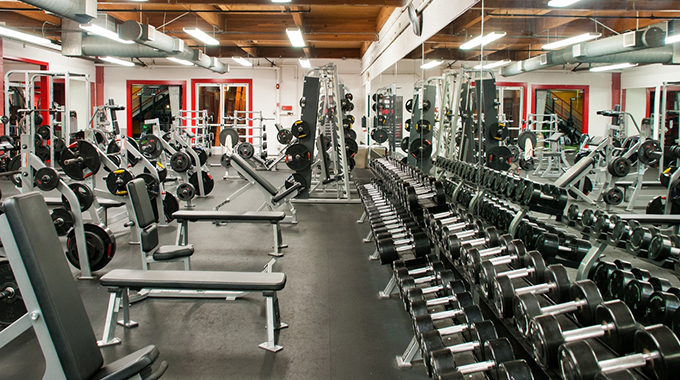
Simon Gama
Free weights provide a more complete workout. However, they also require more expertise in their use.
When lifting free weights like barbells and dumbbells, not only is the prime mover or agonist being worked but all muscles responsible stabilising the joint. The result is to increase the strength of the stabiliser muscles. Greater care is required when using free weights. Improper technique can result in injury to the user or bystander if the weights are dropped.
It is important to remember to enlist the aid of a spotter whenever free weights are raised over the head. A spotter’s responsibility is to ensure the safety of the user during the execution of the exercise. The spotter must observe the condition of the user and try to anticipate exhaustion. The spotter must also make sure that balance and an even lift is executed by the user. A spotter’s strength is not as important as his or her vigilance.
Machines provide a safer workout than free weights. Machines also specifically target a particular muscle automatically. It’s harder to cheat during an exercise by incorporating unintentional muscle groups. However, since lateral movement is generally restricted, machines do not provide as complete a workout.
When lifting overhead machines, a spotter is not required since the weights are confined to a rack and not directly overhead. Some machines are not adjustable for height or length of limbs on an individual basis. This can cause poor fit and even undue stress on joints when the supporting pressure is incorrectly applied. The Biceps Curl and Triceps Concentration machines in many gyms are not adjustable and may cause undue stress on elbow joints instead of applying pressure to the back of the upper arm along the triceps.
In summary, for free weights, the best workout is when a spotter is available and proper lifting technique is executed. In contrast, machines provide a better workout than could be safely achieved using free weights when a spotter is not available.
Proper lifting technique
The technique incorporated into lifting weights is the most important part of weight training. Improper technique can be responsible for everything from unintentionally exercising the wrong set of muscles to an injury requiring surgery and possible years of recovery. Tears can occur in muscles, tendons, and ligaments. Joints can be damaged with possible chronic implications. Technique can be learnt from reading exercise magazines or books, specially geared weight room technique. However, in most cases, a few initial trips to the weight room with a certified personal trainer can be extremely helpful to get you started on the proper exercises with respect to your goals and instruct you on proper technique. Starting a workout programme without a trainer is like going to school without a teacher.
The following guidelines should be followed when lifting weights: Lift weights from the floor with legs and not the back, use a smooth full range of motion, don’t jerk the weights, don’t lock the knees (keep them slightly bent), don’t put pressure on the teeth, the enamel can crack, keep back alignment, don’t hyper extend or flex the back, don’t chat with your buddy, concentrate on the task, unoxygenated muscles can cramp, breathe on the exertion.
Sets and Repetitions
A repetition is referred to as a Rep and is a single lift of the weights. A group of Reps are called a Set. An exercise is generally composed of three to four Sets. The amount of weights to use is dependent on the goal of the participant and the fitness level. If the goal is to build muscle at the fastest rate then six to eight Reps should be done with heavier weight. If the goal is to simply tone or maintain the existing muscle strength then 12 to 16 Reps should be done with a lighter weight.
Participants should never use the heavy weight category if they have not lifted before or if significant amount of time has passed since they have last trained. When initially beginning a training programme it is recommended to use the light category for at least three to four weeks before progressing to the medium weight level.
There are various methods for determining the amount of weights to incorporate into a training effort (heavy, medium and light). The 1 Repetition Maximum (1RM) method is determined by the highest weight that one can lift only once and not again. A percentage of this 1RM value is then calculated to use for multiple Reps and Sets. For example if the participant can bench press 150 1bs as a maximum effort and only once then the 1RM is 150lbs, a percentage of this weight is used for full complement of Reps and Sets. For the Light category, 50% of the 1RM is used.
Another method that can be used to determine the weight to use for particular exercises is to simply estimate the initial weight. Do as many as you can. If your goal is to build muscle at the fastest rate, then if you can do more than 8 Reps then the weight is too light. If you can’t do more than 6 Reps, then the weight is too heavy. — Additional information from online sources.
The writer, Simon Gama is a fitness trainer at Body Works Gym in Bulawayo.



 derick.khumalo