Online Reporter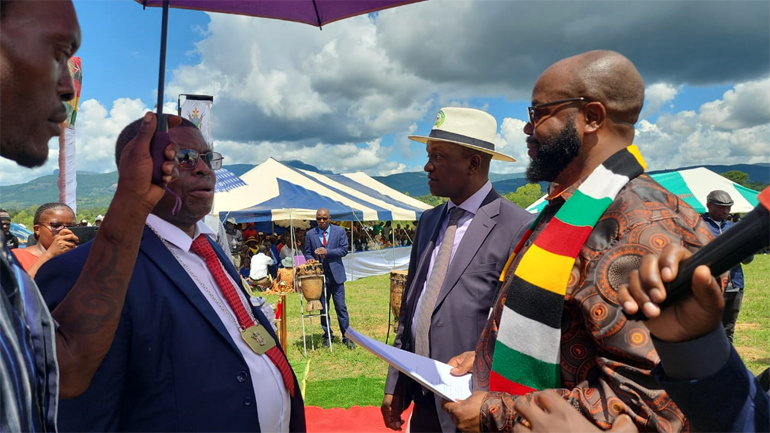
Takudzwa Manzero
Post Correspondent
THE rhythmic pulse of the shima drumbeat echoed through the lush hills of Bonda, reverberating across the majestic Mutarazi Falls and the towering Nyanga Mountain range, all the way to the verdant tea estates of Zindi and Chikomba.
The air was electric with anticipation as the resilient Samanga community gathered to witness a momentous installation of St David’s Bonda Girls’ High School headmaster, Mr Caston Chitsidzo Samanga as the substantive Headman Samanga.
As the ceremony unfolded at Gatsi Secondary School, the community’s excitement was palpable – it was more than just a transfer of power – but a celebration of heritage, tradition and leadership.
To understand how the clan began, one has to look east into the 21st-century Mozambique where Chief Samanga resided, stretching from Manga town in Sofala Province near Beira into the Eastern Highlands of present-day Bonda, where he was at odds with Chief Sanyanga over a boundary dispute.
With the Berlin Conference and Portuguese incursions, part of the royal family was pushed into settling in present-day Zimbabwe, where Samanga’s three wives each bore children into the royal household.
Oral tradition gathered in Zimbabwe has it that in one house – Nyamudzonono Kashiya and Bindira – were board, then in the second, Nyamhanza-Maradzika and Munyuku were board, while in the third and last house was Chipapata.
From these three houses, the first descendants of the Samanga Clan were born before migrating to other areas.
National Records and Archives Mutare Office documents of 1976, show that the first statesman of the then-called “Manga Tribal Trust Land” was Nyamudzonono Kashiya, born alongside his brother, Bindira, who later succeeded him as per tradition upon his death in an incursive war.
The headmanship would then begin with Bindira, whose descendants would later assume the role of the father of the clan, while the other households, which comprised those born from the house of the siblings, Nyamhanza-Maradzika, Munyuku, and Chipapata would take up the political and economic activities of the clan.
Samanga and Chief Mutasa would then be connected through marriage, in which the former acquired the latter’s daughter’s hand in marriage, with the new son-in-law giving away a piece of land as dowry.
This patch of land, given by the son-in-law Nyamudzonono Kashiya, is now under Headman Mandeya, who is Chief Mutasa’s younger brother and Samanga family father-in-law.
The land also boasts a rich military history dating back to pre-independence, with one of the most revered military leaders, Chipapata, who would later give birth to the Samanga people now using the surname Chitsunge. Chipapata was hailed for his ability to coordinate men and women in battle and counter insurgents with scorched earth tactics.
Chipapata, serving as a headman and general alongside his brother, Nyamanza, is said to have refused to surrender to the Madzviti insurgents.
He achieved this by leaving wild yams (majo) that naturally grows in the area’s rivers, which is supposed to be cooked and dried twice on bare rock before consumption.
Instead, he cooked it just once, leading to the death of a large army due to food poisoning.
He was later allegedly killed by a Shangaan raiding party sent from Chipinge by Ngungunyana, who attacked the Samanga people as his father Mzila had done.
The Chipinge-based raiders would gradually earn themselves the name “Madzviti” among the Manyika people, a title reflecting imperialistic oppression.
This turn of events in the 18th century included merciless raids on the Manyika people, which were so severe that they had to seek refuge in the Nyanga Mountain range, change totems upon torture and subjugation, and live with the reality of dispossession of their lands.
The enduring Samanga people would say: “Toendepi tichisiya Manga, yakatiponesa nemajo (How can I leave the valley where a staple plantain grows and nourishes us for survival, and yet during the war, it killed the enemy in his haste).
This statement would come to pass in the liberation war struggle, as the mountains offered refuge and safe passage to the liberation war fighters into neighbouring Mozambique as early as 1975.
The genealogy of headmanship moves from Bindira to Chipapata, then Nyamanza, Chitsunge, Gadzayi, Vharandeni, Rutsayi, Jombo, Tapera, and Chekufa.
The latest in that sequence is Mr Caston Chitsidzo Samanga.
He is the third-born son of Mr Masara Langton Samanga from Manzero Village, in Honde Valley.
At 14-years-old, Mr Samanga was a mujibha (war collaborator), helping the cause of the revolution in the Samanga area.
He attended local schools, including St Joseph’s Primary School, Gatsi Secondary and then Hartzell High School in 1980 for A-Level.
He is a devout member of the Anglican Diocese of Manicaland, and married Mrs Catherine Tsuro-Samanga in 1987, with whom they have three boys and one girl.
All his children are now graduates, befitting the man who has made his name as an education giant – having worked at St Faith’s for 16 years, St Anne’s Goto (three years), St James’ Zongoro (two years), and then St David’s (Bonda) Girls’ High School (16 years and still counting).
After proceeding to University of Zimbabwe for a Bachelor’s in Arts and Diploma in Education, he later graduated with a Masters’ Degree in Public Sector Management at Africa University.
His thrust for the emancipation of mental slavery following Zimbabwe’s independence has borne many millennial and Gen-Z intellectuals present across the four corners of the earth.
His elevation to the headman role brought jubilation to the community, as this is their opportunity for elevation under astute, internationally recognised leadership that wants to give back to the land of his ancestry.
Headman Samanga fills a leadership vacuum created by the passing of Mr Chekufa Chitsunge, the previous headman, and marks a new chapter in the Samanga community’s history.
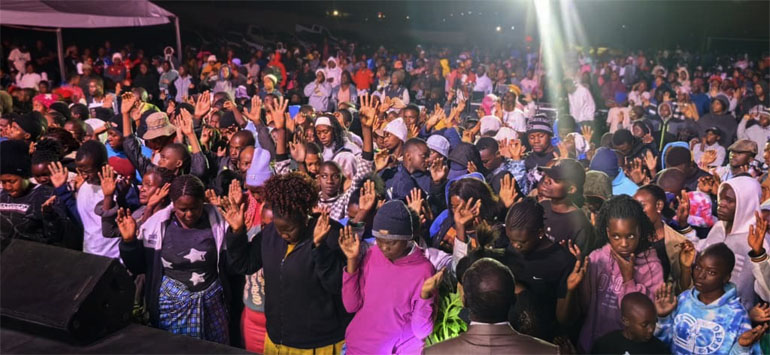
The installation ceremony was a vibrant display of cultural pride, with traditional music, dance, and feasting. Community’s enthusiasm was evident as they welcomed Samanga into his new role, eager to see the positive impact he will bring to the area.
His inauguration was attended by the local community, learners from St David’s Girls’ High, business partners, the clergy, and local Government officials, including village heads, Chief Mutasa, and Minister of State for Manicaland Provincial Affairs and Devolution, Advocate Misheck Mugadza.
Advocate Mugadza said he was proud to be installing a man of astute leadership.
“Let us work well with our traditional leadership and Government. I am thankful to President Mnangagwa, and the New Dispensation for joining hands with the chiefs in order to usher in rural transformation and development while looking forward to Vision 2030,” he said.
He reminded the new headman of his new duties, saying: “Your duty will be to assist the chief in the performance of his duties. Report to the police any crime in the area as soon as possible. Keep the chief and rural development council updated on any changes to village heads, registrar, and people under you. It is important that you mediate in local disputes, changes to customary law, forbid incest, and handle cases of stray livestock. I urge you to enforce environmental preservation on behalf of the chief, the rural district council, and the chief. I urge you to keep the peace in your area and preserve the President’s Vision 2030. I congratulate you on the big day you have set up today,” he said.
As per traditional custom, the new spiritual leader of the area will be looked up to by the community to preserve the African Traditional religion rites, which include, but are not limited to, the brewing of maganzvo annually.
Chief James Mutasa congratulated the Shumba Gwara Clan on coming up with a leader amicably.
“Now that you have been appointed a headman, you have been upgraded to a higher office working for the betterment of the chief and the President. This will be a new challenge, different from taking care of learners at St David’s Bonda Girls’ High School, as you will be serving people from different backgrounds and lifestyles. It will be up to you to preserve the traditional customs of the Samanga people as written in Chapter 15, sections 283 and 282, as per the Constitution. The traditional boundaries, uniqueness of identity, and customs of being a Samanga Clan member thus rest in your hands. As you take up your tasks, remember to ensure that marriage happens in the proper channels, while you yourself abstain from taking a second wife. I hope you stick to your purity and are never tempted onto the dark side so as to gain more power. As you join the Mutasa leadership, I hope you will read the Leadership Act so as to aid development in the area and the less fortunate,” he said.
Village head and cousin, Mr Christopher Manzero, said: “I am happy with the inauguration of Headman Samanga today. We grew up together here in Honde Valley and even worked together in Rusape around 1986. I am happy that he has taken the role, and optimistic that he will lead us all transparently.”
His son and namesake, Mr Chitsidzo Samanga, said: “I have never been more proud of my father as I am today. Though I am now based in Harare, it gives me a great sense of pride that he has been selected to lead the clan. What he has done is so inspiring, not only to me, but also to the next generation. I hope in the future I can emulate his compassion and servant leadership.”
Headman Samanga’s elder brother, Mr Washington Samanga, said: “As a family, we are grateful to the President, the Minister of State for Manicaland Provincial Affairs and Devolution, our Chief, ZANU PF Central Committee member, and Member of Parliament for coming to support us. We are grateful to the community and workers who made today a reality. We also thank the Chipapata family for singing and dancing with us to celebrate the ascension of Caston through the night.”