admin
admin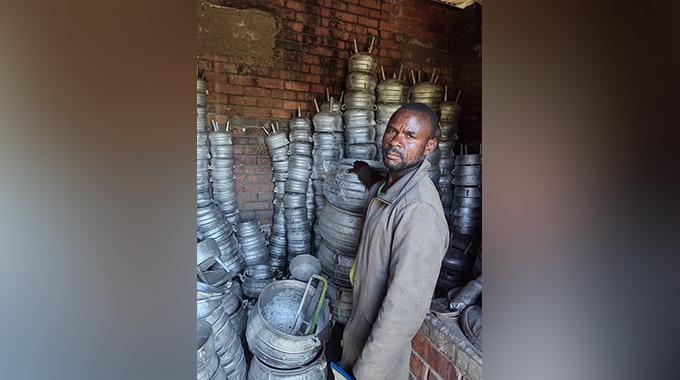
Blessing Khanye
WHILE most people consider empty soft or beer cans to be trash, however, Edmore Mhandu (40), a former pushcart operator has defied expectations. He now makes a living by crafting unique three-legged pots from these very same discarded cans.
Mhandu’s journey began in 2008 as a pushcart operator in Gokwe. He later relocated to Bulawayo and continued working at the long-distance bus terminus,eRenkini. However, his path took an unexpected turn when he decided to transform discarded empty aluminum cans – once considered mere waste – into valuable raw materials. With these, he crafts unique three-legged pots and other utensils, generating a sustainable income.
“The pushcart business used to be good,” Mhandu reminisced.
“Back in 2008, I could pull in US$30 to US$40 a day. But times changed. The competition got stiff with more and more vendors hitting the streets. My profits started to dwindle. That’s when I decided to take a leap,” he continued. “I’d saved some money from my pushcart days, and I saw an opportunity. Everyone throws away empty soft or beer cans, but I saw potential. I used those savings to invest in some tools and get started on this project of making three-legged pots. It’s a chance to not only be my own boss but also make a good living.”
He added: “In 2012, I embarked on this project – giving new life to discarded beverage cans. People toss them away as garbage, but I saw potential. I use specifically aluminum cans from those empty soft or beer cans because they melt well. I use a coal furnace to melt them down, and then I pour the molten aluminum into moulds to create these unique three-legged pots.”
While the profit per pot might not be massive, Mhandu admits that making more pots allows him to generate a good income.
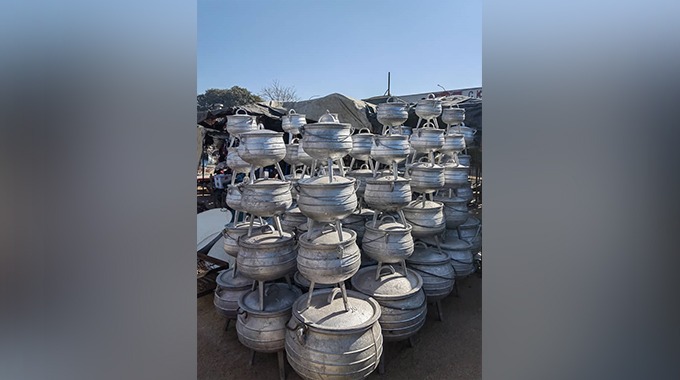
“I can make at least 15 pots a day, which translates to a good profit. On a busy day, I can bring in as much as US$300, even on a slow day I make US$70. That’s a significant improvement from my pushcart days. In fact, my business has thrived so much that I now have three stalls at Renkini where I sell my pots.”
However, running a successful business isn’t without its hurdles.
“The biggest hurdle, however, is the lack of a permanent workshop. Currently, I operate out of makeshift spaces, juggling production between the three stalls. This makes it difficult to streamline the process, manage inventory efficiently, and even expand my product line. Ideally, I’d have a dedicated workspace that would allow me to centralize production and potentially hire additional staff.
“Sourcing enough aluminum cans to meet demand is also difficult, especially with the rising price of scrap metal. Additionally, managing the production process across three stalls while maintaining quality control requires constant attention,” said Mhandu.
He said even with the challenges, he was optimistic about the future.
“With a proper workshop, I can streamline production, expand my product range, and potentially create even more jobs,” he said.
Mhandu’s dedication is inspiring. He has managed to create a livelihood not just for himself, but for seven employees as well. Three of these are saleswomen running his stalls, while the remaining four work at his workshop.
One of Mhandu’s employees Gracious Moyo said: “My boss is an incredibly kind and generous man. He took a chance on me when I was struggling to raise my three children on my own. I didn’t have a job, and things were very difficult. But thanks to him, I’m now a salesperson and I’m finally able to provide for my kids and make sure their school fees are paid on time. I’m eternally grateful for this opportunity”.
Moyo’s experience working for Mhandu has even inspired her to pursue her own entrepreneurial dreams.
“I’m looking forward to starting my own small business in the coming years. His (Mandu) work ethic and dedication have been a true inspiration,” she said.
Meanwhile, Mhandu’s creative approach exemplifies the power of waste management and its role in environmental preservation. His success story inspires others to see the value in waste and the possibilities of recycling. This can lead to increased recycling efforts and a reduction in overall waste.
In essence, Mhandu’s resourceful upcycling not only provides him with a livelihood but also contributes to a cleaner and more sustainable environment.



 Online Reporter