
Gibson Mhaka-Zimpapers Politics Hub
THE dusty horizons of Maphisa Growth Point in Matobo district — traditionally a quiet administrative hub in Matabeleland South province — are currently obscured by a different kind of haze: the productive dust of heavy machinery and the feverish activity of construction crews.
As Zimbabwe prepares to mark its 46th Independence Day anniversary, the town has become the living embodiment of President Mnangagwa’s mantra of “leaving no one and no place behind”.
The decision to host the main national celebrations in this rural heartland is not merely a symbolic gesture of rotating festivities; it is a calculated developmental masterstroke.
This year, it has turned Maphisa into a blueprint for how the attainment of Vision 2030 can be accelerated through targeted, event-led infrastructure development.
When the Zimpapers news crew visited Maphisa recently, the air was thick with an unmistakable sense of euphoria.
The usual rhythmic pace of rural life had been replaced by a high-octane “hive of activity”.
From the local business centre to the peripheral villages of Mahetshe, the community is united by a singular, electric anticipation. For the first time since 1980, the “whole of Government” is descending upon Matabeleland South.
This shift has ignited a sense of pride among locals, who previously only viewed such grand national events through the flickering screens of television sets or heard them over the airwaves of the national broadcaster.
“I have only watched these celebrations on television since 1980. This will be my first time attending in person,” remarked Mr Jameson Masuku (84), his eyes bright with the reflection of the ongoing works.
“These stadiums and laboratories being constructed will remain long after the celebrations are over.”
Infrastructure: The lasting legacy
The most visible indicator of this independence windfall is the rapid rise of modern infrastructure.
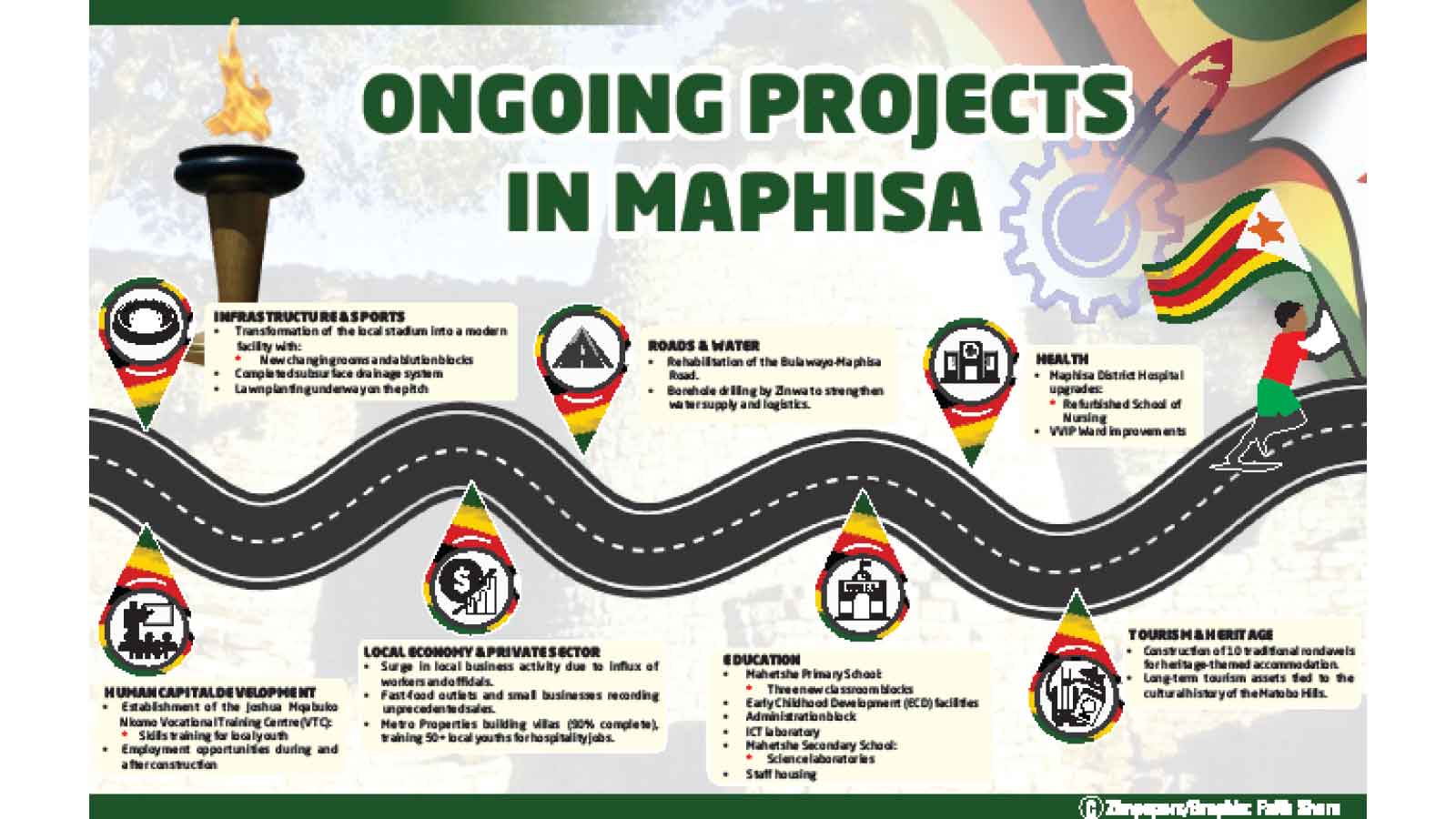
The local stadium, once a modest ground, is being transformed into a modern facility that will anchor sporting development in the district for decades.
Site engineer Sean Mukwamba confirmed the systematic progress.
“The changing rooms and ablution blocks have reached ring-beam level,” he said.
“We have completed 100 percent of the subsurface drainage system, and lawn planting on the pitch is halfway done. Our team is working systematically across all fronts to meet deadlines.”
Beyond the stadium, the educational landscape of Matobo is being rewritten.
At Mahetshe Primary School, the venue for the Children’s Party, construction of three classroom blocks, early childhood development (ECD) facilities, an administration block and a state-of-the-art information and communication technology (ICT) laboratory is nearing completion.
Nearby, Mahetshe Secondary School is having science laboratories and staff housing — facilities that will bridge the digital and academic divide between rural and urban learners.
Health and heritage
The decentralisation model extends its reach into the social fabric of the district.
Maphisa District Hospital is undergoing a significant facelift, including upgrades to the School of Nursing and the VVIP Ward.
These are not temporary fixes for a one-day event; they are permanent enhancements to the provincial healthcare delivery system.
Furthermore, the Ministry of Tourism and Hospitality Industry is constructing 10 traditional rondavels.
These will provide heritage-themed accommodation for delegates, but more importantly, they will remain as permanent tourism assets, tapping into the rich cultural history of the Matobo hills.
Perhaps the most significant pillar of this transformative drive is the focus on human capital.
In honour of the late Father Zimbabwe, the Government is establishing the Joshua Mqabuko Nkomo Vocational Training Centre (VTC). This institution is designed to be a factory of skills, ensuring that the youth of Matobo are not just spectators of development but active participants in the economy.
Ms Nolwazi Sibanda (26) said the VTC would equip the local youth with “life-saving skills”, providing an alternative to the traditional migration to neighbouring countries in search of work. The project has already begun creating employment long before the first certificate is issued.
Local bricklayer Mthokozisi Moyo (25) is one of many artisans currently employed on site.
“This has opened many doors for us. Even after the celebrations, the skills we have gained will lead to more opportunities,” he said.
The theme for this year’s celebrations “Zim@46: Unity and Development Towards Vision 2030”, is being felt in the pockets of local entrepreneurs.
The influx of engineers, Government officials and construction workers has created a localised economic boom.
Mrs Ellen Moyo, a local fast-food outlet owner, shared her excitement.
“We are recording brisk business like never before. The preparations have breathed life into our local economy even before the celebrations begin.”
The private sector is also following the Government’s lead.
Expanding its footprint into the hospitality sector, Metro Properties is currently finalising the construction of villas, which are now 90 percent complete.
They are designed to provide both premium housing and professional hospitality services.
Operations manager Mr Andy Gandidze highlighted the social impact.
“We are training more than 50 local youths who will be deployed at our villas . . . This is a development we are very proud of.”
As the countdown to April 18 continues, rehabilitation of the Bulawayo-Maphisa road and drilling of boreholes by the Zimbabwe National Water Authority (Zinwa) ensure that logistics of the event are as robust as the infrastructure it leaves behind.
Matabeleland South Permanent Secretary for Provincial Affairs and Devolution Mrs Latiso Dlamini-Maseko summed up the provincial sentiment during a recent inspection.
“Maphisa is rising, and we invite everyone to come on April 18 to witness a transformed Matabeleland South,” she said.
“We have seen structures rise to window level within a single month . . . the momentum is now undeniable.”
The decentralisation of Independence Day to Maphisa has proven to be more than just a party; it is a profound developmental intervention.
When the national anthem plays and the flame is lit, it will not just signal a day of memory, but a future of opportunity.
The rural heartland is indeed being transformed into a sea of celebration, honouring the sacrifices of the past by building the schools, hospitals and stadiums of the future.