Online Reporter
Theseus Mauruki Shambare
Features Writer
EVERY morning, before the sun breaks through the horizon over Chivi’s dry landscape, 18-year-old Nothando Zulu used to begin her day with a journey.
It was not a journey of opportunity and necessity.
Living with her aunt in Ward 3, Chivi District, Masvingo Province, Nothando’s routine involved walking about three kilometres to the nearest borehole to fetch water for household use.
The distance was only one part of the challenge. The water itself was another burden.
“The water from the old borehole was not easy to use because it was hard and salty. Even the wells around us had the same problem,” she said.
“Sometimes you would walk a long distance only to bring home water that was not really of good quality. It affected everything because water is needed for cooking, washing and daily life.”
Today, the distance between Nothando and water has been shortened.
A Village Business Unit (VBU) established near her homestead has brought a solar-powered borehole closer to the community, reducing the burden of water collection while creating a new source of livelihood.
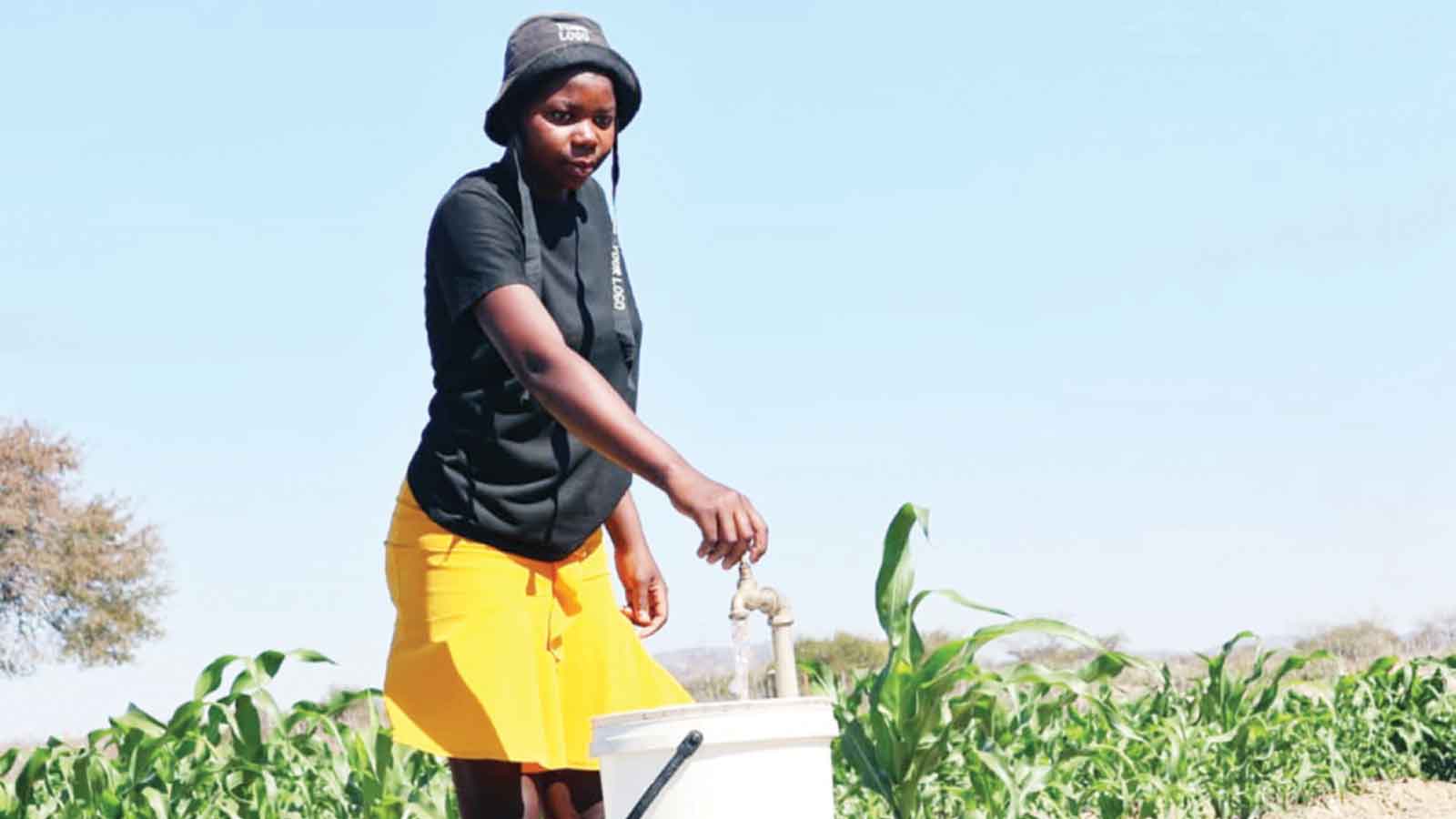
For Nothando, the borehole represents more than convenience. It represents a different future.
“We are now closer to water, and that gives us more time. Instead of spending many hours looking for water, people can focus on other things, including farming and improving their lives,” she said.
Across Chivi District, where communities have long battled the effects of erratic rainfall and recurring droughts, women like Nothando are experiencing a transformation that goes beyond agriculture.
They are moving from being carriers of water to managers of production; from spending hours searching for basic resources to using those resources to create income; and from surviving seasons to building businesses.
Chivi largely falls under agro-ecological Regions IV and V, areas characterised by low and unreliable rainfall, prolonged dry spells and frequent droughts.
The experiences of Chivi’s women reflect a wider national reality.
Data from the Zimbabwe National Statistics Agency (ZimStat) shows that rural women remain the backbone of agricultural production and household food security, accounting for more than 60 percent of agricultural labour in many communal areas.
Yet, despite their central role in feeding communities, many continue to face economic disadvantages, limited access to productive resources and a heavy burden of unpaid care work.
In rural Zimbabwe, women often spend between 16 and 18 hours a day balancing farming activities, household responsibilities and care-giving, while female-headed households remain particularly vulnerable to poverty.
Climate shocks such as droughts have deepened these pressures, forcing women to travel longer distances in search of water and other basic necessities while still maintaining struggling family farms.
Therefore, the Village Business Unit model is addressing not only agricultural challenges, but also some of the structural barriers that have historically limited rural women’s economic participation by placing water, production and income-generating opportunities closer to them.
For generations, households in these areas have relied heavily on rain-fed agriculture, leaving farmers vulnerable whenever rainfall patterns failed.
Research by the Food and Agriculture Organisation (FAO) and other agricultural assessments has highlighted how climate variability has increased pressure on rural households, particularly women, who often carry the responsibility of securing food, water and household welfare.
The Village Business Unit model is changing that reality by combining irrigation, collective production and community ownership.
At Chigume Village Business Unit, 50 members — 48 of them women — are producing crops such as sugar beans and green mealies.
At the nearby Virira Village Business Unit, women are also dominating the production of cabbages, tomatoes and green mealies, with 30 women among the 37 members.
For these women, farming is no longer just a response to hunger. It is becoming a pathway to independence.
For 36-year-old Tendai Mativenga, the greatest harvest from the project will not only be measured in tonnes of crops. It will be measured in confidence.
“As a young married woman, there are many things I want to buy for myself without always asking my husband. A woman also wants to feel that she is contributing something to her family,” she said.
“When you have your own income, it reduces pressure in the home because you are also able to support your family. You can buy household items, help with children’s needs and contribute when there are challenges.”
Tendai believes the VBU has changed how women view themselves.
“We are no longer only depending on others. We are working together, producing and making decisions. This has given women confidence because we can see what we are capable of doing.”
For 48-year-old Laiza Marava, the project represents the recognition of work women have always done, but which was often invisible.
“Women have always worked in the fields and taken care of families, but many times our efforts were not seen as a business,” she said.
“This project has changed that thinking. We are now producing, knowing that what we are doing has value. We are not just growing crops for consumption; we are creating something that can bring income.”
For elderly women in the community, the change represents a major shift from the struggles they experienced.
Chiedza Chigume, born in 1960 and married to the village head, has witnessed decades of changing seasons and farming challenges.
“I have seen many years where people planted crops, but the rains disappointed them. Women suffered the most because they were responsible for making sure there was food and water at home,” she said.
“Today, what gives me hope is that women are coming together and taking ownership of projects like this. We are no longer just waiting for someone to assist us. We are part of creating solutions.”
At 62, Sekai Tawanda represents another generation of women who have spent their lives working the land.
She believes the biggest change is not only the availability of water, but the change in attitude.
“For many years, farming was something people did because they had no other choice. But now we are seeing farming becoming a business,” she said.
“When women have access to resources, they can do great things. Water has given us confidence because we know our work can produce results.”
At Virira Village Business Unit, 49-year-old widow Rosewitta Mateveke carries a story of resilience.
She lost her husband in 2006 and had to raise four children alone.
Through difficult seasons and unreliable rainfall, she continued farming and managed to educate her children, some of whom are now truck drivers and professionals.
“I know what it means to struggle because after losing my husband, I had to take care of my children on my own,” she said. “Farming helped me survive, but it was never easy because everything depended on the rains.”
Today, with access to irrigation water, she sees a different future.
“The biggest change is that we can now plan. Before, you planted and waited for the rains. Sometimes you lost everything. Now we have water, and we know that if we work hard, we can produce.”
Yeukai Johane (43), believes the VBU has also strengthened relationships among women.
“Before this project, everyone was trying to survive individually. Now we work together and support each other,” she said.
“When one woman succeeds, the whole community benefits because we are sharing knowledge and working towards the same goal.”
Agricultural Planning and Development director Mr Leonard Munamati said the empowerment of women was one of the key objectives of the Village Business Unit programme.
He said women’s economic participation was critical because they constituted the majority of Zimbabwe’s population.
“Village Business Units also empower women. Already, we know that in this country, women are the majority of the population. So, when we empower women, we have actually empowered the whole community, be it at village level, at ward level, or as a country,” he said.
“If we empower women, we have empowered the whole nation.”
Mr Munamati said women participating in VBUs were becoming financially independent through agricultural production.
“In this Village Business Unit, we have seen that almost the whole committee is made up of women.
“These women can now get their own cash without waiting for money coming from the father or their husbands. They can also get their money and be able to support their own families,” he said.
Beyond income, he said the programme was improving household nutrition by promoting production of nutritious crops while also improving access to water through solar-powered boreholes.
“So, Village Business Units have empowered women in rural communities,” he said.
Across Chivi, the transformation is quietly unfolding. The women who once walked kilometres carrying buckets are now using water to grow crops, generate income and strengthen their families.
For Nothando, the change is simple.
“The water is now closer, and the opportunities are also closer,” she said.
And in the fields of Chivi, women are proving that when communities invest in water, they are not only growing crops. They are growing confidence, independence and a new generation of rural entrepreneurs.