admin
admin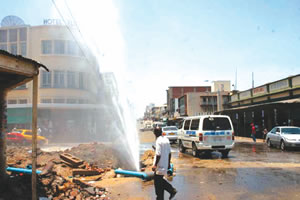
support the capital’s water and sewer upgrading and rehabilitation.
Questions abound why with all the funding, loans, humanitarian grants and internal resources, does Harare still experience water challenges.
Management is well aware that some of the city’s water pipes were laid as far back as 1972 and have not been replaced.
Some effort was made a few months ago but the bulk of the work still needs to be done.
So why are all the pipes not being replaced to avoid frequent and temporary shutdowns?
With funding for water and sewer now flowing, would it not be prudent for the city fathers to address the piping system with vigour especially after acknowledging that millions of litres in treated water are lost on a daily basis?
For example, the eight major leaks that were on the city’s two pipelines from Morton Jaffray to Warren Control were losing 30 megalitres daily for up to two weeks.
Mabvuku and Tafara combined consume 13 megalitres a day, implying that the daily losses could supply the suburb for two and a half days.
To be specific on the available funding so far, the Chinese Export and Import Bank gave a US$144 million loan at very concessionary rates in a move that helps cement Zimbabwe’s Look East Policy.
Government chipped in with US$17,1 million that was used to lay new water and sewer pipes in the Central Business District, Mabvuku, Tafara, Budiriro, Glen View and Highfield among some of the hardest hit areas.
The city has used US$7 million towards water and sewer from its own resources. This is the reason why council management has encouraged ratepayers to pay their water bills to help build internal funding.
However, a visit to the municipal offices at Rowan Martin outside the city centre, reveals that there is always a long queue of residents querying the amounts on the bills sent to them by the authority.
Many feel that they are being clandestinely charged for the lost water gushing out through the ancient and broken down pipe system.
The biggest and most meaningful funding has come from China albeit as a loan.
Harare took a cue to implement Government Look East policy at a micro level and the results are there for all to see. The funds have come at a time Bretton Woods institutions – the World Bank and
International Monetary Fund – are either reluctant to fully support Zimbabwe and in this case Harare.
For some time, the gap has been very difficult to fill but because of a mutual foreign policy born out of a “commonality of interests” between China and Zimbabwe, the dragging of feet by the West over capital projects funding is fast losing “appeal”.
The latest funding of US$9,5 million has come from an African Institution, the African Development Bank. The funds initially earmarked for cholera intervention in 2008 will now be used on water and sewer capital projects.
Other interventions by funding partners – mostly NGOs centred on non-capital projects such as the provision of soap, buckets and toiletries during the cholera era.
Harare Water director Eng Christopher Zvobgo reckons the funding has improved the city’s water and sewer delivery.
In February 2009, the city averaged only 320 megalitres of treated water against a huge demand of 1 200 megalitres.
And if one factors in the amounts lost through burst pipes then that means only a fraction of the output reaches the residents.
“We have increased our daily output to an average 620 megalitres a day. The money has come in handy.
“Once we utilise the US$144 from China we will increase output to 720 megalitres a day,” he said. But if most of it is spilled needlessly along the delivery routes then what good will the improvement do?
Eng Zvobgo said using internal and external resources, Harare now manages to treat 54 megalitres of sewage at Firle Sewer Treatment Plant. The plant has capacity to treat 144 megalitres. An additional 72 megalitres would be added by end of this month.
The AfDB funds are meant for the upgrading of the Firle and Crowborough Sewage Treatment Plants.
The grant would be used to rehabilitate chemical dosing equipment, revamp the water distribution network and to install new flow meters. Part of the grant would go towards the purchase of vehicles and upgrading of sewer equipment at Firle.
All having been said consumers look forward to a flawless water supply given the huge funding that has come Harare’s way and that which has been promised to the city.
After all they are paying through the nose for what is a basic human right which the council should be providing at cost price with no profit built into the pricing equation.


 Online Reporter