admin
admin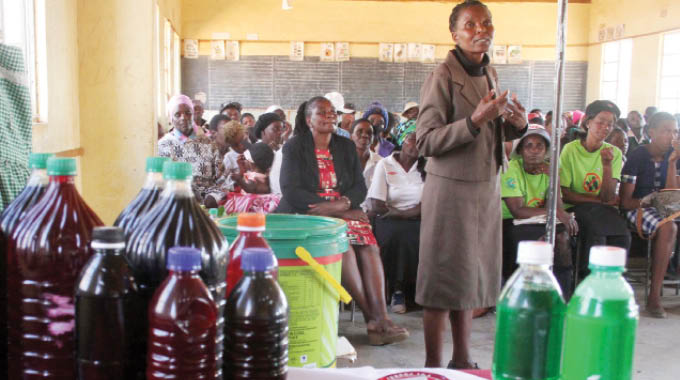
Kudzai Chikiwa, Features Reporter
There is dead silence at a school garden at Nhlambabaloyi Primary School in Ntabazinduna as Mrs Nomalanga Moyo gives an account of how she abandoned her family to become an illegal gold panner for six years after failing to bear fists and blows from her husband on a daily basis.
Mrs Moyo (58) struggles to hold her tears back as she shows a scar from a wound she sustained when she was beaten by her husband of many years.
“It’s a miracle that I’m still alive. I could’ve died long back because my husband was more of a monster than a man. He would beat me ruthlessly,” she said as she lifted her left hand showing her scar.
With her grandchild strapped on her back, her voice still cracked and caught in her throat, she recalls when she packed her bags and left her matrimonial home to be an illegal gold panner.
“Have you ever been tortured and harassed by someone just for asking for some money to look after the family up to a point of choosing to live in the bush than endure the suffering?” she said with a trembling voice. I became an illegal gold panner for six good years. There is nothing you can tell me about omakorokoza (illegal gold panners) because I have been there. I would lift 20kg of sand to search for a small amount of gold,” she said.
The mother of nine almost burst into tears as she recalled how she once suffered a stroke as a result of stress. “I was not slim like this but stress almost killed me. I suffered a stroke and couldn’t even remember my name. My last child didn’t breast feed well because I was not healthy,” she said sobbingly.
Mrs Moyo said her husband would beat her up whenever she asked about money for the upkeep of the family.
“It’s not easy being a housewife. Gender-based violence has been rife in our society for the longest time. I experienced this torture since 1998. Asking for a coin would almost cost you your life,” she said.
Mrs Moyo mirrors many women especially in rural areas who experience gender-based violence (GBV).
Although GBV comes in many forms, experts say many unemployed women are abused on economic grounds especially when they ask for money for the upkeep of the family.
Mrs Moyo and other 12 GBV survivors in Ntabazinduna have changed their stories. Instead of remaining victims, they have started their own income generating projects.
They formed a support group after realising the intensity of abuse of women largely because of economic challenges.
This is the first project in Zimbabwe of that nature and it is assisting the survivors to raise their own money.
Start Awareness Support Action (SASA) in Ward 6, Umguza was established to support survivors of GBV and those experiencing abuse.
The support group meets once a week as a way of sharing experiences and to inspire and empower each other through GBV messages.
Through collaborations, the group managed to get skills training which was initiated by the Ministry of Women Affairs, Community, Small and Medium Enterprises and also supported by Gender Links, Umguza Rural District Council (URDC), Zimbabwe Association of Church related Hospitals (ZACH) and Swedish Diakonia.
The GBV survivors are trained to make floor polish, dish washing soap and washing powder among other products.
The group of survivors also managed to secure a nutrition garden at Nhlambabaloyi Primary School. They sell the produce to buy books and pay school fees for their children.
Mrs Siphiwe Ncube, a Ward 1 Village Health Worker and part of the GBV survivors’ projects said women are grateful for the projects which have since reduced cases of economic induced GBV.
“We realised that many women are not free to report GBV cases and we decided to do door to door counseling of women who we knew were victims (before they became survivors).It was not easy for them to come out clear but today we are proud that we’ve started something tangible,” she said showcasing some dish washing liquid and floor polish to delegates who were touring their projects.
Mrs Ncube said the group started off by selling herbs to get capital and later, with support from the Ministry of Women Affairs and other stakeholders, started their project.
“We didn’t have money so we had to start from scratch. We sold herbs and mats until we got ZWL$498 capital. Now we can pay our children’s school fees, buy books and food. Indeed, we’re empowered,” she said.
The Umguza RDC through Gender Links is also supporting the group by chemicals for soap making.
Mrs Lynder Maphosa, Umguza RDC Gender Focal Person commended such programmes saying the local authority is committed to empowering GBV survivors.
“We are 100 percent behind this initiative as it is one of our core mandates as council. Together with non-governmental organisations and Government departments, the council works hard to enhance the provision of sexual reproductive health rights, empower women, improve provision of social services and eradicate GBV,” she said.
Mrs Maphosa said the rural council has been working with Gender Links since 2015 to ensure there is gender equality and equity in their programmes and activities. “To achieve this, the council has signed MoU’s and developed partnerships with various NGOs and government departments. As a council, we have a stand-alone gender committee that includes heads of all departments and their representatives. The main responsibility of the committee is to facilitate the mainstreaming of gender into our programmes,” she said.
Through funding from the Swedish Government, Gender Links has managed to capacitate councilors and officials leading to the development of a gender action plan.
Gender Links has now partnered with Diakonia to strengthen programmes and activities with Umguza RDC being one of the hub centres. One of the men who were touring the GBV survivors’ projects said it was a good initiative which would ‘lessen the burden on men’.
“Women cry for 50/50 and for me, a sign that we are equal is when you also bring food on the table. Lazy women or let me say those who don’t want to use their own hands are a burden to men. You can’t be interviewing me about the money I worked on my own,” said Mr Fanyane Ganyani.
Quizzed on why men are not among the GBV survivors given that issues of abuse apply to both genders, he said “only cowards admit that they are abused by women”.
“It takes a coward to report that your wife is abusing you. It appears as if you have been bewitched. After all, the majority of us know how to hustle so it’s rare to suffer economic abuse. I can’t be bowing down, begging for money from a woman,” he said.
Mr Ganyani said it is common in urban areas where a man of a lower office can marry a wife who is a top official. “This is rare in our rural set up but in towns we have cases of men who are beaten or abused by women who find themselves climbing the success ladder. Many women fail to humble themselves and end up taking the position of men,” he said.
Speaking at a media and advocacy meeting in Bulawayo recently, a counselor from Msasa Project said it was frightening that cases of GBV were increasing despite awareness campaigns conducted by stakeholders.
“Last year to date we have dealt with 2 817 cases of women who were abused, of which 2 272 were new cases. Of that number, 369 needed shelter support,” said the official.
Msasa Project said the majority of women who reported physical assault were seeking protection orders against their husbands.
“Our statistics show that 426 women reported physical assault where women would have been battered using various objects and 165 managed to get protection orders against the perpetrators,” said the official.
The counselor said women in rural areas rarely report cases of GBV.
“This may be because they are not empowered enough or they are just afraid. More needs to be done to empower them. Sometimes we just hear cases from hospitals and wonder why someone had been quiet,” she said.
Most survivors, she said, face challenges at some police stations where they are made to report cases at the front desk instead of the victim friendly unit.
“Survivors are not comfortable describing their experience at a public place and they need privacy. Most women allege that the police do not treat them in a victim friendly manner,” said the official.
Msasa project, as a way to conscientise people on GBV, has engaged stakeholders including the police, courts and traditional leaders in making them aware of how to treat GBV survivors. — @tamary98


 Online Reporter