Chronicle Editor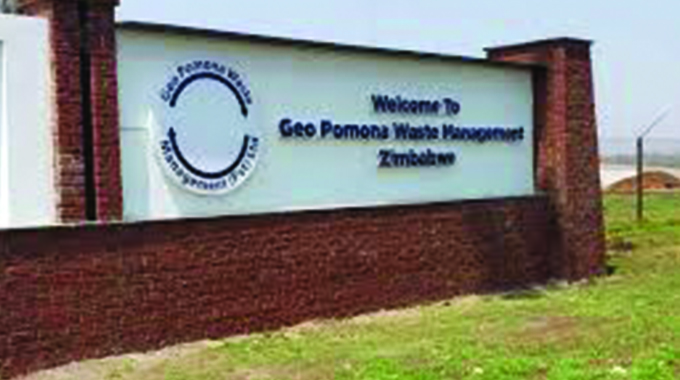
Richard Muponde, Zimpapers Politics Hub
GEO Pomona Waste Management represents a state-of-the-art approach to waste management, incorporating crucial elements such as proper waste sorting, leachate treatment, and the establishment of waste-to-energy facilities in fighting the effects of climate change and ensuring good public health.
This innovative project has significant importance to the region, addressing critical environmental and public health challenges in Africa as a result of pollution of the environment with solid waste and contamination of water bodies with leachate.
Leachate is defined as any contaminated liquid that is generated from water percolating through a solid waste disposal site, accumulating contaminants, and moving into subsurface areas. The implementation of the advanced waste management techniques by Geo Pomona Waste Management has set a high standard for sustainable and environmentally conscious waste disposal practices in the SADC region.
The project’s emphasis on proper waste sorting ensures that recyclable materials are separated from non-recyclable waste, leading to reduced environmental impact and increased resource efficiency. The implementation of leachate treatment facilities mitigates the harmful effects of leachate, a by-product of waste decomposition that can contaminate soil and water sources.
In that vein, the establishment of waste-to-energy facilities demonstrates a commitment to harnessing renewable energy sources and reducing reliance on traditional fossil fuels. A tour of the facility by Zimpapers Politics Hub, last Tuesday revealed a top-notch innovation which has the potential to solve the problems of waste management in the SADC region.
Geo Pomona is part of the line-up of massive innovative infrastructure development facilities to be toured by SADC Heads of State and Government during the 44th SADC Summit to be held later this month.

A new weigh bridge is under construction to properly record and charge waste being brought by waste collectors with two dump pits to collect hazardous substances having been completed and licensed by the Environmental Management Agency (EMA).
The dump pits will work connected to two ponds which collect leachate from the hazardous dump pits where the water is purified to 99,9 percent purity. A purification plant is already on the site and Italian engineers are on the site training Geo Pomona engineers on how to operate and maintain it. It uses reverse osmosis to purify the water.
The water will then be used to irrigated vegetation that will be planted on top of the sealed landfills to create a green scenery. The other water will be used to irrigate turf at the Fifa satisfied sporting facilities on site. The purification plant is set to be commissioned next week.
A power generating plant is also being established to provide electricity to the national grid. Responding to questions from Zimpapers Politics Hub, Geo Pomona chairman and chief executive officer, Dr Delish Nguwaya said the multi-million-dollar Geo Pomona Waste Management project stands to benefit other countries by serving as a model for transformative waste management practices.
“By showcasing effective waste management strategies and technologies during the Geo Pomona tour, the project aims to inspire SADC member states to implement similar systems, thereby improving waste management across the region,” Dr Nguwaya said.
“With the support of the SADC Chairperson and the visionary leadership of President Emmerson Mnangagwa, Geo Pomona Waste Management is committed to collaborating with other Southern African nations. The goal is to replicate the successful aspects of the project, such as proper waste sorting, leachate treatment, and the establishment of waste-to-energy facilities. This collaboration can help convert dumpsites into properly managed waste management facilities, addressing significant environmental and public health challenges in Africa.”
He said Geo Pomona Waste Management aims to attract investments from the visiting SADC Heads of State in areas closely linked to the project, an effort which is part of a broader initiative to benefit both Zimbabwe and the African continent. “The company is particularly interested in collaborating with countries facing significant waste management challenges, as these partnerships could lead to mutual benefits and improved environmental practices across the region.
Investments are welcome in the waste management sector, and Geo Pomona Waste Management sees this as an opportunity to showcase the potential for impactful projects. Aligning with President Emmerson Mnangagwa’s message that ‘Zimbabwe is open for business,’ the company is eager to engage with potential investors from all SADC Member States,” he said.
He said during the visit of the SADC Heads of State, Geo Pomona Waste Management aims to share its transformative journey from a dumpsite to a properly managed waste management facility. The presentation, he said, will highlight several key facilities and features. Two weighbridges are connected to traffic lanes for accurate waste measurement, supported by a data capturing system that records various details such as customer information, waste type, and weight.
Encapsulation A process called encapsulation that involves the covering existing waste with geomembrane, geotextile, and soil to restrict greenhouse gases is meant to contribute to the reduction of global warming effects.
Another innovation being implemented involves the concrete batch plant, which is a 60 cubic meter per hour batch plant constructed to support the concrete needs of the Waste-to-Energy plant.
New Landfills: Engineered landfills for hazardous waste, with the first cell complete and equipped with environmental monitoring systems.
Other plans include landfills for municipal solid waste and ashes from the Waste-to-Energy Plant and the wastewater treatment system designed to treat leachate from the new landfills, ensuring environmentally safe disposal. Finally, there is the sorting plant- facility for separating waste, which is crucial for efficient recycling and waste management. The waste to energy plant is capable of incinerating 1 000 tonnes of waste per day and will generate 16-22 MW of electricity, contributing to the national grid.
Dr Nguwaya said Geo Pomona Waste Management has made significant progress in preparing to host the SADC Heads of State and Government as most of the facilities they plan to showcase are now at advanced stages of development. “Currently, we are in the process of constructing roads within the site to connect the various facilities, ensuring smooth and convenient access for the visiting delegates,” Dr Nguwaya said.
As the SADC Heads of State converge on Zimbabwe with business executives in tow, collaboration with other Southern African states presents a valuable opportunity to replicate the successful aspects of the Geo Pomona Waste Management project.
Sharing knowledge, expertise, and best practices, SADC states can work together to transform dumpsites into properly managed waste management facilities creating “Disney lands”. Such collaborative efforts hold the potential to significantly improve waste management practices across the region, leading to a cleaner environment and enhanced public health.
The exchange of knowledge and technology related to waste sorting, leachate treatment, and waste-to-energy facilities can empower other Southern African states to adopt similar sustainable waste management practices.
These initiatives when collaborated SADC can collectively address the challenges associated with improper waste disposal and contribute to the overall environmental sustainability of the region. If the Geo Pomona Waste Management project’s successful aspects are replicated in other SADC countries, it can yield numerous benefits.
Proper waste sorting, when implemented on a broader scale, can significantly reduce the volume of waste destined for landfills, leading to decreased environmental pollution and improved resource utilisation. Leachate treatment facilities can help prevent soil and water contamination, safeguarding vital natural resources and ecosystems.
On top of the establishment of waste-to-energy facilities, other SADC countries can contribute to the diversification of energy sources and reduce reliance on non-renewable resources. This does not only address environmental concerns but also promotes energy independence and resilience.
Above all collaboration and adoption of successful waste management practices from the Geo Pomona Waste Management project can play a pivotal role in addressing environmental and public health challenges across the SADC region.


 Online Reporter